

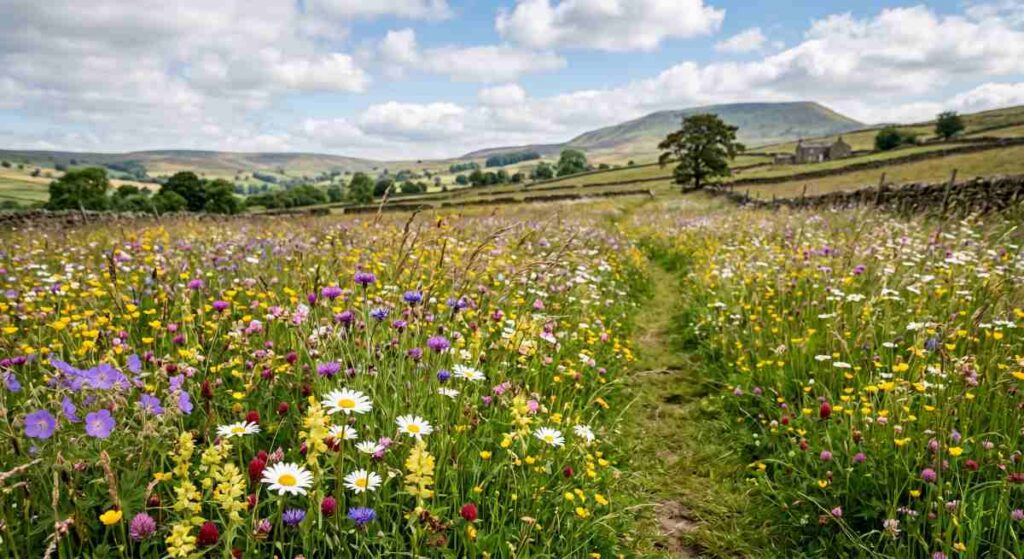
Wildflower Seeds for Lancashire: Native Mixes for a County of Contrasts
Wildflower Seeds for Lancashire: Native Mixes for a County of Contrasts
Lancashire spans a dramatic range of landscapes for a county of its size. The Forest of Bowland — one of England’s most overlooked upland landscapes — carries extensive moorland, acidic grassland, and the nationally rare Hen Harrier on its heathery plateau. The Ribble Valley is some of the finest enclosed farmland in the north of England, with surviving hay meadows and hedgerow networks. The Fylde coastal plain to the west is low-lying, reclaimed mosses and improved grassland. The West Pennine Moors above Bolton and Blackburn carry the same acidic gritstone moorland as the South Pennines. And the Lune Valley in the north-east is sheltered river valley country with a traditional pastoral character.
Lancashire’s climate is wet, particularly in the west and uplands — Bowland and the West Pennine Moors receive significant rainfall. High rainfall supports fast germination but also drives vigorous grass growth. Ground preparation and Yellow Rattle are more critical in Lancashire’s wet climate than in drier counties to the east and south.
Lancashire’s soils and habitats: moorland, valley, and coast
The Forest of Bowland AONB — the upland plateau north of the Ribble between Lancaster and Clitheroe — sits on Millstone Grit, producing thin, acidic, peaty soils. Heather (Calluna vulgaris), Purple Moor-grass (Molinia caerulea), Bilberry (Vaccinium myrtillus), and Cottongrass (Eriophorum angustifolium) are characteristic. On enclosed lower slopes and inbye land at the moorland edge, traditional hay meadow communities survive. Acidic soils mixes are appropriate for upland restoration on the Bowland fringe; traditional meadow mixes for the enclosed lower ground.
The Ribble Valley — from Settle through Clitheroe to Preston — carries limestone-influenced soils in the upper valley grading to more fertile red sandstone and alluvial soils lower down. The upper Ribble Valley has limestone grassland character; the lower valley is enclosed farmland with surviving hay meadow and hedgerow flora.
The West Pennine Moors above Darwen, Bolton, and Rossendale carry classic South Pennine acidic moorland on Millstone Grit. These habitats are primarily management rather than seed-introduction territory. On the lower enclosed pastures below the moor line, traditional meadow and acidic soils mixes establish well.
The Lancashire Mosses — the reclaimed raised bogs of the Fylde — carry deep peat soils beneath intensive agricultural use. Where mosses are being restored to wetland, specialist bog restoration techniques are needed. On better-drained farmland margins surrounding the mosses, Wetland and Pond mixes suit the seasonally wet conditions.
Choosing the right wildflower seeds for Lancashire
Traditional Meadow Mix — the core choice for the Ribble Valley lowland farmland, the Lune Valley, and any moderately fertile, reasonably well-drained site across Lancashire. Meadow Cranesbill (Geranium pratense), Knapweed (Centaurea nigra), Ox-eye Daisy (Leucanthemum vulgare), Yellow Rattle (Rhinanthus minor), Great Burnet (Sanguisorba officinalis), Ragged Robin (Lychnis flos-cuculi), and Bird’s-foot Trefoil (Lotus corniculatus) are all characteristic of the Lancashire meadow flora. Yellow Rattle is essential on all sites with existing grass.
Acidic Soils Mix — for the Forest of Bowland upland fringe, the West Pennine Moors lower slopes, and any Lancashire site with a pH below 5.5. Heath Bedstraw (Galium saxatile), Tormentil (Potentilla erecta), Harebell (Campanula rotundifolia), Devil’s Bit Scabious (Succisa pratensis), and Heath Spotted Orchid (Dactylorhiza maculata) precursors are the target species.
Chalk and Limestone Mix — for the upper Ribble Valley around Settle, the limestone outcrops of the Bowland fringe, and any site with a pH above 6.5 and thin, free-draining alkaline soil. Common Rock-rose (Helianthemum nummularium), Small Scabious (Scabiosa columbaria), Horseshoe Vetch (Hippocrepis comosa), and Wild Thyme (Thymus polytrichus) are appropriate for Lancashire’s limestone sites.
Wetland and Pond Mix — for the Lancashire Moss margins, river banks along the Ribble, Lune, and Wyre, and any site with seasonally waterlogged conditions. Ragged Robin, Yellow Flag Iris (Iris pseudacorus), Meadowsweet (Filipendula ulmaria), Purple Loosestrife (Lythrum salicaria), and Marsh Marigold (Caltha palustris) suit Lancashire’s wet lowland conditions.
Sowing wildflower seeds in Lancashire: timing and ground preparation
Lancashire’s high rainfall makes Autumn sowing (late August to October) the strongly preferred approach. On the wetter western sites, aim for September sowing to avoid waterlogged ground conditions of late autumn. Spring sowing (March to May) is viable on the drier Ribble Valley and Lune Valley sites but carries more risk of grass competition in Lancashire’s mild, wet springs.
Yellow Rattle must be sown in September on all lowland and valley sites. Lancashire’s mild, wet climate means grasses recover quickly after any disturbance — without Yellow Rattle suppressing grass roots, the sward will reassert itself within two to three seasons regardless of how thorough the initial preparation was.
On upland acidic sites, shallow scarification avoids erosion risk on slopes. On the Ribble and Lune Valley farmland, rotovation or topsoil stripping exposes 50 to 70 percent bare soil. On limestone sites of the upper Ribble, scarification of thin turf to expose 40 to 60 percent bare rock is usually sufficient.
Managing Lancashire wildflower habitats for the long term
The traditional Lancashire hay meadow model — cut in late July or August after wildflowers have set seed, remove all cuttings, graze the aftermath lightly with cattle through Autumn, never fertilise — is the management framework for lowland meadow sites. The Ribble Valley’s surviving hay meadows are some of the finest in northern England and demonstrate what this management achieves.
On Bowland and the West Pennine Moors, rotational heather burning or cutting is the primary management tool for moorland habitats. On lower enclosed pastures, the meadow cutting regime applies. Lancashire’s mild, wet climate accelerates germination but makes management in the early years more important — grasses reassert quickly without consistent cutting and Yellow Rattle in the mix.
Locally sourced wildflower seeds for Lancashire
Wildahome sources seed from UK meadows and partner farms, with provenance matched to regional habitats wherever possible. For Lancashire projects, the Traditional Meadow, Acidic Soils, Chalk and Limestone, and Wetland and Pond mixes all contain species appropriate to the county’s varied habitats. Lancashire’s wet climate and varied geology make getting the mix right particularly worthwhile — contact us before ordering.
From the moorland of Bowland to the hay meadows of the Ribble Valley and the wetland margins of the Lancashire Mosses, the county holds important wildflower habitats across its full breadth. Browse our seed mixes or get in touch to discuss your project.
Ready to get started?
Shop: Traditional Wildflower Meadow Mix →Frequently asked questions
When's the best time to sow a wildflower mix?
Late summer to early autumn (August to September) is the best sowing window for most of the UK -- seed goes into warm, moist soil ahead of winter and gets the cold, damp period many native wildflower seeds need to break dormancy. A second window opens in spring (March to April) once the ground has warmed, though autumn sowing usually establishes faster with fewer weed problems.
Why does local seed provenance matter?
Seed grown from populations adapted to similar soil, rainfall and temperature conditions germinates more reliably and settles into a stronger, longer-lived meadow than seed sourced from a very different climate. That's why we match seed to comparable growing conditions rather than supplying one generic UK-wide mix.
Do I need to prepare the ground before sowing?
Yes, and it's the single biggest factor in whether a meadow succeeds. Existing vegetation and topsoil fertility need to be reduced, since most UK soils are too nutrient-rich for wildflowers and favour competitive grasses and weeds instead. In practice that usually means clearing down to bare soil, raking to a fine tilth, and sometimes sowing yellow rattle alongside the mix to suppress grass vigour.
How long before it looks like a proper meadow?
Most sites show flowers in year one, but a settled, species-rich meadow typically takes two to three growing seasons to establish as slower perennials build up and the balance between grasses and wildflowers matures. Very fertile ground can take longer, since excess nutrients need to be drawn down through repeated cutting and removal of cuttings.
What ongoing management does a wildflower meadow need?
An annual cut in late summer, after flowering and seed-set, with the cuttings removed rather than left to rot down, is the core of long-term management. This keeps fertility low and stops coarse grasses and scrub taking over. Spring topping and occasional scarification help in the early years, and light grazing can replace cutting on some sites.
More county guides
Find the right native wildflower mix for your county, or browse our full list by region.