

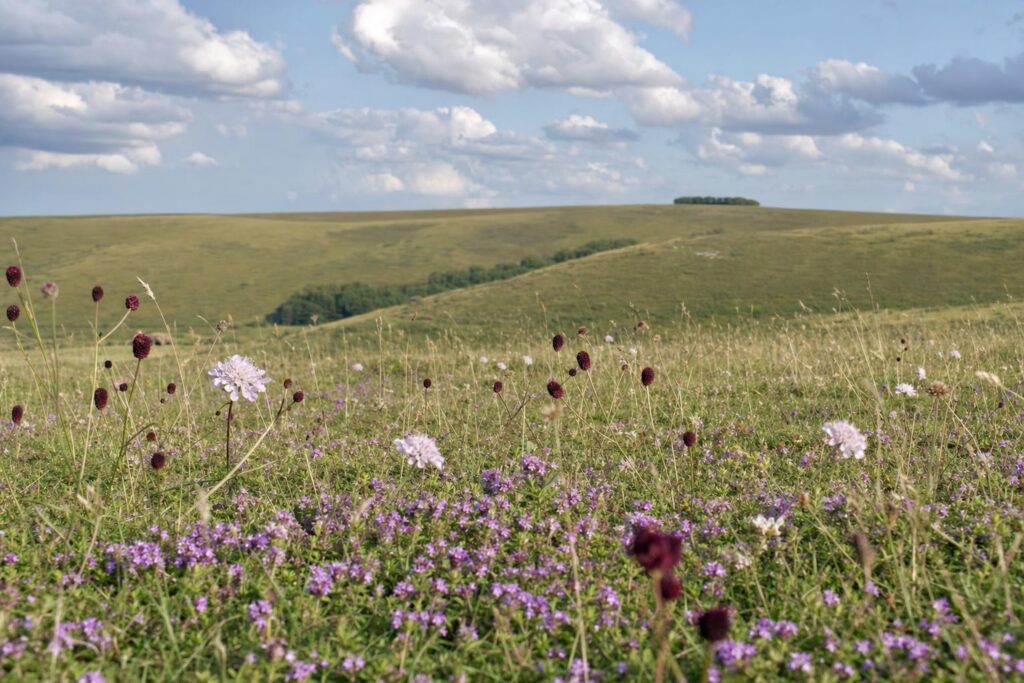
North Wessex Downs Wildflower Seeds: A Guide to Chalk Downland and Its Neighbours
The North Wessex Downs are the largest National Landscape in south-east England: 1,730 square kilometres of open chalk downs, dry valleys, beech hangers and chalk rivers across Wiltshire, Berkshire, Hampshire and Oxfordshire. The steep scarps at Pewsey, Cherhill and Hackpen Hill hold some of the finest chalk grassland in the country, up to 50 plant species in a square metre. Choosing North Wessex Downs wildflower seeds well starts with knowing which part of the Downs you are on.
Only one part of it suits a chalk seed mix. The open downs sit on thin, dry chalk, but the higher plateau is capped with heavier clay-with-flints, the Vale of Pewsey has deep, fertile greensand loam, and the Kennet valley is internationally protected floodplain. Each needs a different approach.
This guide explains how to tell them apart, which chalk wildflowers grow well from seed, what to leave out, and how to sow and manage a meadow that suits this landscape.
Four landscapes inside the North Wessex Downs
The open chalk downs and scarp
The spine of the Downs is uplifted chalk with steep scarps, combes and sarsen-strewn downs such as Fyfield Down. Soils on the scarps and ridges are thin, well drained and low in nutrients. Much of the gentler high downland was ploughed for arable after the Second World War, so species-rich grassland now survives mainly on slopes too steep to plough. Ex-arable land and field margins on this chalk are where new chalk grassland can be created.
The clay-with-flints plateau
On the higher ridges, around Savernake and across the North Hampshire Downs, the chalk is capped with clay-with-flints. Soils are heavier and less limy, and the land is wooded, with oak, ash and hazel, ancient wood pasture and pockets of heath. A chalk mix does not belong here; woodland edge, hedgerow and neutral grassland approaches fit better.
The Vale of Pewsey
Between the Marlborough Downs and Salisbury Plain, the Vale sits on greensand and clay with deep, fertile loams and springs feeding the Hampshire Avon. Chalk plants struggle on soil this rich. The priorities here are arable field margins, watercourse buffers, hedgerows and orchards.
The Kennet valley
The Kennet and Lambourn are internationally important chalk rivers, and their floodplain is protected as a Special Area of Conservation for wet grassland, fen and the tiny Desmoulin’s whorl snail. Sowing seed on designated floodplain is not appropriate. Management, grazing and catchment care come first.
Is North Wessex chalk different from the South Downs and Chilterns?
In the plants that matter for a seed mix, not much. Sheep’s fescue, quaking grass, salad burnet, small scabious, lady’s bedstraw, kidney vetch and greater knapweed are native across all three. The North Wessex Downs are inland, so they lack the coastal and chalk heath plants of the South Downs, and they are more open and arable than the wooded Chilterns.
What does matter is local rarity. Pewsey Downs and Hackpen Hill are strongholds of the early gentian, a plant found only in Britain. Gentians and orchids should never be sown, and seed of any kind should be kept away from designated chalk sites unless Natural England advises otherwise.
Testing your soil before buying North Wessex Downs wildflower seeds
Most of the Downs is farmed, and past fertiliser is the main barrier to new chalk grassland. Test pH and phosphorus field by field. Chalk grassland wants a pH above about 7.5 and a low phosphorus index, ideally 0 or 1. Where phosphorus is high, take hay cuts and remove them for a few years before sowing.
Restoration studies on ex-arable chalk show that the old seed bank is mostly arable weeds, not chalk flowers, so they will not come back on their own. Sowing speeds things up considerably. Research on chalk scarps by Kew’s Changing Chalk programme found that sowing native chalk species roughly halved regrowing scrub and unwanted plants over five years.
Check for archaeology too. The Downs hold the Avebury World Heritage Site and hundreds of scheduled monuments, where ploughing or deep cultivation is not allowed. On those sites, light surface preparation is the only option.
Which chalk wildflowers grow well from seed
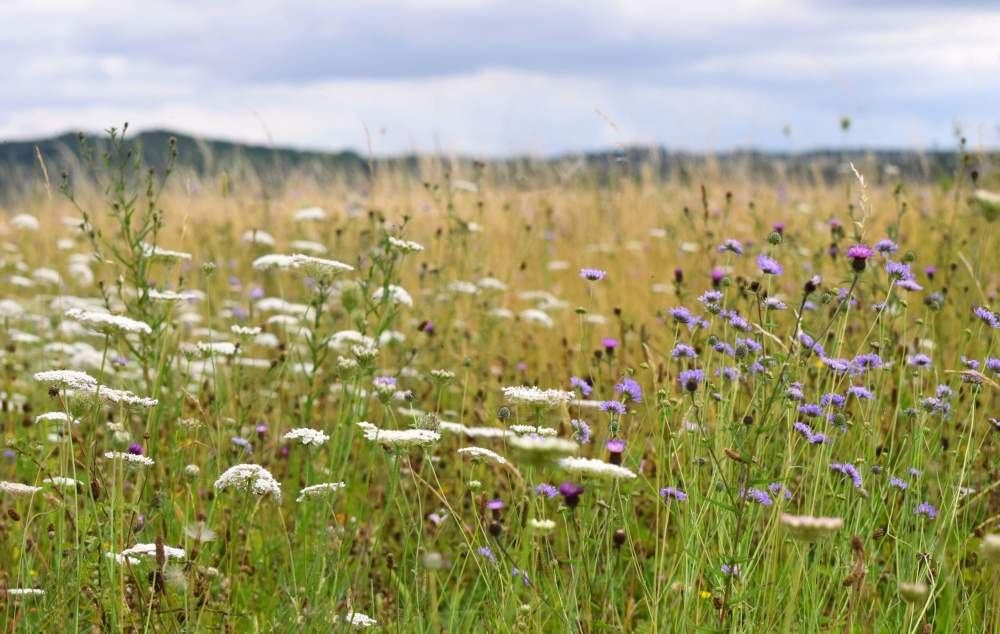
Build around reliable chalk species. Salad burnet (Poterium sanguisorba), lady’s bedstraw (Galium verum), greater knapweed (Centaurea scabiosa), small scabious (Scabiosa columbaria), bird’s-foot-trefoil (Lotus corniculatus), kidney vetch (Anthyllis vulneraria), hoary plantain and oxeye daisy all establish well. Fine grasses such as sheep’s fescue, crested dog’s-tail and quaking grass leave room for flowers.
Add yellow rattle (Rhinanthus minor) to weaken the grasses, sown in autumn. Cowslip and dropwort are slower and worth adding once the sward has settled. Horseshoe vetch and common rock-rose are the food plants of the downland blues but establish slowly from seed; plug plants or local green hay work better.
Never sow tor-grass or upright brome. Both are native, but on fertile ex-arable chalk they spread fast and smother smaller flowers. Leave out orchids, gentians and pasqueflower, which cannot be established reliably from a seed mix.
Wildlife of the North Wessex Downs
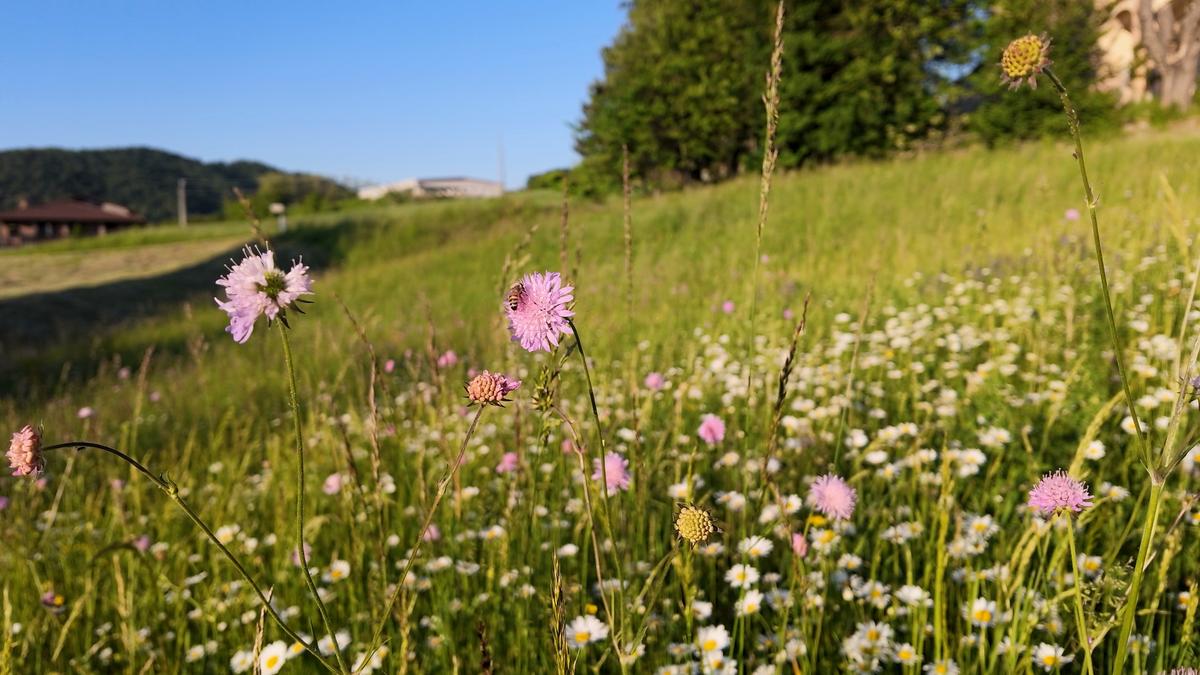
The scarp grasslands support Adonis and chalkhill blues, the Duke of Burgundy, silver-spotted skipper and marsh fritillary, alongside the rare wart-biter cricket. These insects need a mix of short, warm turf with bare chalk and taller tussocks and scrub edges, so variety in the sward matters more than a uniform display.
The farmed downs are equally important for birds. Stone curlew still breed on the Lambourn Downs, and skylark, corn bunting, grey partridge, lapwing and yellowhammer depend on flower-rich margins and winter seed. Wildflower strips that flower from cowslip time through to knapweed and scabious in late summer give pollinators food all season.
How to sow a chalk meadow on the Downs
Clear perennial weeds first, then prepare a fine, firm seedbed without deep cultivation. On ex-arable land, allow a flush of weeds to germinate and remove it. Do not add compost, manure or fertiliser.
Sow between mid-August and late October onto bare ground. Mix the seed with kiln-dried sand, sow on the surface and roll it in. Never rake it in. Use 3 g/m² for a 100% wildflower mix and 5 g/m² for an 80/20 mix of grasses and wildflowers. Where a species-rich downland lies next door, green hay or seed harvested from it is the better choice.
Managing a downland meadow for the long term
Keep stock off for the first year and cut and remove annual weeds before they set seed. From the second year, take a hay cut after flowering, usually from mid-July, leave it a few days to drop seed, then remove it. Graze in autumn and winter if you can; sheep and cattle keep coarse grasses in check and create the short turf many downland insects need. Expect three to five years for a sown chalk meadow to settle.
Wildahome seed mixes for North Wessex Downs sites
For the open chalk downs and scarp we recommend our Chalk & Limestone range. The 100% wildflower mix contains 23 native species for sowing into prepared grassland, and the 80/20 mix combines 28 wildflowers with fine native grasses for bare ground and arable reversion. In the Vale of Pewsey and on lower valley loams, our Loam & Alluvial guidance is the better fit. The clay-with-flints plateau and the Kennet floodplain need management guidance rather than a chalk mix.
To be clear about provenance, our mixes contain UK-native species chosen for chalk soil. They are not harvested in the North Wessex Downs. Near designated sites or where local provenance matters, talk to us about a bespoke approach or local green hay.
Plan your North Wessex Downs meadow
Work out which of the four landscapes you are in, test pH and phosphorus, and check for archaeology. Thin chalk with low phosphorus suits our Chalk & Limestone mixes. Email hello@wildahome.co.uk with your location, soil results and goals, and we will help you choose. Our county guides for Wiltshire, Berkshire, Hampshire and Oxfordshire cover the wider picture.
Frequently Asked Questions
What wildflower seeds grow best on the North Wessex Downs?
On thin chalk, salad burnet, lady’s bedstraw, greater knapweed, small scabious, bird’s-foot-trefoil and kidney vetch establish well with fine grasses such as sheep’s fescue and quaking grass. Add yellow rattle in autumn. Cowslip and dropwort can follow once the sward settles.
Is North Wessex chalk grassland different from the South Downs?
The core chalk plants are the same, so the same chalk mix suits both. The North Wessex Downs are inland and more open, and hold special rarities such as the early gentian, which must never be sown. Keep seed away from designated chalk sites.
Can I sow a chalk mix on the clay-with-flints plateau?
Usually not. The plateau caps are heavier, less limy soils that naturally carry woodland, wood pasture and neutral grassland. Test the pH; if it is below about 7, a chalk mix will struggle. Woodland edge and neutral meadow approaches fit better.
Are North Wessex Downs wildflower seeds locally sourced?
Most are not, including ours. Standard mixes contain UK-native species chosen for chalk, not seed harvested on the Downs. Local seed comes from green hay or seed harvested from nearby species-rich downland, which is the best option beside designated sites.
When should I sow wildflowers on chalk?
Sow between mid-August and late October onto bare, firm ground. Autumn sowing gives yellow rattle and cowslip the winter cold they need and lets seedlings root before summer. Sow on the surface, roll it in and do not water.
Can I sow wildflowers near archaeological sites on the Downs?
Only with light surface preparation and the right permissions. Scheduled monuments and the Avebury World Heritage Site cannot be ploughed or deeply cultivated. Check with Historic England or your local authority before working on or near them.
How long does a chalk meadow take to establish?
Expect three to five years for a sown chalk meadow to settle, and longer on ex-arable land with high phosphorus. Keep stock off in the first year, take a hay cut each summer and remove it, and graze in autumn and winter.
Ready to get started?
Shop: Traditional Wildflower Meadow Mix →