

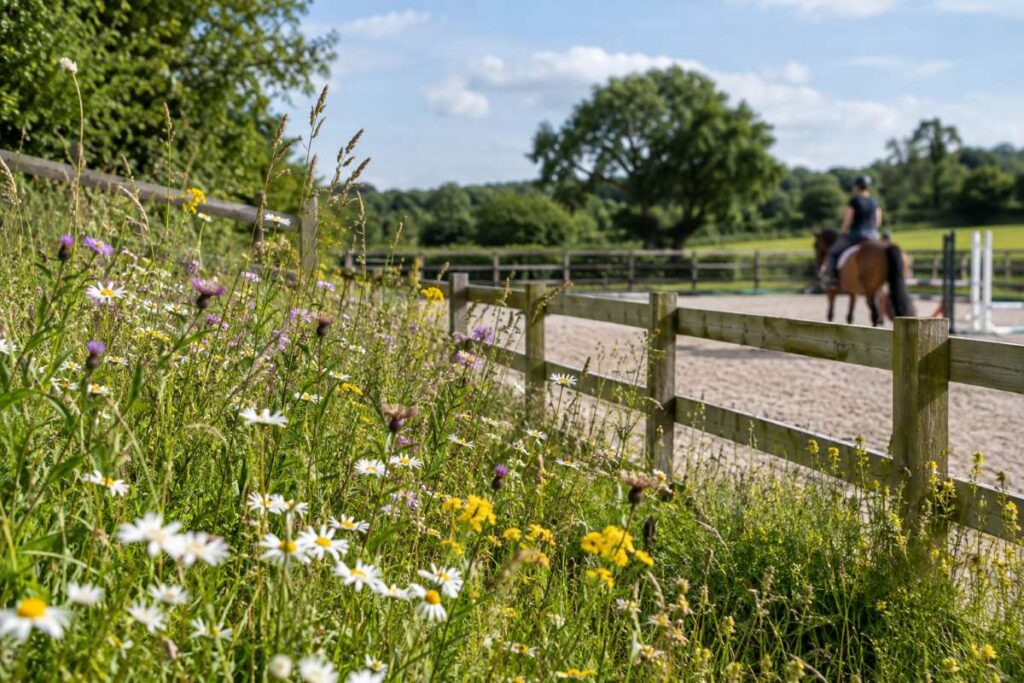
How Equestrian Sites Can Become More Nature Friendly with Wildflower Seeds
Equestrian holdings occupy a surprising amount of land. Between them, livery yards, riding schools, competition venues and private horse owners manage a substantial share of the UK’s lowland grassland — and much of it is managed intensively, with fertilised, ryegrass-dominated paddocks, closely trimmed hedges and mown verges everywhere.
That represents a real opportunity. Nature-friendly equestrian sites are achievable without giving up grazing, arena space or safe working conditions, because most yards contain ground that horses never use: track verges, awkward corners, the strip behind the muck heap, the bank beside the entrance, the margins of the hay field. Put wildflowers there and you gain habitat at no operational cost.
It has to be done carefully. Horses graze selectively and will eat things they should not, some native plants are dangerous to them, and anything that affects visibility, footing or emergency access is a safety issue before it is an ecological one. This guide covers where wildflowers work on an equestrian site, where they do not, how to handle the plant safety question properly, and how to fit establishment and management around a working yard.
One point up front, because it matters: no wildflower seed mix should be assumed safe for horses. Suitability depends on the species in the mix, how the area is managed, and whether horses can reach it. Check every mix against the ground it is going on, and take specialist or veterinary advice where there is any doubt.
Why biodiversity matters on equestrian land
The ecological case is straightforward. The UK has lost around 97% of its species-rich meadows since the 1930s, and much of what remains is fragmented. Grazed land has a role in restoring that, because meadows evolved under grazing and cutting — the plant communities in question exist because of livestock, not despite them.
There is also a practical case that horse owners tend to appreciate more quickly.
Soil health. Deep-rooted forbs open compacted soil, improve infiltration and reduce poaching and runoff. A paddock full of shallow-rooted ryegrass and nothing else drains badly and compacts easily.
Forage variety. Herb-rich swards provide varied minerals and a lower-sugar, higher-fibre diet than improved ryegrass, which suits many horses better — particularly those prone to laminitis. Species-rich pasture is a recognised approach in good grassland management for horses, though it needs setting up properly.
Predatory insects. Diverse margins support the hoverflies, beetles and parasitic wasps that reduce nuisance fly populations around a yard.
Landscape and reputation. Venues and eco-friendly riding schools that look after their land visibly are increasingly noticed by clients, and by the grant and stewardship schemes that fund this kind of work.
Regulatory direction. Farm and estate businesses with equestrian enterprises are increasingly working within environmental land management and biodiversity net gain frameworks. Margins established now count towards obligations later.
What wildflower areas do for wildlife
A species-rich margin on equestrian land supports far more than the paddock beside it.
Pollinators are the obvious beneficiaries: bumblebees need continuous forage from March to September, and species such as Red Clover, Bird’s-foot Trefoil, Knapweed and the vetches carry them through. Butterflies need both nectar and larval food plants, most of which are native grasses and forbs found in unimproved sward.
Birds benefit through the invertebrates and the seed. Yellowhammer, Linnet and finches feed on meadow seed heads through Autumn and Winter, and Swallows and House Martins — already common around yards — hunt insects over flowering margins. Barn Owls hunt the voles that live in tussocky grass.
The soil biology matters too, though it is invisible. Diverse root systems support the fungal and bacterial networks that hold structure together, which is why a herb-rich margin holds up better under wet-weather traffic than a rye monoculture.
Where wildflowers work on nature-friendly equestrian sites
The rule is straightforward: plant where horses are not, and where nobody needs a clear line of sight.
Field margins. A 3–6m strip around the edge of a paddock, fenced off from grazing, is the highest-value option on most yards. It connects to hedgerows, costs a small percentage of grazing area, and can be managed with one cut a year.
Unused corners. Odd triangles, ground behind buildings, the awkward strip between two fence lines. These are usually strimmed occasionally for tidiness and nothing else.
Track and lane edges. Verges alongside hacking tracks and access lanes, provided sightlines at junctions stay open and the ridden surface is kept clear.
Pond and ditch margins. Damp margins hold species that will grow nowhere else on the holding, and they are difficult to mow anyway. Fence them from stock.
Entrance areas and around buildings. The approach to the yard, verges by the car park, the ground around the office. Keep these tidy-edged and low, since first impressions matter commercially.
Hay field margins. Where you cut your own hay, the margins can be managed for wildflowers even if the main crop is not, giving wildflower margins for farms and equestrian holdings a productive dual role.
Muck heap surrounds and hardstanding edges. High-nutrient ground is poor for wildflowers, so treat these as buffer areas with robust species rather than as meadow restoration.
Bank and slope areas. Steep ground that is dangerous to mow suits wildflowers well.
Where wildflowers are not appropriate
This list matters more than the previous one.
- Active turnout fields. Horses graze selectively and will seek out particular plants. Unless you are deliberately managing a species-rich pasture with veterinary and specialist input, keep sown wildflower areas fenced off from grazing.
- Jumping areas, gallops and cross-country tracks. Footing must be even and predictable, and vegetation must not conceal ground conditions.
- Arena edges and surrounds. Anything that sheds seed, leaf or debris onto a surface adds maintenance and can affect footing. Keep a mown buffer.
- Emergency and vehicle routes. Horse ambulance, vet and fire access must stay clear, legible and passable at all times.
- Horse-access routes and gateways. Handling areas need clear footing and clear sight of the horse’s legs.
- Anywhere sightlines are essential. Junctions, road exits, blind corners on hacking routes, and any point where a rider needs to see approaching traffic or another horse.
- Around water troughs, gates and field shelters. These are high-traffic, high-poaching zones. Nothing establishes there.
- Immediately alongside fencing horses can reach over. Horses browse over fences. If a mix contains anything you would not want eaten, set the margin back.
Plant safety: the part that needs proper attention
No seed mix is automatically safe for horses, and this is where responsibility sits with the yard rather than the supplier.
*Ragwort (Jacobaea vulgaris)* is the primary concern. It causes cumulative, irreversible liver damage, and it is more dangerous dried in hay than growing, because horses avoid the bitter growing plant but eat it readily when wilted. It colonises disturbed bare ground, which is exactly what a newly cultivated seedbed provides. Inspect any new area through its first two years, pull plants complete with root before they seed, and dispose of them properly. Legal duties apply where there is a risk of spread to grazing or forage land.
Other species to be aware of include Foxglove, Yew, Hemlock, Water Dropwort, Bracken, Horsetail, St John’s Wort (which causes photosensitisation), Buttercup in quantity in hay, and acorns from Oak. Sycamore deserves particular attention: its seeds and seedlings contain hypoglycin A, which causes atypical myopathy, and the risk is highest in Autumn and Spring on grazing near mature sycamores.
Practical steps:
- Ask for the full species list of any mix, in writing, before ordering — not the marketing description alone.
- Cross-check that list against current veterinary guidance on plants toxic to horses.
- Assume that disturbed ground will produce weeds that were not in the mix, ragwort included, and plan inspections accordingly.
- Fence sown areas from grazing unless you have specific advice that the sward is suitable.
- Check hay from any new area carefully before feeding, and if there is doubt, do not feed it.
- Involve your vet where you are considering grazing or cutting hay from a species-rich sward for the first time.
Being cautious here costs very little. Getting it wrong can cost a horse.
Choosing a mix that suits the site and its management
Work through the same filters that apply to any meadow, plus one that is specific to equestrian ground.
Soil type and drainage come first. Chalk, clay, sand, loam and damp ground each need a different mix.
Fertility is the equestrian complication. Paddocks that have carried horses for years, or received muck, are usually high in phosphate and nitrogen. That favours vigorous grasses, docks and nettles over wildflowers. On such ground, either accept slow progress, strip the enriched topsoil, or choose a robust mix suited to higher fertility and use Yellow Rattle to reduce grass vigour.
Sunlight and aspect determine whether you need a full-sun meadow mix or a shade and woodland-edge blend for margins under trees.
The management you can actually deliver should shape the choice. If an area can only be cut in July because of competition dates, choose species that flower earlier. If it can be left until September, the options widen.
Species safety as covered above.
Choose regionally sourced native seed. Local provenance stock is better adapted to your conditions and supports the pollinators already present, and on land near existing semi-natural grassland it avoids diluting local genetics.
Preparation, sowing and establishment
The technique is the same as any meadow, with equestrian-specific care around timing and protection.
- Fence first. Physically separate the area before any cultivation. This is the step that most often gets deferred and most often causes failure.
- Reduce fertility where you can. Cut and remove the existing sward, and on very rich ground consider stripping the top few centimetres. Add nothing.
- Expose bare soil across at least half the area by scarifying hard, rotovating or ploughing.
- Allow a fallow period of four to six weeks, let the weed flush germinate, and take it out with a shallow cultivation before sowing. On equestrian ground this step also flushes out ragwort seed that would otherwise appear later.
- Firm the seedbed. Rake to a fine tilth and roll or tread.
- Sow onto the surface, mixing seed with dry sand or sawdust for even coverage, in two passes at right angles. Late August to early October is the main window; March to early May is the alternative on heavy ground.
- Roll again. Seed-to-soil contact decides germination.
- Leave it alone over Winter, keeping horses, vehicles and machinery off entirely.
Protecting new areas from trampling and overgrazing
New sowings on an equestrian site face pressures that a garden meadow does not.
Post-and-rail or temporary electric fencing, set back far enough that horses cannot browse over it, is the minimum. On sites with turnout adjacent, allow a metre of clearance. Where the boundary crosses a hacking route, use a clear physical barrier rather than relying on riders remembering.
Overgrazing is the slower risk. If a margin is eventually brought into a grazing rotation, it needs light, intermittent grazing in Autumn or Winter only, well after seed set, and stock must come off before the sward is bitten down. Continuous grazing turns a species-rich margin back into rye and docks within two seasons.
Machinery is the third pressure. Mark the boundaries on the yard’s maintenance plan, brief every member of staff including relief and seasonal cover, and check the plan each Spring.
Signage, boundaries and guiding people
On a busy yard, physical clarity does more than instruction.
Use consistent fencing so wildflower areas are read the same way everywhere. Keep a mown strip between the ridden or walked route and the sown area, which signals intent and keeps the margin looking managed rather than neglected. Small, factual signs work: what the area is, when it is cut, why it is there.
Brief liveries and clients directly. On a yard with thirty owners, one person deciding to hand-graze on a margin can undo a season’s work. A short note on the noticeboard and a mention at the yard meeting is usually enough.
For eco-friendly riding schools, this is also teaching material. Pony Club and riding school groups respond well to being shown which plants are dangerous and which are valuable, and it makes the boundaries stick.
Connecting wildflowers with other habitat features
Wildflower margins work best as part of a joined-up scheme.
Hedgerows are the backbone. Cutting on a two or three-year rotation, and letting hedges thicken and gain height, adds far more than any other single change. Hedges also give horses shade and shelter.
Trees in and around paddocks provide shade, though species choice matters — avoid planting Sycamore, Yew or Oak where horses graze.
Ponds with shallow, fenced margins support amphibians and dragonflies and add real value at low cost.
Deadwood and log piles in unused corners support fungi, beetles and reptiles. Keep them away from paddocks, arenas and access routes, and use only untreated timber.
Reduced mowing on verges, tracksides and around buildings costs nothing and delivers immediately.
Taken together these features give biodiversity on equestrian land the structural variety that a margin alone cannot.
Practical safety issues around a working yard
- Visibility. Vegetation must not obscure junctions, road exits, gateways, arena entrances or approaching horses.
- Fire. Hay, straw and dry standing vegetation together are a serious risk. Keep a cut, clear buffer between long grass and any hay or straw store, and away from smoking areas and machinery.
- Machinery. Cutting a wildflower margin means a tractor or pedestrian mower operating near horses. Plan cutting for quiet periods, secure horses, and use exclusion zones.
- Hay quality. Any hay cut from a species-rich sward must be checked for ragwort and inspected before feeding.
- Trip hazards and public access. Where footpaths cross the holding, keep them mown to full width, keep long vegetation back from stiles and gates, and ensure signage stays visible.
- Ticks. Long grass holds ticks. Brief staff and clients, keep working areas short, and check horses and dogs after work in longer vegetation.
- Ground conditions. Never allow vegetation to conceal holes, ruts or drainage covers on ground horses or people use.
Where to start on nature-friendly equestrian sites
| Potential location | Biodiversity opportunity | Equestrian consideration | Suggested management approach |
|---|---|---|---|
| Paddock margins (3–6m) | Pollinator forage, bird seed, links to hedgerows | Must be fenced from grazing; loses a little grazing area | Sow perennial meadow mix; one cut late July–September; remove arisings |
| Unused corners and odd ground | Refuge habitat, invertebrate overwintering | Usually none; check sightlines | Sow or allow natural regeneration; cut every 1–2 years on rotation |
| Track and lane verges | Linear habitat corridor | Sightlines at junctions must stay open | Sow low-growing mix; keep a mown strip beside the ridden surface |
| Pond and ditch margins | Amphibians, dragonflies, damp-ground species | Fence from stock; drowning and poaching risk | Damp-ground mix; cut sections on rotation, never all at once |
| Entrance and building surrounds | Visible pollinator habitat; client-facing | Must look managed and tidy | Small annual or low perennial areas; defined edges; cut as needed |
| Hay field margins | Species-rich forage and seed source | Ragwort inspection essential before cutting hay | Cut after seed set; check crop carefully; remove arisings |
| Banks and steep ground | Warm, dry habitat; often species-rich | Unsafe to mow; keep clear of ridden routes | Sow dry-ground mix or seed mats; cut every 1–2 years |
| Arena and gallop surrounds | Limited — buffer value only | Debris on surfaces; footing and visibility | Keep mown; place wildflower areas beyond the buffer |
| Muck heap and hardstanding edges | Low — high nutrient ground | Runoff and nutrient management | Robust buffer species; do not attempt meadow restoration |
A step-by-step plan that fits a working yard
- Survey the holding in July, when growth is at its heaviest. Map grazing, hacking routes, arenas, access and emergency routes, existing habitat and the ground horses never use. Photograph fixed viewpoints.
- Identify candidate areas from the ground horses do not need, checking each against sightlines, access and traffic.
- Check fertility and soil type. A basic soil test on any area intended for meadow restoration is worth the cost, since phosphate levels tell you whether the project is realistic.
- Obtain full species lists for shortlisted mixes and check them against current veterinary guidance on plants toxic to horses.
- Consult the people affected — yard manager, liveries, instructors, groundstaff — before anything is fenced. Objections raised afterwards are harder to resolve.
- Fence and mark the areas physically, and add them to the maintenance plan.
- Prepare and sow in the autumn window, after the competition and turnout pressure of Summer has eased.
- Protect through Winter, keeping horses, vehicles and machinery off entirely.
- Manage year one with two or three cuts to 5–7cm from May, arisings removed each time. Inspect for ragwort throughout.
- Move to the annual regime in year two: one hay cut after seed set, arisings dried a few days then removed. Leave 10–20% uncut on rotation.
- Review each Autumn. Record what flowered, what dominated, ragwort pressure, and how the area is holding up. Extend, overseed or adjust the cutting date.
Choosing seed for equestrian ground
Wildahome supplies regionally sourced native mixes selected by soil type — chalk and limestone, heavy clay, loam, sandy and free-draining ground, damp margins and shade — with a full species list available for every mix, which is what you need before putting anything on land near horses. On enriched paddock ground, Yellow Rattle is usually the sensible starting point, reducing grass vigour over two or three seasons so that a more diverse sward can establish. Seed mats suit banks, entrance areas and the small defined patches around buildings where broadcast seed is hard to place evenly. Where a site has both dry banks and damp ditch margins, planting in zones with mixes matched to each will always outperform a single compromise blend.
Tell us about your yard
If you are planning wildflower seeds for horse paddocks, margins or unused ground, the useful conversation starts with your site — soil type, fertility history, how much of the holding is grazed, what equipment you have for cutting and clearing, and where horses can and cannot reach. Send us a description or a plan and we will advise on suitable mixes, supply the full species lists so you can check them against veterinary guidance, and give a realistic view of what your ground will do. Where a paddock is too enriched for meadow restoration, we will tell you that rather than sell you seed that will not establish.
Frequently Asked Questions
Are wildflower seed mixes safe for horses?
No mix should be assumed safe. Suitability depends on the species included, how the area is managed and whether horses can reach it. Request the full species list in writing, check it against current veterinary guidance on plants toxic to horses, fence sown areas from grazing, and involve your vet before grazing or cutting hay from a new species-rich sward.
Can I sow wildflowers directly into a horse paddock?
Only with care. Paddocks are usually too enriched for wildflowers to compete, and grazing horses will select out particular plants. Most yards do better fencing a 3–6m margin and managing that as meadow, keeping the grazing area separate. Sowing wildflower seeds for horse paddocks in use requires specialist and veterinary input.
How do I keep ragwort out of a new wildflower area?
Assume it will appear on disturbed ground and inspect from the first Spring. Pull plants complete with root before they set seed and dispose of them properly, never leaving wilted plants where horses can reach them. A fallow period before sowing, flushing and removing the weed germination, considerably reduces later pressure.
Will wildflower margins reduce my grazing area significantly?
A 3–6m margin around a paddock typically takes 5–10% of the area, and often less on larger fields. The ground lost is usually the least productive — shaded, poached along fence lines, or awkward for machinery. Many yards find the trade-off worthwhile for the habitat, soil and shelter benefits it brings.
When should I sow wildflowers on nature-friendly equestrian sites?
Late August to early October suits most sites, using natural rainfall and fitting the quieter part of the yard calendar. March to early May is the alternative on heavy clay or ground that waterlogs. Fence the area before cultivating, and keep horses and machinery off through the following Winter.
What are the benefits of creating nature-friendly equestrian sites?
Deep-rooted species improve soil structure, drainage and resistance to poaching. Herb-rich swards provide varied, lower-sugar forage suited to many horses. Diverse margins support the insects that keep nuisance fly numbers down, and improve the appearance of the holding. Established margins can also count towards stewardship and biodiversity net gain obligations.
How do I stop liveries and staff from disturbing new wildflower areas?
Physical boundaries work better than instructions. Fence the areas properly, keep a mown strip between them and any route, and put up small factual signs explaining what they are and when they are cut. Add them to the written maintenance plan, and brief liveries, instructors and relief staff directly rather than relying on a noticeboard alone.
Ready to get started?
Shop: Traditional Wildflower Meadow Mix →