

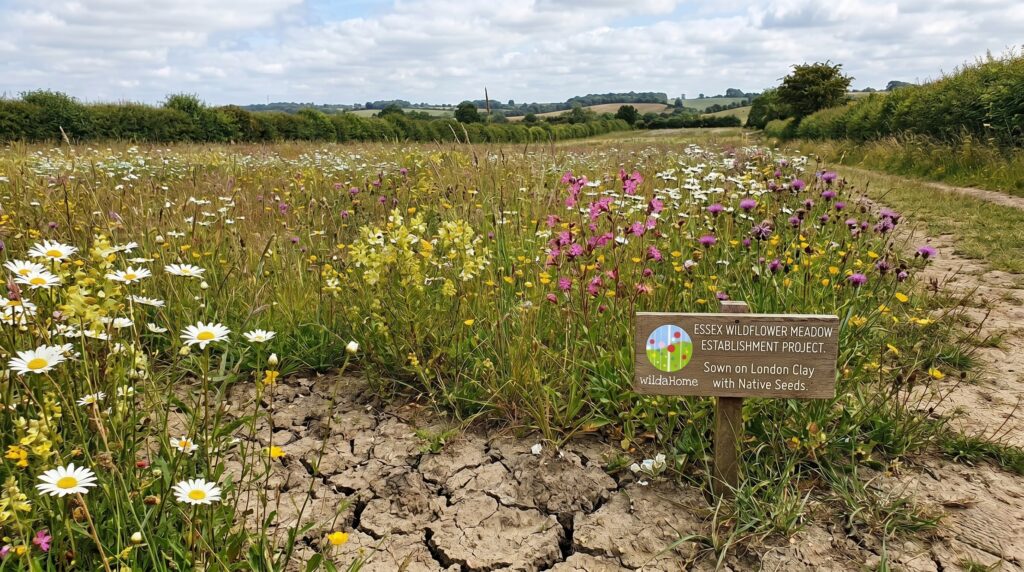
Wildflower Seeds for Essex — Matching Your Mix to the County’s Soils and Habitats
Essex Soils: What You Are Working With
London Clay is the defining soil type across a large area of Essex — from the Thames valley northwards through Chelmsford, Braintree, and Colchester. It is heavy, poorly draining, and can become compacted under livestock or vehicle pressure. Fertility is often moderate, which means ground preparation needs to address both soil structure and nutrient levels before sowing.
The boulder clays and chalky till of north Essex — around Saffron Walden and towards the Suffolk border — are better draining and slightly more alkaline. These soils carry traditional meadow flora well, and some sites with calcareous influence can support a chalk grassland edge.
The coastal zone — Essex coast, Blackwater Estuary, Colne, Crouch, and Thames marshes — is alluvial and low-lying. Flood meadow species suit these wet, neutral-to-alkaline soils, and the wetland mix is the correct choice wherever seasonal waterlogging occurs.
Choosing the Right Wildflower Seed Mix for Essex
Traditional Meadow Mix — This is the primary choice for most Essex sites on London Clay and boulder clay. It contains Oxeye Daisy, Meadow Buttercup, Field Scabious (Knautia arvensis), Meadow Cranesbill (Geranium pratense), Ragged Robin, and Red Clover. The 80/20 grass/wildflower version at 5g/m² is the practical choice for field-scale work. The 100% wildflower version at 1–3g/m² suits smaller areas and border margins.
Chalk and Limestone Mix — Relevant for north Essex sites with calcareous boulder clay influence and good drainage. If your soil is free-draining and alkaline, this mix will outperform the Traditional Meadow version. Species include Cowslip, Kidney Vetch (Anthyllis vulneraria), Marjoram, and Salad Burnet.
Wetland and Pond Mix — For low-lying coastal areas, river valley meadows, pond margins, and any ground subject to seasonal flooding. Purple Loosestrife, Meadowsweet (Filipendula ulmaria), Yellow Flag Iris, Water Mint, and Great Burnet (Sanguisorba officinalis) establish well on alluvial Essex soils.
Hedgerow and Banks Mix — For field margins, roadside verges, and hedgerow bases. Cow Parsley, Garlic Mustard, Wild Carrot, and Red Campion provide structural cover and early foraging for pollinators emerging from field margins.
Why Locally Sourced Seed Performs Better on Essex Soils
Essex wildflower populations have adapted to local conditions — the drainage patterns of London Clay, the seasonal rainfall of the east, the temperature patterns of the Thames corridor. Seed harvested from local donor sites carries this adaptation. It germinates in sync with local weather, establishes under the same soil chemistry, and supports local pollinator populations that have co-evolved with these plants over generations.
Continental seed — widely used in cheaper generic mixes — may look similar on a species list but perform differently in the field. Local provenance is not a premium feature; it is what makes the difference between a meadow that self-sustains and one that degrades after year three.
Ground Preparation on Essex Clay
The most common reason wildflower sowing fails on London Clay is insufficient ground preparation. The challenge is twofold: compacted soil structure prevents root penetration, and residual fertility from improved grassland or cultivation favours rank grasses over wildflowers.
Work the ground in late Summer when the clay is dry enough to cultivate without smearing. A tined cultivator or disc harrow creates more open structure than a plough, which can bring subsoil to the surface. After primary cultivation, allow weeds to germinate and clear them by surface cultivation before final seedbed preparation. This reduces the seed bank before sowing.
Avoid adding any organic matter, compost, or fertiliser. The goal is low-fertility, fine-textured soil. Roll after sowing to press seed into contact with the surface — this is particularly important on clay where surface drying can leave seed stranded.
Sowing Windows for Essex
Autumn sowing (August to October) is the recommended window for most Essex sites. Native wildflowers that require cold stratification — including Yellow Rattle (Rhinanthus minor), Cowslip, and Meadow Buttercup — will germinate more reliably having experienced winter temperatures. Yellow Rattle must be sown in Autumn; it will not germinate reliably from a Spring sowing.
Spring sowing (March to May) works for a range of species and is viable where Autumn sowing was not possible. On clay soils, wait until the ground has warmed and surface moisture has reduced before cultivating and sowing.
Establishment expectations should be realistic. Year one will show annuals and fast-establishing species. Perennials take root in year two and begin to flower in year three. Three seasons is the normal timeframe for a well-established meadow — not a sign of failure.
Seed Mats in Essex Gardens
For residential gardens, smaller plots, and areas where precise placement matters, Wildahome seed mats are a practical alternative to loose sowing. The mats arrive pre-seeded with a habitat-appropriate mix, are laid onto prepared soil, and covered with 25mm of topsoil. Water consistently for the first three weeks.
Seed mats are particularly useful in Essex gardens where the clay surface can cap and dry quickly after sowing — the mat holds seed in place and maintains surface contact through early germination. They can be used at any time of year, including for Autumn planting on prepared beds.
Long-Term Meadow Management
Cut once a year in late Summer — late July to September depending on when your latest flowering species have set seed. Remove all cuttings from the site immediately. This is the most important management task and the one most often skipped. Leaving cut material on the ground adds nutrients, which reverses the low-fertility conditions that sustain your wildflower community.
On clay soils, avoid cutting when wet. Heavy machinery on wet clay causes compaction that takes years to recover. Hand tools or a light tractor with flotation tyres are better options for smaller areas.
Yellow Rattle, once established, helps manage grass competition through the growing season. It is semi-parasitic on grass roots, reducing their vigour and opening the sward for slower-establishing forbs. Retain it as a key component of ongoing management.
Ready to get started?
Shop: Traditional Wildflower Meadow Mix →Frequently asked questions
When's the best time to sow a wildflower mix?
Late summer to early autumn (August to September) is the best sowing window for most of the UK -- seed goes into warm, moist soil ahead of winter and gets the cold, damp period many native wildflower seeds need to break dormancy. A second window opens in spring (March to April) once the ground has warmed, though autumn sowing usually establishes faster with fewer weed problems.
Why does local seed provenance matter?
Seed grown from populations adapted to similar soil, rainfall and temperature conditions germinates more reliably and settles into a stronger, longer-lived meadow than seed sourced from a very different climate. That's why we match seed to comparable growing conditions rather than supplying one generic UK-wide mix.
Do I need to prepare the ground before sowing?
Yes, and it's the single biggest factor in whether a meadow succeeds. Existing vegetation and topsoil fertility need to be reduced, since most UK soils are too nutrient-rich for wildflowers and favour competitive grasses and weeds instead. In practice that usually means clearing down to bare soil, raking to a fine tilth, and sometimes sowing yellow rattle alongside the mix to suppress grass vigour.
How long before it looks like a proper meadow?
Most sites show flowers in year one, but a settled, species-rich meadow typically takes two to three growing seasons to establish as slower perennials build up and the balance between grasses and wildflowers matures. Very fertile ground can take longer, since excess nutrients need to be drawn down through repeated cutting and removal of cuttings.
What ongoing management does a wildflower meadow need?
An annual cut in late summer, after flowering and seed-set, with the cuttings removed rather than left to rot down, is the core of long-term management. This keeps fertility low and stops coarse grasses and scrub taking over. Spring topping and occasional scarification help in the early years, and light grazing can replace cutting on some sites.
More county guides
Find the right native wildflower mix for your county, or browse our full list by region.