

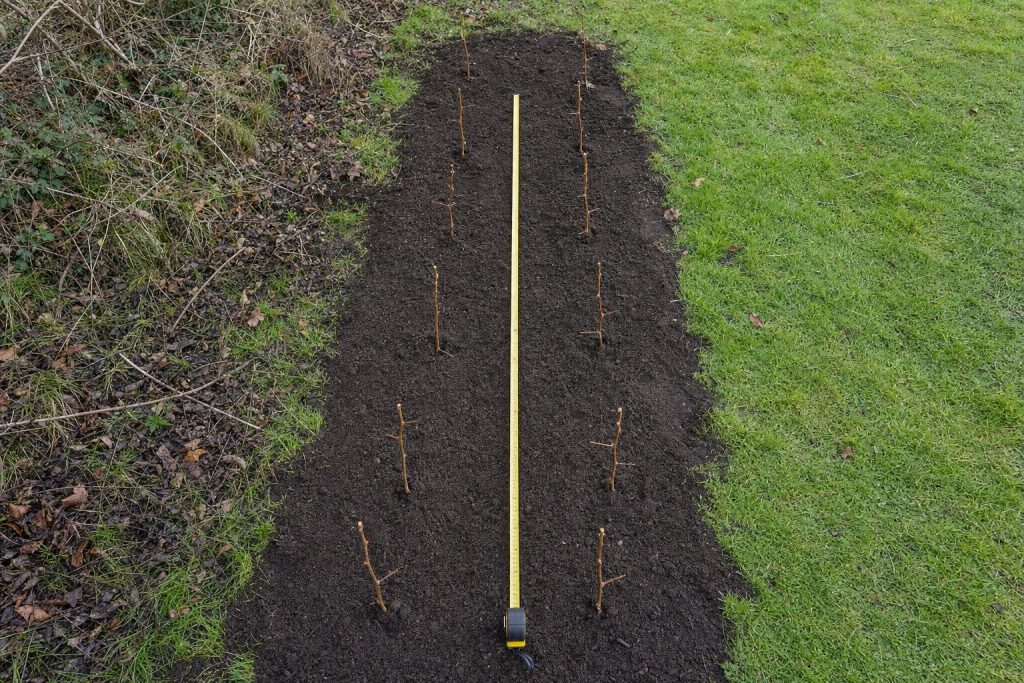
How Many Hedge Plants Per Metre? Spacing for Single and Double Rows
Getting the number of hedge plants per metre right is the difference between a hedge that closes up in three years and one that stays gappy for a decade. Plant too sparsely and the base never fills in; plant too densely and you pay for plants that crowd each other out. For most native hedges, the answer is 5 plants per metre in a double staggered row. This guide explains why, when to vary it, and how to work out the quantity for your own boundary.
The short answer
For 40–60 cm bare-root native hedging:
- Double staggered row: 5 plants per metre (rows 40 cm apart, plants 40 cm apart in each row). This is the standard for a dense garden or boundary hedge.
- Double row for grant schemes: 6 plants per metre, where a grant specification requires it.
- Single row: 3 plants per metre (about 33 cm apart). Cheaper, but slower to thicken and less dense at the base.
Single row or double staggered row?
A single row of hedge plants is fine for a narrow space, a low internal hedge or a quick boundary on a budget. But each plant has to fill a gap on both sides on its own, so the hedge takes longer to become dense, and gaps from any losses show more.
A double staggered row puts two lines of plants 40 cm apart, with each plant opposite a gap in the other row. The two rows knit together, the base thickens much sooner, and the hedge copes far better if a plant or two fails. For wildlife, a wider, denser base also means more cover for nesting birds and small mammals.
Unless space is very tight, plant a double staggered row.
How many hedge plants per metre for different hedges
| Hedge type | Layout | Plants per metre |
|---|---|---|
| Garden or boundary hedge | Double staggered row | 5 |
| Grant-funded farm hedge (e.g. England BN11) | Double staggered row | 6 or more |
| Narrow space or low internal hedge | Single row | 3 |
| Formal beech or hornbeam hedge | Single or double row | 3–5 |
| Hedge with standard trees | Double row, plus a tree every 10–15 m | 5, plus trees |
Hedges for grant schemes and BNG
Grant schemes often set their own density. In England, the Countryside Stewardship hedge planting option asks for at least 6 plants per metre in a double row, with no single species making up more than 70% of the mix. If you are planting for a grant or a biodiversity net gain plan, check the specification before ordering, and keep the species evenly mixed along every 30 m. Our biodiversity net gain page explains how hedgerows are assessed.
Calculating how many hedge plants you need
Measure the boundary in metres and multiply by your density:
| Hedge length | Double row at 5/m | Double row at 6/m | Single row at 3/m |
|---|---|---|---|
| 5 m | 25 | 30 | 15 |
| 10 m | 50 | 60 | 30 |
| 25 m | 125 | 150 | 75 |
| 50 m | 250 | 300 | 150 |
| 100 m | 500 | 600 | 300 |
Add a few spares, around 5%, for gapping up any losses the following winter. Our native hedging kits are sized on the 5-per-metre double row: 25 plants for 5 m, 50 for 10 m, 125 for 25 m and 250 for 50 m.
Measuring curves and corners
Measure along the line the hedge will actually follow, not the straight-line distance. Run a tape or string along the planned line, including curves. At a corner, keep the stagger going round the turn rather than doubling up plants at the point.
Does plant size change the spacing?
For the 40–60 cm whips used in most new native hedges, 5 per metre is right. Larger plants of 90–120 cm cost more and are sometimes planted at slightly wider spacing, but they establish more slowly and need more aftercare. Small cell-grown plants can be planted more densely. For gardens and small plots, 40–60 cm bare-root plants give the best balance of cost, establishment and density.
Setting out the planting line
- Peg a string line along the front row.
- Peg a second line 40 cm behind it.
- Mark every 40 cm along the front row.
- On the back row, mark every 40 cm starting 20 cm in, so plants sit opposite the gaps.
- Mix species as you set out, rather than planting in blocks.
Plant inside your boundary so the mature hedge stays on your land. Allow at least 1 m of width for the mature hedge on each side of the planting line, more if it will be a wide wildlife hedge.
Full planting steps, including the first formative cut, are in our guide on how to plant a bare-root hedge.
Spacing for trees in a hedge
Hedges with occasional trees growing through them have more wildlife value, and the statutory biodiversity metric scores a “native hedgerow with trees” higher. Add a standard tree, such as oak, field maple, rowan or wild cherry, every 10–15 m in the hedge line. Tag them so they aren’t cut when the hedge is trimmed.
What about the strip under the hedge?
Leave a 1 m strip along the hedge free of grass for the first three years. Once the hedge is established, that strip can become a band of wildflowers. Our Hedgerow & Banks wildflower mix is chosen for the dappled shade at a hedge base, and our guide on what to plant under a hedge covers bulbs and other planting.
Get the right quantities first time
If you’d like help working out quantities for a long boundary, an awkward plot or a grant specification, send us the details through our advice page and we’ll suggest the mix and number of plants. Or choose a kit length from our native hedging range: every kit includes the plants, hedge-bottom seed and planting guide, with delivery included.
Frequently Asked Questions
How many hedge plants per metre should I plant?
For most native hedges, plant 5 per metre in a double staggered row: two rows 40 cm apart, with plants 40 cm apart along each row and staggered. That gives a dense hedge within three to five years. Grant schemes sometimes require 6 per metre.
How many hedge plants per metre for a single row?
Plant 3 per metre, about 33 cm apart, for a single-row native hedge. A single row is cheaper and suits narrow spaces, but it takes longer to thicken and any losses leave more obvious gaps than in a double staggered row.
How far apart should hedge rows be?
For a double staggered row of 40–60 cm native hedging, space the two rows about 40 cm apart. Plants in each row go 40 cm apart, with the back row offset so each plant sits opposite a gap in the front row.
How many hedge plants do I need for 10 metres?
For 10 m of native hedge in a double staggered row at 5 plants per metre, you need 50 plants. At 6 per metre, you need 60. For a single row at 3 per metre, you need 30. Add around 5% spare for gapping up any losses.
Is 6 plants per metre better than 5?
Six per metre gives a slightly denser hedge sooner and is required by some grant schemes, such as England's BN11 option. For gardens and boundaries, 5 per metre in a double staggered row gives a dense hedge at lower cost, and is the standard we recommend.
How wide will a native hedge grow?
A maintained native hedge is usually 1–2 m wide. Hedges managed for wildlife are often allowed to reach 2–3 m wide and tall. Plant at least 1 m inside a boundary, so the mature hedge doesn't overhang a neighbour's land, a path or a road.
Can I plant a hedge too close together?
Yes. Planting much more densely than 6 per metre wastes plants, as they compete for light and water and many will fail. At 5 per metre in a double row, each plant has room to bush out while the hedge still closes up quickly.
Ready to get started?
Shop: Native Hedging Kits →