

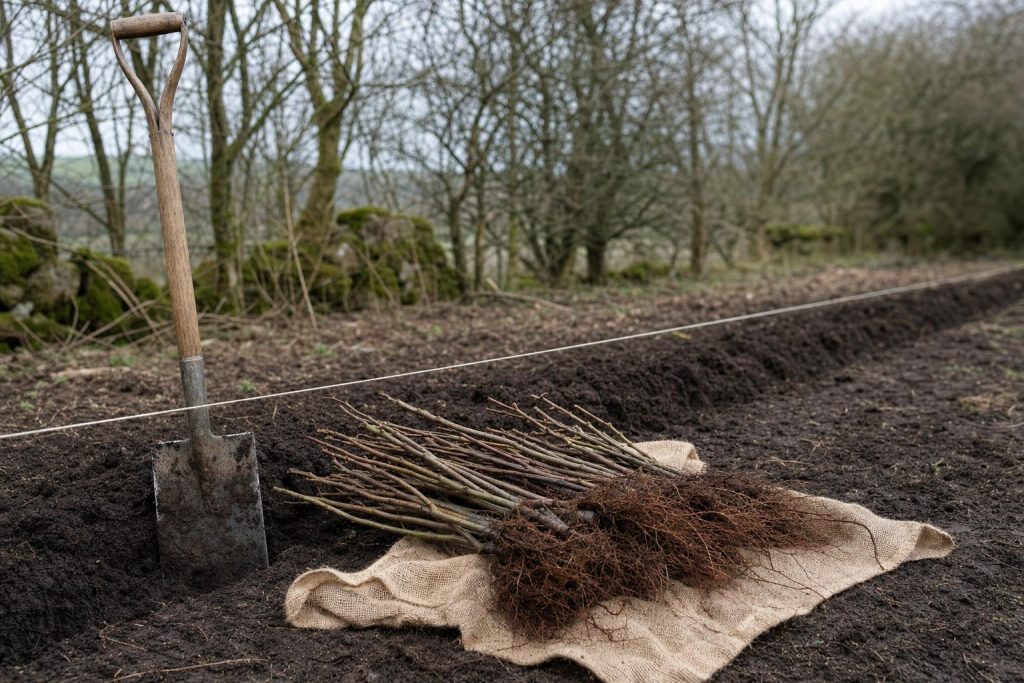
How to Plant a Bare-Root Hedge: A Step-by-Step Guide for Native Hedging
A native hedge planted well in its first winter will still be thickening and feeding wildlife fifty years from now. Planted badly, it ends up gappy, leggy and choked with grass by year three. The difference is rarely the plants. It is almost always the planting and the first two years of care. This guide covers how to plant a bare-root hedge properly, from the day the box arrives to the formative cuts that make a hedge dense at the base.
Bare-root plants are lifted from the nursery field while dormant, between November and March, and sent out without pots or soil. They cost less than pot-grown plants, establish quickly because their roots go straight into your soil, and suit the 40–60 cm whips used in most new native hedges. The trade-off is timing: bare-root hedging has to be planted in the dormant season, and the roots must never dry out.
If you are still choosing a mix, start with our guide to choosing a native hedge for your garden. If you know the length you need, our native hedging kits are sized for 5 m to 50 m runs.
When to plant a bare-root hedge
Plant any time from November to March, whenever the ground is not frozen or waterlogged. Late November and December are ideal. The soil still holds some warmth, so roots start to grow before spring and the plants are anchored by the time they come into leaf.
February and March planting works well too, but you lose a few weeks of root growth. Plants put in late may need watering through a dry April and May.
What to do if you can’t plant straight away
Open the box the day it arrives. Check the roots are damp, and report any problems to us immediately. If you can’t plant within two or three days:
- keep the bundles in their bags somewhere cool, frost-free and out of the wind, such as a shed or garage
- for longer delays, “heel in” the plants: dig a trench, lay the bundles in at an angle, cover the roots with soil and firm it down
Heeled-in plants will sit happily for several weeks. Never leave bare roots exposed to wind or sun, even for half an hour. Fine feeder roots die quickly once they dry.
Preparing the ground for native hedging
A new hedge’s biggest competitor is grass. Turf around young whips takes the water and nutrients they need in their first spring, so clear a strip about 1 m wide along the hedge line. Skim off turf, dig it in upside down, or cover the strip with cardboard or a mulch mat for a few weeks before planting.
Don’t add compost, manure or fertiliser. Native hedging species grow well in ordinary soil, and extra fertility mainly feeds weeds and the grass you have just cleared. It also works against the wildflowers you may want to sow along the hedge base later. The one exception is very poor, compacted ground: loosen it with a fork to a spade’s depth so roots can move through it.
On heavy clay, plant along a slight ridge rather than in a trench, so water doesn’t sit around the roots in winter.
How to plant a bare-root hedge, step by step
Most garden and boundary hedges are planted as a double staggered row, which gives a dense hedge far sooner than a single line. Spacing is covered in detail in how many hedge plants per metre, but the standard is 5 plants per metre.
- Mark two parallel lines 40 cm apart along the hedge line.
- Set out the plants 40 cm apart along each line, staggering the second row so each plant sits opposite a gap in the first. That gives 5 plants per metre.
- Mix the species as you go rather than planting in blocks, so every metre of hedge has a spread of species. In a hawthorn-based mix, about every other plant will be hawthorn.
- Dig a slot or pit wide enough to spread the roots without bending them. A spade slot opened with a back-and-forth rock works for whips; use a small pit for larger roots.
- Plant at the same depth the plant grew in the nursery, shown by the soil mark on the stem. Don’t bury the stem deeper.
- Backfill, then firm the soil around each plant with your heel, so there are no air pockets and the plant doesn’t move when tugged.
- Water once to settle the soil, even in winter.
Protection from rabbits and deer
Where rabbits or hares are about, guard every plant. Spiral guards held up by a bamboo cane are the standard for 40–60 cm hedging. Our Hedge Protection Pack covers 25 plants. Deer need taller guards or fencing. Where a hedge borders grazing, fence it on the stock side, set back about a metre, until it is established. Our Paddock Edge Hedge mix is chosen for edges around horses and donkeys.
The formative cut: the step most people skip
A young hedge left to grow straight up becomes tall and thin at the base. To make it bush out from low down, cut it back in its first spring, just before the buds break, usually in March.
- Hawthorn, blackthorn and hazel: cut back by about a third, or harder if they are leggy. They respond with dense new shoots from low on the stem.
- Beech and hornbeam: trim lightly, removing only the tips of side shoots. They thicken more slowly and dislike hard cutting when young.
- Holly: leave alone in the first year.
It feels wrong to cut back plants you have just paid for, but this is what makes the difference between a hedge and a row of sticks. Repeat a lighter trim the following winter.
Aftercare: the first three years of a native hedge
Weeding and mulching
Keep the 1 m strip clear of grass and vigorous weeds for the first three growing seasons. Hand weeding in May and July is usually enough. A mulch of bark, wood chip or a biodegradable mulch mat cuts the work and holds moisture through dry spells.
Watering
Hedges planted in early winter rarely need watering, but a dry spring can stress new plants. If there has been little rain for two or three weeks between April and June, give each plant a good soak once a week rather than a little often.
Gapping up
Expect a few losses, even with good planting. Note any gaps in summer and replace them with matching species the next winter, before the hedge closes over them.
Trimming once established
From year three, trim the hedge in late winter, January or February, so the berries have fed birds through autumn and the hedge is cut before nesting starts. Avoid cutting between March and August, when birds may be nesting. For the most wildlife value, cut on a two- or three-year rotation rather than every year, and let the hedge grow a little taller and wider each time.
Common mistakes when planting a hedge
- Letting roots dry out. It’s the most common cause of losses. Keep roots covered from box to hole.
- Planting too deep or in a waterlogged trench. Match the nursery soil mark and keep water away from the roots on clay.
- Leaving the grass. A hedge planted into turf can lose a year or two of growth.
- Feeding the hedge. Fertiliser benefits weeds more than native hedging.
- Skipping the first cut. The base stays thin for years.
- Planting one species in blocks. Mix species evenly so the whole hedge has the same diversity.
A hedge kit with the planning done
Our native hedging kits are built to follow this guide. Each one contains 40–60 cm bare-root plants for a double staggered row at 5 plants per metre, mixed to a set species recipe, plus seed of our Hedgerow & Banks wildflower mix for the strip along the hedge base, and a printed planting and aftercare guide. Choose the Wildlife Garden Hedge for an all-round wildlife boundary, the Thornless Family Hedge beside paths and play areas, the Bee & Bird Hedge for pollinators, the Privacy & Shelter Hedge for winter screening, or the Paddock Edge Hedge for grazing land.
Kits come in 5 m, 10 m, 25 m and 50 m lengths, with delivery included and dispatch from November to March.
Plan your hedge with us
If you’re unsure which mix suits your site, or you have a longer boundary, a slope or a mixed site to plan, send us a few details through our advice page. Tell us the length, the soil and what the hedge needs to do: screen, keep stock in, or bring in wildlife. We’ll suggest a mix and quantities, and for larger projects we can put together a bespoke quote. When you’re ready, browse the full Trees & Hedging range.
Frequently Asked Questions
When is the best time to plant a bare-root hedge?
Plant between November and March, while the plants are dormant, on any day the ground isn't frozen or waterlogged. Late November and December are best because the soil is still slightly warm, so roots establish before spring. Hedges planted in February or March grow well too but may need watering through a dry spring.
How do you plant a bare-root hedge in a double row?
Mark two lines 40 cm apart and set plants 40 cm apart along each, staggered so each plant faces a gap in the other row. That gives 5 plants per metre. Plant at the nursery soil mark, firm in well with your heel, and water once to settle the soil.
How long can bare-root hedging stay in the bag before planting?
Kept in their sealed bags somewhere cool, sheltered and frost-free, bare-root plants will usually keep for a few days. For anything longer, heel them into a trench in the garden with the roots covered and firmed in. They will then keep for several weeks until conditions allow planting.
Should I cut back a new hedge after planting?
Yes, for most species. In the first March, cut hawthorn, blackthorn and hazel back by about a third to make them bush out from the base. Trim beech and hornbeam only lightly, and leave holly alone. This formative cut is what gives a dense hedge rather than a row of tall, thin stems.
Do I need to water a newly planted bare-root hedge?
Water once at planting to settle the soil. After that, winter-planted hedges rarely need watering until spring. If April to June brings two or three dry weeks, give each plant a thorough soak once a week. Deep, occasional watering encourages deeper roots than little and often.
Do I need tree guards on a new hedge?
Use spiral guards and canes wherever rabbits or hares are present, as they can strip young whips in a single night. Deer need taller guards or fencing. In a fully enclosed garden with no rabbits, you can usually do without guards. Remove guards after two or three years, once stems are woody.
Can I plant a bare-root hedge in clay soil?
Yes. Most native hedging species, including hawthorn, field maple, hazel and hornbeam, grow well on clay. Avoid planting in a dug trench where water collects. Plant on a slight ridge instead, loosen compacted ground with a fork, and don't add compost, which holds even more water around the roots.
Ready to get started?
Shop: Native Hedging Kits →