

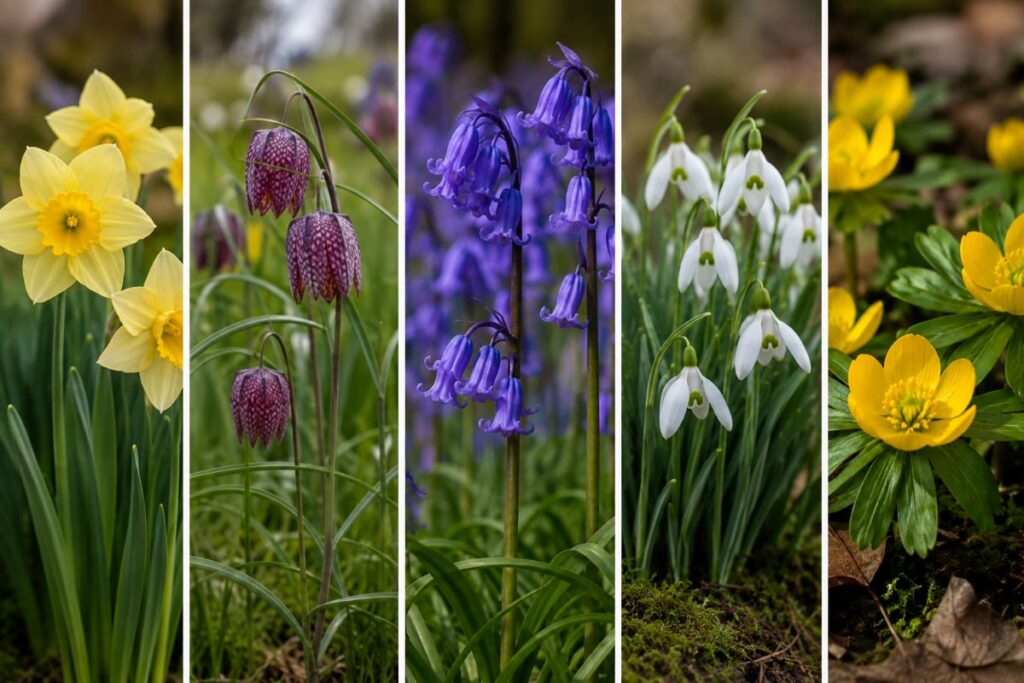
Growing Native Bulbs from Seed: Bluebell, Wild Daffodil and Wild Garlic
Native bulbs such as bluebell, wild daffodil and wild garlic can all be grown from seed. Sow the seed in late summer or autumn, as soon as it arrives, onto bare, moist soil in dappled shade at about 1g per m². It germinates over winter or the following spring, then spends several years building a bulb before it flowers: around two to three years for wild garlic, four to six for bluebell and five to seven for wild daffodil. Seed costs a fraction of bulbs per plant and is the practical way to establish woodland flora across large areas.
This guide explains when bulb seed is the right choice, how it germinates, how to sow it, and what the ground should look like year by year. It is written for landowners, woodland and tree-planting projects, estates, community groups and gardeners with room to wait.
At a glance
- When to sow: late summer to late autumn, straight away. Do not store bulb seed over winter.
- Where: dappled shade, moist humus-rich soil, bare ground with leaf litter left in place.
- Sowing rate: 1g per m² as standard; up to 2g per m² for faster, denser cover.
- Time to flower: wild garlic 2-3 years, bluebell 4-6 years, wild daffodil 5-7 years.
- Do not: fertilise, bury the seed deeply, or mow between February and the end of June.
Why grow native bulbs from seed?
In the wild, woodland bulbs spread almost entirely by seed. Bluebell colonies creep outwards a short distance each year as seed drops around the parent plants, and wild garlic carpets thicken the same way. Sowing seed simply does the same job deliberately, and at a scale bulbs rarely allow.
Cost per plant
A gram of bluebell seed holds around 200 seeds. Even allowing for the fact that not every seed becomes a flowering plant, the cost per plant is a small fraction of buying bulbs. On a woodland creation scheme, a long hedgebank or the floor of a new orchard, that difference decides whether you can plant the whole site or only the bit by the gate.
Genetic diversity
Every seedling is genetically different. A population raised from seed has the variation it needs to cope with different soils, wetter and drier years and pests and diseases. Bulbs, by contrast, are often divisions of a limited stock. For conservation and habitat creation work, that diversity is a real advantage.
Provenance and the law
Native bluebell is listed on Schedule 8 of the Wildlife and Countryside Act 1981, which makes it an offence to sell bluebell plants, bulbs or seed taken from the wild. Buying seed from cultivated UK stock is the responsible route, and it avoids the risk of introducing Spanish or hybrid bluebells, which can cross with native colonies and dilute them. Our native bulb seed is supplied from cultivated UK stock of the native species.
Seed or bulbs: which should you choose?
Neither is better in every situation. The right choice depends on how big the area is, how soon you need flowers and who will see them.
| Bulb seed | Dry bulbs (autumn) | Bulbs in the green (spring) | |
|---|---|---|---|
| First flowers | 2-7 years depending on species | Usually the next spring | Usually the next spring, sometimes after a settling year |
| Cost per plant | Lowest | Higher | Higher |
| Area it suits | Large: woodland, tree planting, estates, long banks | Small to medium, high-profile spots | Small to medium, high-profile spots |
| Genetic diversity | High | Lower | Lower |
| Planting season | Late summer to late autumn | September to November | Late winter to spring |
On most larger projects the best answer is both: dry bulbs or bulbs in the green along paths, entrances and viewpoints for an early show, and seed everywhere else for scale. By the time the seed-raised plants flower, the bulbs will be seeding into the surrounding ground too.
How bulb seed germinates (and why autumn matters)
Bluebell, wild daffodil and wild garlic are woodland plants that grow, flower and set seed in spring before the tree canopy closes, then disappear underground for summer. Their seed is shed in early summer and is built to wait for the right moment.
Bluebell and wild daffodil seeds are shed with an embryo that is not fully grown. The embryo develops inside the seed through the warmth of late summer, and the seed germinates as temperatures cool in autumn and winter. Wild daffodil seed in particular becomes more dormant if it dries out or is stored, which is why prompt sowing matters. Wild garlic needs a spell of winter cold before it will germinate, and its seedlings appear the following spring.
The practical result is the same for all three: sow in late summer or autumn, as soon as you receive the seed, and let the seasons do the rest. Seed kept in a warm house over winter or sown in spring often sits dormant for a year or fails.
Species by species
Bluebell (Hyacinthoides non-scripta)
The backbone of the woodland floor. Bluebells need dappled shade and moist, humus-rich soil that does not dry out in spring, and suit broadleaved woodland, coppice, hedgebanks, orchards and shelterbelts. Seedlings make one thin, grass-like leaf a year and usually flower after four to six years. Around 200 seeds per gram. Native bluebell seed | Buying and planting bluebell bulbs
Wild daffodil (Narcissus pseudonarcissus)
The small, pale-petalled Lent lily of damp woods, riversides, old orchards and hay meadows, flowering in March and April. It tolerates more light than bluebell and naturalises well in grass that is not cut until the leaves have died back. It is the slowest to raise from seed, usually five to seven years to flower. All parts are poisonous. Wild daffodil seed
Wild garlic or ramsons (Allium ursinum)
The quickest to establish: seedlings appear the spring after sowing and most flower in their second or third year. It needs shade and soil that stays damp in spring, such as stream sides, wet woodland and shaded hollows, and can spread vigorously where it is happy. Wild garlic seed | Growing wild garlic from bulbs and seed
A mixed woodland layer
Our Woodland Bulb Seed Mix combines all three at 60% bluebell, 25% wild daffodil and 15% wild garlic by weight. Bluebell leads because it is the most shade-tolerant and forms the main carpet. Wild daffodil adds early colour on lighter edges and damper ground. Wild garlic is held back to 15% because it establishes fastest and could otherwise crowd the slower species on moist soils. Over time each species settles where conditions suit it best, which is how a natural woodland flora forms.
How to sow native bulb seed: step by step
- Choose the ground. Dappled or partial shade under deciduous trees, along a hedgebank or woodland edge, with soil that stays moist in spring. Avoid hot, dry, south-facing slopes and ground that waterlogs for long periods.
- Clear the competition. Remove bramble, nettle, dense grass and other coarse growth. On grassy ground, cut short and scarify hard to expose at least half bare soil. Leave fallen leaves and leaf litter in place.
- Do not feed the soil. No compost, manure, topsoil or fertiliser. Extra nutrients favour nettles, docks and coarse grasses that smother young bulbs.
- Bulk the seed. Mix it with dry sand (roughly four parts sand to one part seed) so you can see where you have sown and spread it evenly.
- Sow on the surface. Scatter at 1g per m², or up to 2g per m² where you want faster cover. Walk the area in two directions for an even spread.
- Press it in. Tread, roll or firm the seed into the surface, or scatter a thin layer of leaf mould over it. Do not rake it in deeply or bury it.
- Mark the area. Seedlings look like grass. A simple map or a few marker posts stop them being weeded or strimmed by mistake.
If you have a small amount of seed or a site with heavy weed pressure, you can also sow into deep pots or trays of low-nutrient compost left outdoors or in a cold frame, then plant the young bulbs out after two growing seasons.
What to expect, year by year
- First winter and spring: wild garlic seedlings appear in spring. Bluebell and daffodil seedlings emerge from late winter as single, thread-like leaves. Many people think nothing has come up; look closely.
- Years 2-3: leaves become a little broader each year. Wild garlic begins to flower. The bluebell and daffodil bulbs are still building underground.
- Years 4-6: the first bluebell flower spikes appear, often scattered at first.
- Years 5-7: wild daffodils begin to flower.
- Years 8-10 onwards: plants self-seed and bulbs divide, and patches join up into a continuous spring layer that maintains itself.
Germination is never 100% and will vary with the season, the site and how quickly the seed was sown. That is normal. Seed that does not germinate in the first year can still come through in the second.
Long-term management
Do this
- Keep bramble, bracken and coarse weeds in check, especially in the first three years.
- Let flowers set seed and leaves die back naturally; the leaves feed next year’s bulb.
- If the area is grass, make the first cut in July or later and remove the cuttings.
- On woodland sites, light coppicing or thinning that lets dappled light reach the floor helps bulbs flower well.
Avoid this
- Mowing, strimming or grazing hard between February and late June.
- Fertilising, mulching with rich compost or dumping grass clippings on the area.
- Planting Spanish or hybrid bluebells anywhere nearby.
- Picking wild garlic leaves before the patch has had two or three years to establish, and sowing wild daffodil where people forage wild garlic.
Where bulb seed fits in larger projects
Bulb seed is particularly useful on new woodland and tree-planting schemes, where it can be sown between the young trees so the ground flora establishes as the canopy develops. It also suits hedgerow restoration and hedgebank creation, orchard floors, riparian buffers along streams, estate woodlands, and community woodland or school projects where a long timescale is part of the story. On sites where grass is strong, pairing it with yellow rattle in woodland creation helps open the sward in the early years.
For planting dates across the whole range, see our native bulb planting calendar, and for bulbs themselves, how to plant wildflower bulbs.
Need help with quantities?
If you are planning a larger area, tell us the size of the site, the soil and how much shade it gets, and we will suggest the right species, quantities and mix of seed and bulbs. Email hello@wildahome.co.uk or call 0333 242 0602. You can browse the full native bulb seed range here.
Frequently Asked Questions
Can you grow bluebells from seed?
Yes. Sow native bluebell seed in late summer or autumn onto bare, moist soil in dappled shade at about 1g per m². It germinates over winter and usually flowers after four to six years, then spreads by self-seeding.
How long do native bulbs take to flower from seed?
Wild garlic usually flowers in two to three years, bluebell in four to six years and wild daffodil in five to seven years. A full, self-sustaining carpet takes eight to ten years or more.
When is the best time to sow bulb seed?
Late summer to late autumn, as soon as the seed arrives. Bluebell, wild daffodil and wild garlic seed all rely on autumn and winter conditions to germinate, so storing seed over winter or sowing in spring reduces germination.
Is it cheaper to grow bluebells from seed or bulbs?
Seed is far cheaper per plant: a gram of bluebell seed holds around 200 seeds. Bulbs cost more but flower the next spring, so they suit small or high-profile areas, while seed suits large sites where you can wait.
How deep should I sow bluebell and wild garlic seed?
On the surface. Scatter the seed, then press it in by treading or rolling, or cover with a thin layer of leaf mould. Wild garlic can be covered by up to 1-2cm. Burying seed deeply reduces germination.
Why has my bulb seed not come up?
It probably has. Bluebell and daffodil seedlings are single, thread-like leaves that look like grass and are easily missed or weeded out. Some seed also waits until its second spring, especially if it was sown late or stored before sowing.
Is it legal to buy bluebell seed?
Yes, from cultivated stock. Native bluebell is on Schedule 8 of the Wildlife and Countryside Act 1981, which bans selling bluebell plants, bulbs or seed collected from the wild. Buy from suppliers whose seed comes from cultivated UK stock of the native species.
Ready to get started?
Shop: Traditional Wildflower Meadow Mix →