

Wildflower Seeds for Suffolk: Native Mixes for East Anglia’s Most Varied County
Wildflower Seeds for Suffolk: Native Mixes for East Anglia’s Most Varied County
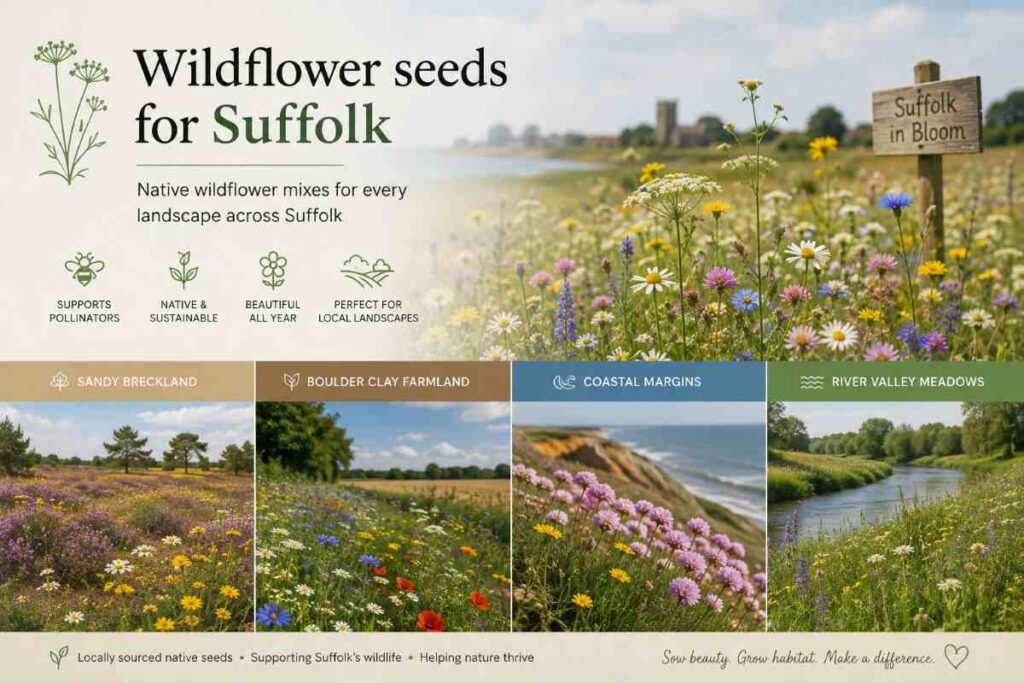
Suffolk is drier than almost any other English county — the driest, in fact, in many years. That low rainfall and the county’s varied geology produce a range of soil types and wildflower habitats that surprises many people unfamiliar with the region. The sandy Breckland straddling the Norfolk border is one of the most ecologically distinctive landscapes in lowland England. The boulder clay farmland of central and south Suffolk — the High Suffolk plateau — is ancient arable country with a rich history of hedgerow and meadow flora. The river valleys of the Stour, Orwell, Deben, Waveney, and Little Ouse carry alluvial meadow habitats. And the coastal margins include shingle, saltmarsh, and the acid grassland of the Sandlings.
For anyone looking for wildflower seeds in Suffolk, the county’s low rainfall is an important practical consideration. Germination and establishment can be slower in dry years, particularly on the free-draining Breckland sands. Autumn sowing is even more important here than in wetter counties — it catches the autumn and winter moisture before the dry spring arrives. The right mix and the right preparation remain the deciding factors, but in Suffolk timing matters more than almost anywhere else in England.
Suffolk’s soils and habitats: from Breck to boulder clay
The Breckland — straddling the Suffolk-Norfolk border around Thetford, Mildenhall, and Brandon — sits on glacial sands and gravels overlying chalk. The resulting soils are light, free-draining, and naturally low in nutrients. This combination of low fertility and chalk-influenced subsoil produces a unique ecosystem: open sandy grassland with species including Field Wormwood (Artemisia campestris), Breckland Speedwell (Veronica praecox), Spanish Catchfly (Silene otites), and the rare Breckland Thyme (Thymus serpyllum). For restoration work on Breckland margins and sandy heaths, a combination of acidic soils and traditional meadow species in low-rate mixes is appropriate.
The boulder clay plateau of High Suffolk — the broad agricultural heartland between Bury St Edmunds, Sudbury, Eye, and Halesworth — carries heavy, moderately fertile clay soils. Where old meadows survive in valley bottoms and on awkward field corners, they carry Knapweed (Centaurea nigra), Meadow Cranesbill (Geranium pratense), Oxlip (Primula elatior) in the east, and a strong contingent of umbellifers. Establishing wildflowers on clay requires thorough fertility reduction first.
The river valleys of the Stour, Waveney, Deben, and Orwell carry a range of alluvial habitats from well-drained terrace grassland to seasonally flooded wet meadow. These riverside sites are among the most productive for wildflower seed establishment in Suffolk, combining reasonable moisture with more moderate fertility than the clay plateau above.
The Suffolk Sandlings — the strip of acid sandy heathland running from Lowestoft south to Ipswich — sits on Crag sands and Kesgrave gravels, producing very acidic, nutrient-poor soils. The surviving Sandlings heath carries Heather (Calluna vulgaris), Bell Heather (Erica cinerea), and Gorse (Ulex europaeus). On intact sites, management is the priority; on degraded Sandlings margins, an acidic soils mix supports restoration.
Choosing the right wildflower seeds for Suffolk
Traditional Meadow Mix — the core choice for Suffolk’s boulder clay farmland, the river valley terraces, and any moderately fertile, reasonably well-drained site across the county. Knapweed, Ox-eye Daisy (Leucanthemum vulgare), Meadow Cranesbill, Yellow Rattle (Rhinanthus minor), Bird’s-foot Trefoil (Lotus corniculatus), Wild Carrot (Daucus carota), and Musk Mallow (Malva moschata) are all characteristic of the Suffolk meadow flora. Yellow Rattle is essential on any site with established grass.
Acidic Soils Mix — for the Sandlings heath, the Breckland sandy margins, and any Suffolk site with a pH below 5.5 and light, free-draining, nutrient-poor soil. Heath Bedstraw (Galium saxatile), Tormentil (Potentilla erecta), Harebell (Campanula rotundifolia), and Devil’s Bit Scabious (Succisa pratensis) are appropriate. On the Sandlings, the Acidic Soils mix at low sowing rates into lightly scarified sand supports heathland grassland restoration alongside management of the woody heathland community.
Wetland and Pond Mix — for Suffolk’s river valley wet meadows, pond margins, and any site with seasonally waterlogged ground. The Stour, Waveney, and Deben valleys are the primary target areas. Ragged Robin (Lychnis flos-cuculi), Yellow Flag Iris (Iris pseudacorus), Meadowsweet (Filipendula ulmaria), Purple Loosestrife (Lythrum salicaria), and Great Willowherb (Epilobium hirsutum) suit the Suffolk river valley conditions. Sow in Autumn into exposed wet or moist soil.
Hedgerow and Banks Mix — for Suffolk’s ancient hedgerow network, particularly on the clay plateau where hollow lanes and wide hedgerow bases carry a rich native flora. Red Campion (Silene dioica), Foxglove (Digitalis purpurea), Herb Robert (Geranium robertianum), Primrose (Primula vulgaris), and Greater Stitchwort (Stellaria holostea) are characteristic Suffolk hedgerow species. Sow into loosened bank material in Autumn.
Sowing wildflower seeds in Suffolk: timing and ground preparation
Suffolk’s low annual rainfall — typically 550 to 650mm — makes Autumn sowing more important here than in almost any other English county. Sow in late August to October to catch the autumn moisture before the characteristically dry Suffolk spring. Spring sowing (March to May) is a viable option but carries more risk in dry years, particularly on the free-draining Breckland and Sandlings soils.
Yellow Rattle must be sown in September on all sites with existing grass. On Suffolk’s heavy clay plateau, it is the most important single component of any meadow mix — without it, the competitive grass sward will reassert itself within two to three seasons. On the lighter Breckland and Sandlings soils, natural low fertility reduces grass competition, but Yellow Rattle remains a valuable inclusion.
Ground preparation on the boulder clay soils of High Suffolk requires real effort. Topsoil stripping or prolonged low-input management is the most reliable route to reducing fertility. On the lighter valley soils and Breckland sands, scarification to expose 50 to 70 percent bare soil is usually sufficient. On the Sandlings, very low sowing rates (1g per m2 or less) into lightly disturbed sand are more appropriate than the heavier rates used on clay or loam.
Managing Suffolk wildflower habitats for the long term
The standard meadow management rule applies across Suffolk: cut once in late Summer (August to September), remove all cuttings, and do not fertilise. On the fertile boulder clay, aftermath grazing by cattle in Autumn is valuable for keeping grass competition in check. On the lighter valley and Breckland soils, the cut-and-remove regime alone is usually sufficient.
On the Sandlings and Breckland margins, heathland management — rotational cutting or mowing of heather, scrub control, and creation of bare sandy patches — is the primary tool. Wildflower seed introduction supplements management rather than replaces it. Rabbit grazing, historically important for maintaining open Breckland grassland, is a natural management tool on sites where populations remain.
Establishment in Suffolk typically takes two to three years. On the light, low-fertility Breckland and Sandlings soils, year two can show strong results. On the heavy boulder clay, year three is more realistic. Suffolk’s dry summers can stress young wildflower plants in establishment years — summer browning on lighter soils is normal; the perennials survive underground and recover when autumn rain returns.
Locally sourced wildflower seeds for Suffolk
Wildahome sources seed from UK meadows and partner farms, with provenance matched to regional habitats wherever possible. For Suffolk projects, the Traditional Meadow, Acidic Soils, Wetland and Pond, and Hedgerow and Banks mixes all contain species appropriate to the county’s range of habitats. Suffolk’s dry climate and varied geology mean a brief conversation before ordering is often worthwhile — contact us to discuss your site.
From the unique flora of the Breckland to the river valley meadows of the Stour and Waveney, Suffolk holds wildflower communities found nowhere else in England. Browse our seed mixes or get in touch to discuss what you’re working with.
Ready to get started?
Shop: Traditional Wildflower Meadow Mix →Frequently asked questions
When's the best time to sow a wildflower mix?
Late summer to early autumn (August to September) is the best sowing window for most of the UK -- seed goes into warm, moist soil ahead of winter and gets the cold, damp period many native wildflower seeds need to break dormancy. A second window opens in spring (March to April) once the ground has warmed, though autumn sowing usually establishes faster with fewer weed problems.
Why does local seed provenance matter?
Seed grown from populations adapted to similar soil, rainfall and temperature conditions germinates more reliably and settles into a stronger, longer-lived meadow than seed sourced from a very different climate. That's why we match seed to comparable growing conditions rather than supplying one generic UK-wide mix.
Do I need to prepare the ground before sowing?
Yes, and it's the single biggest factor in whether a meadow succeeds. Existing vegetation and topsoil fertility need to be reduced, since most UK soils are too nutrient-rich for wildflowers and favour competitive grasses and weeds instead. In practice that usually means clearing down to bare soil, raking to a fine tilth, and sometimes sowing yellow rattle alongside the mix to suppress grass vigour.
How long before it looks like a proper meadow?
Most sites show flowers in year one, but a settled, species-rich meadow typically takes two to three growing seasons to establish as slower perennials build up and the balance between grasses and wildflowers matures. Very fertile ground can take longer, since excess nutrients need to be drawn down through repeated cutting and removal of cuttings.
What ongoing management does a wildflower meadow need?
An annual cut in late summer, after flowering and seed-set, with the cuttings removed rather than left to rot down, is the core of long-term management. This keeps fertility low and stops coarse grasses and scrub taking over. Spring topping and occasional scarification help in the early years, and light grazing can replace cutting on some sites.
More county guides
Find the right native wildflower mix for your county, or browse our full list by region.