

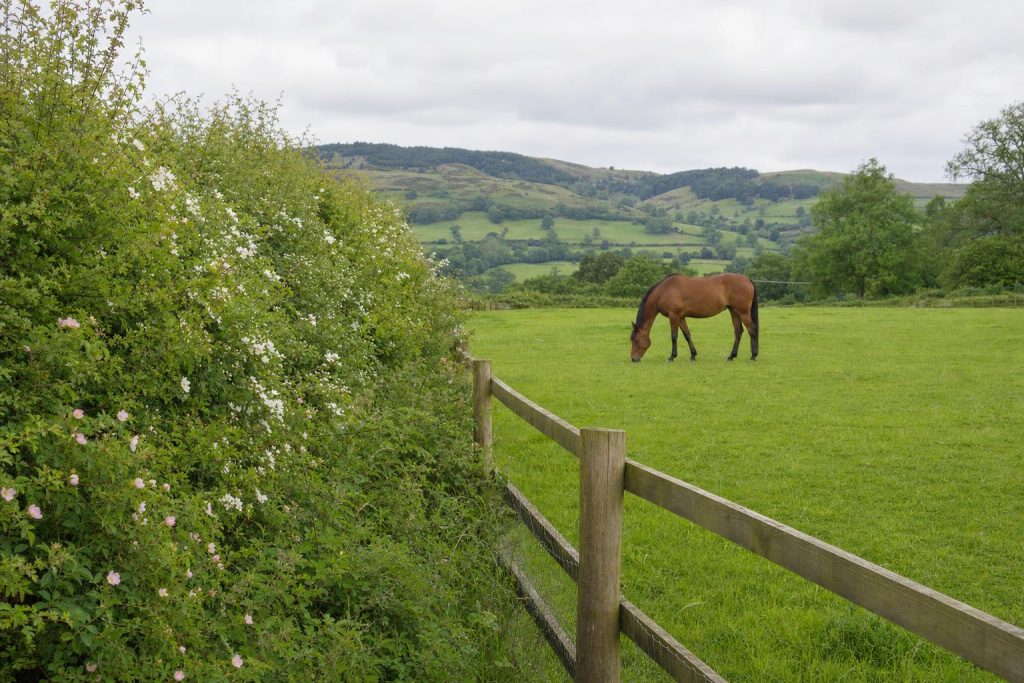
Which Hedge Plants Are Safe for Horses? A Paddock Hedging Guide
A good hedge is one of the best things you can give a horse paddock. It breaks the wind, gives shade in summer, offers a little natural browse and is a living, stock-resistant boundary. But horses will eat almost anything within reach, especially in a bare winter field, and some common hedging plants are seriously poisonous. Choosing hedge plants safe for horses is the first decision, not an afterthought.
The good news is that the backbone of a traditional British hedge, hawthorn, is one of the safest and most useful plants you can put around horses. Add hazel, field maple, hornbeam, dogwood and dog rose and you have a dense, mixed native hedge that horses can browse without harm, and that feeds and shelters wildlife too.
This guide sets out which native hedge plants are safe for horses and donkeys, which ones to keep well away from grazing, and which sit in a grey area. It also covers the poisonous plants that often appear at the foot of a hedge, and how to plant, fence and manage a paddock hedge so it stays safe for years.
It is written for horse and donkey owners, smallholders and anyone managing grazing land. If in doubt about a particular plant or a horse showing signs of illness, always speak to your vet.
Why plant a hedge around a horse paddock?
Post-and-rail fencing marks a boundary, but it does nothing for shelter. A mature hedge filters the wind rather than blocking it, which gives a calmer, wider sheltered zone on its lee side than a solid wall. In summer, it gives shade and some relief from flies.
A mixed native hedge also adds variety to a horse’s diet. Horses and donkeys browse hedgerow shoots, leaves and twigs naturally, and many owners notice their animals seek out particular species, especially hazel, hawthorn and dog rose.
Then there is wildlife. A native paddock hedge provides nesting sites, blossom for pollinators and autumn fruit for birds, and links your land to the wider landscape. On a smallholding, it is often the single most valuable habitat you can create.
The key is to choose species that give all of that without putting your animals at risk.
Hedge plants safe for horses: the core species
These native species are widely planted around horses and donkeys and make an excellent paddock hedge between them.
Hawthorn (Crataegus monogyna)
Hawthorn is the classic stock hedge and should make up around half of a paddock mix. It is safe for horses, who happily browse the fresh shoots, and it grows into a dense, thorny barrier that animals respect. Its short thorns deter leaning and pushing without the long, brittle spines of blackthorn. It flowers in May and its haws feed birds through the winter.
Hazel (Corylus avellana)
Hazel is thornless, fast-growing and safe. It is often the first species horses go for, so expect it to be browsed hard where they can reach it. Its catkins give early pollen for bees in late winter.
Field maple (Acer campestre)
Field maple is our native hedge maple and grows well on clay and chalk. It is a different species from sycamore (Acer pseudoplatanus), the tree behind atypical myopathy. Research at Utrecht University and Wageningen tested hundreds of maple samples and found the toxin, hypoglycin A, in almost all sycamore samples but not in field maple or Norway maple. Some horse charities still advise caution with all maples, so if you would rather avoid any maple at all, ask for a swap.
Hornbeam (Carpinus betulus)
Hornbeam makes a dense, clipped hedge and copes with heavy clay and some shade better than beech. When trimmed as a hedge it holds dry brown leaves through winter, which adds valuable shelter in the cold months. It is widely used in horse-friendly hedging.
Dogwood (Cornus sanguinea)
Dogwood is thornless, thrives on clay and chalk, and gives creamy flowers, black berries and red winter stems. It is regularly included in horse-safe hedging mixes and owners report horses browsing it. It suckers, so it fills gaps at the base well.
Dog rose (Rosa canina)
Dog rose scrambles through the hedge, adding height, summer flowers and hips. Horses browse it, and rose hips are a traditional supplement for horses. Its hooked prickles are smaller and less hazardous than blackthorn spines.
Hedge plants that are poisonous to horses
The following plants should never be planted where horses or donkeys can reach them, including over a fence or from a neighbour’s garden.
| Plant | Risk to horses | Notes |
|---|---|---|
| Yew (Taxus baccata) | Extremely toxic; small amounts can be fatal quickly | Clippings and dead material stay poisonous. Often found in churchyards and old gardens. |
| Sycamore (Acer pseudoplatanus) | Seeds and seedlings cause atypical myopathy, often fatal | Risk peaks in autumn and spring. Seeds blow in from trees nearby. |
| Oak (Quercus) | Acorns and young leaves can cause poisoning | Collect acorns or fence off oaks in autumn. |
| Privet (Ligustrum) | Toxic leaves and berries | A common garden hedge, so check boundaries with gardens. |
| Box (Buxus) | Toxic | Common in formal gardens. |
| Laburnum | Highly toxic, especially seeds | Often a garden tree beside paddocks. |
| Spindle (Euonymus europaeus) | Toxic leaves, bark and fruit | A native hedgerow shrub sold in many wildlife hedge mixes, so check any mix before planting near grazing. |
| Horse chestnut (Aesculus hippocastanum) | Conkers and leaves can cause poisoning | Often planted as a field or parkland tree. Fence off or clear fallen conkers. |
| Cherry laurel and rhododendron | Toxic | Garden screening plants, not natives, but common on boundaries. |
Lists of plants poisonous to horses from the British Horse Society and Blue Cross are worth keeping to hand. If your paddock borders gardens, walk the boundary each year and look at what is growing on the other side.
Borderline species: plant with care
Some native hedge plants are not highly toxic but are best left out of a hedge horses can reach, or used with care.
Blackthorn (Prunus spinosa)
Blackthorn is listed as non-poisonous by the BHS, but its long, sharp spines can puncture skin and hooves and are prone to causing infected wounds. Many owners avoid it in paddock hedges for that reason. Like other plants in the cherry family, its wilting leaves also contain cyanogenic compounds.
Wild cherry (Prunus avium)
Wild cherry is a beautiful hedgerow tree, but its leaves become harmful as they wilt, for example on branches broken off in a storm or left after trimming. Keep it out of hedges around grazing animals.
Holly (Ilex aquifolium)
Holly leaves are low in toxicity and some horses browse young holly in winter, but the berries are harmful. It is slow-growing and prickly. It can be used in moderation in a paddock hedge, set back where horses can’t strip it.
Beech (Fagus sylvatica)
Beech is common in horse-friendly hedging and holds its leaves in winter when clipped. Large quantities of beech nuts can upset some animals, so a mixed hedge, trimmed regularly, is better than a long, untrimmed beech hedge dropping nuts into a bare paddock.
Watch the plants at the base of the hedge
Even a perfectly chosen hedge can have poisonous plants growing at its foot. A hedge bottom is just the kind of shady, undisturbed ground where these plants appear:
- Foxglove (Digitalis purpurea): highly toxic to horses, even dried in hay. Pull it from any paddock edge.
- Common ragwort (Jacobaea vulgaris): causes cumulative, irreversible liver damage and is most dangerous wilted or dried. Remove it from grazing and from land next to it.
- Buttercups: irritant when fresh. Horses usually avoid them unless grazing is short.
- White bryony and black bryony: climbers that scramble through hedges; toxic berries and roots.
- Deadly nightshade and woody nightshade: found along hedges and field edges; toxic.
- Hemlock and hemlock water-dropwort: extremely poisonous umbellifers of damp hedge bottoms, ditches and stream banks. Learn to recognise them and dig them out.
- Common St John’s-wort: can cause photosensitisation, with sunburn-like damage to pale skin.
This matters if you sow wildflowers along a new hedge. Many hedge-bank and woodland-edge seed mixes, including our own Hedgerow & Banks mix, contain foxglove, because it is a characteristic hedge-bottom flower. Only sow a hedge-bank mix on the side of a paddock hedge that animals cannot reach, and choose a horse-safe herb or grazing mix for strips inside the paddock. That is why our Paddock Edge kit comes with horse-safe forage seed rather than a hedge-bank mix. Our guide to what to plant under a hedge covers hedge bases away from grazing.
How to plant and fence a horse-safe hedge
A new hedge needs protecting from horses for its first few years, however safe its species are. Horses and donkeys will strip young whips in a single afternoon.
Planting
- Plant bare-root whips between November and March, when the ground is neither frozen nor waterlogged.
- Use a double staggered row: two rows 40cm apart, with plants 40cm apart in each row, giving 5 plants per metre. This gives a dense, stock-resistant base far sooner than a single row.
- Clear a 1m strip of grass and weeds and keep it weed-free for three summers.
- Make the formative cut in the first March, cutting hawthorn, hazel and most other species back by about a third so they branch from the base.
Our guide to how to plant a bare-root hedge covers each step, and how many hedge plants per metre covers spacing.
Choosing the line
Think about where the shelter is needed. In most of Britain the prevailing wind is from the south-west, so a hedge along the western or south-western side of a paddock gives the most useful lee. Avoid planting directly under existing trees, where young plants struggle for light and water, and keep the hedge line clear of gateways and field shelters so you can trim both faces once it matures.
Fencing
- Fence the hedge on the grazed side, set back about 1m from the hedge line, so horses can’t reach over to the young plants. Electric tape on offset posts is a cheap, flexible option.
- If both sides are grazed, fence both sides.
- Spiral guards protect against rabbits and hares but won’t stop horses or deer.
- The BHS advises that new hedges take years to become stock-proof, and should be backed by fencing so horses can’t find a gap and push through.
Donkeys
Donkeys are enthusiastic browsers and will strip bark as well as leaves. Give a hedge in a donkey paddock a wider fenced margin for longer, and accept that they will keep the paddock side well trimmed once the hedge is established.
Managing a paddock hedge long term
Once a paddock hedge is established, usually after three to five years, you can move the fence closer or remove it and let horses browse the hedge face. A few habits keep it safe:
- Trim in January or February. That avoids the bird nesting season, which runs from March to the end of August, and it is an offence to damage an active nest.
- Clear away clippings. Never leave hedge trimmings lying in a paddock, and never feed them. Wilting material from some species becomes more harmful than the living plant.
- Check after storms. Broken branches, especially from cherry-family trees or nearby oaks and sycamores, should be removed promptly.
- Walk the boundary in spring and autumn. Look for ragwort, foxglove, sycamore seedlings, acorns and bryony along the hedge base, and pull or fence them off.
- Check neighbouring land. Garden hedges of privet, yew, laurel or box beside a paddock are a real poisoning risk. A second fence line may be needed.
Managed this way, a native paddock hedge will shelter your horses and support wildlife for decades.
Product spotlight: the Paddock Edge Hedge Kit
Our Paddock Edge Hedge Kit is designed for exactly this job. It is a hawthorn-based mix of six native species: hawthorn (50%), hazel, field maple, hornbeam, dogwood and dog rose. It leaves out yew, privet, sycamore, oak, box and blackthorn, and if any species is short in a season, it is replaced only with another horse-safe native.
Each kit contains 40–60cm bare-root whips for a double staggered row at 5 plants per metre, in lengths from 5m to 50m, with horse-safe Grazing Garden seed for a strip along the hedge, a printed planting and aftercare guide and delivery included. Add the Hedge Protection Pack where rabbits are about.
For the grazing itself, our horse and donkey range includes the Steady Ley Horse & Donkey Grazing Mix, the Self-Select Herb Mix and the Grazing Garden Wildflower Mix, so the hedge and the paddock can be planned together.
Plan your paddock hedge with us
Every paddock is different: soil, shelter, how many animals and what grows over the boundary. Tell us the length of hedge you need, what animals graze alongside it and what your soil is like, through our advice page, and we’ll suggest a mix and quantities. When you are ready, browse the full Trees & Hedging range.
Frequently Asked Questions
Which hedge plants are safe for horses?
Hawthorn, hazel, field maple, hornbeam, dogwood and dog rose are widely planted around horses and donkeys and make a dense, mixed native hedge. Hawthorn should form around half the hedge, as it is safe to browse and stock-resistant. Avoid yew, privet, box, oak, sycamore and laburnum, and keep the hedge fenced until it is established.
What hedging is poisonous to horses?
Yew is the most dangerous, and even clippings can kill. Privet, box, laburnum, spindle, cherry laurel and rhododendron are also toxic, and sycamore seeds and seedlings cause atypical myopathy. Oak acorns and young leaves can poison horses in autumn and spring. Check garden hedges along your boundary as well as your own planting.
Is field maple safe for horses?
Field maple is a different species from sycamore, which causes atypical myopathy. Dutch research testing hundreds of maple samples found the toxin in sycamore but not in field maple or Norway maple. Some charities still advise caution with all maples, so if you prefer to avoid them entirely, choose a mix without any.
Is hawthorn safe for horses?
Yes. Hawthorn is safe for horses and is the traditional backbone of stock hedges. Horses browse its fresh shoots and leaves, and its dense, thorny growth makes a boundary they respect. Its short thorns are much less hazardous than the long spines of blackthorn.
Is blackthorn safe in a horse paddock hedge?
Blackthorn is not considered poisonous to horses, but its long, sharp spines can puncture skin and hooves and often lead to infected wounds. Many owners leave it out of paddock hedges for that reason. Hawthorn gives the same stock-proof structure with far less risk.
Do I need to fence a new hedge from horses?
Yes. Horses and donkeys will strip young whips quickly, even of safe species. Fence on the grazed side, set back about 1m from the hedge, for the first three to five years until the hedge is dense and established. If both sides are grazed, fence both.
Can horses eat hedge trimmings?
Don’t let them. Clear all hedge trimmings out of the paddock and never feed them. Wilting leaves from some species, especially cherry-family plants, become more harmful than the living plant, and yew clippings from a neighbour’s garden are a well-known cause of fatal poisoning.
Ready to get started?
Shop: Native Hedging Kits →