

Snake’s Head Fritillary: A UK Guide to Floodplain Meadows, Planting and Care
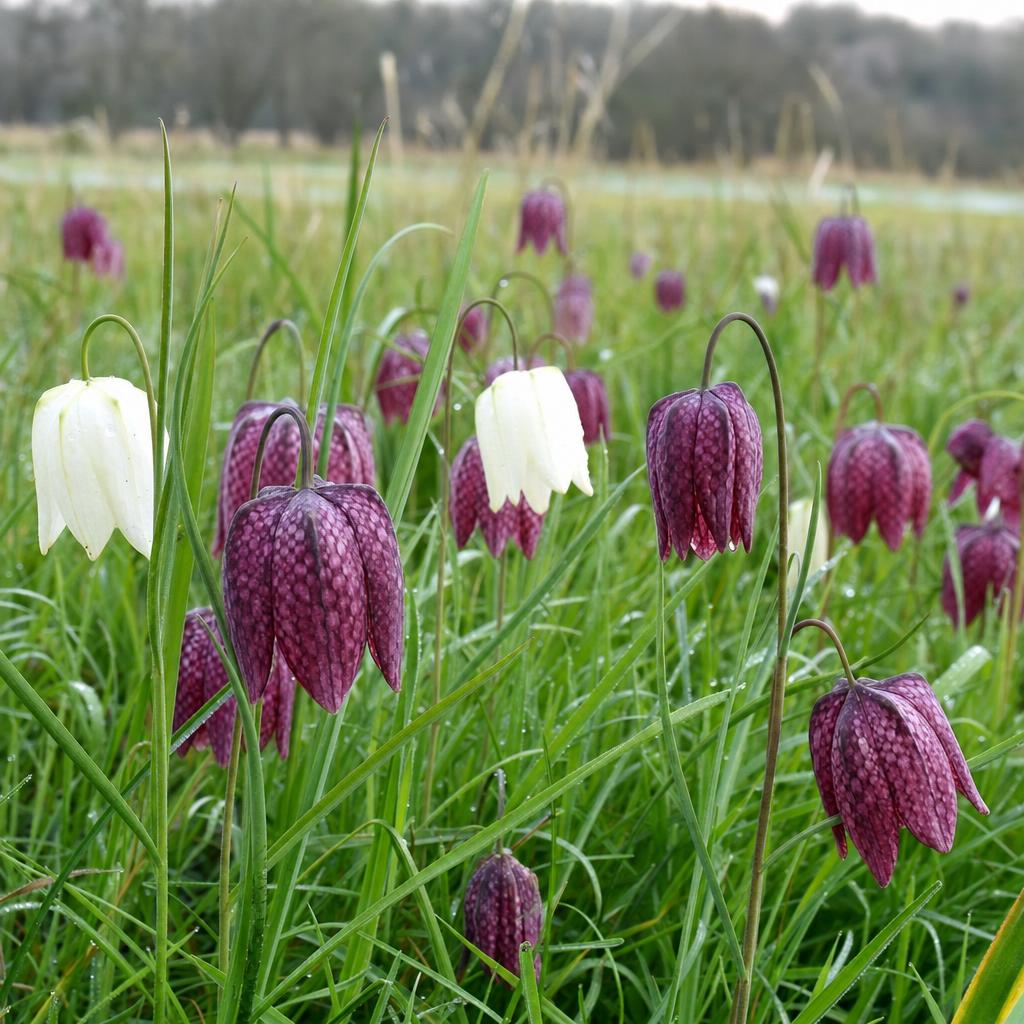
No British meadow flower looks quite like the snake’s head fritillary. In April and May its nodding bells, chequered in purple and pale pink or sometimes pure white, rise above the young grass of a few floodplain meadows in such numbers that people travel to see them.
It is also a plant that rewards understanding. The snake’s head fritillary (Fritillaria meleagris) survives in the wild only where meadows are managed in a very particular way: flooded or wet in winter, shut up in spring, cut for hay in July and grazed afterwards. Change any part of that and colonies fade. Bring the same rhythm into a damp garden meadow or orchard and fritillaries can thrive there too.
This guide covers how to identify snake’s head fritillary, the debate over whether it is native, where the great meadows survive, and how to plant and manage fritillaries so they persist for decades.
How to identify snake’s head fritillary
The snake’s head fritillary is a slender bulbous plant of the lily family, usually 20–30 cm tall and occasionally taller in long meadow grass.
- Flower: a single nodding bell (occasionally two) 3–4 cm long, made of six tepals marked with a crisp chequerboard of purple-brown and pale pink.
- White form: pure white flowers occur naturally in wild populations. At one Swedish meadow they averaged 3.7% of flowers; at Upper Waterhay in Wiltshire they dominate.
- Leaves: three to six narrow, grey-green leaves spaced up the stem, each 6–15 cm long and under 1 cm wide.
- Flowering: mainly April and May, sometimes late March in sheltered gardens. Peak flowering on a site lasts about two weeks.
- Seed: after flowering the stem straightens and carries an upright three-sided capsule.
Young plants are easy to miss. First-year seedlings produce one fine leaf like a blade of grass, and non-flowering plants a single strap leaf. Look closely before you mow.
Other fritillaries sold for gardens include fox’s grape fritillary (F. uva-vulpis), with plum-purple bells edged yellow and no chequering, and the much larger crown imperial. Neither belongs in a meadow planting.
Is snake’s head fritillary native to the UK?
For a long time it was treated as one of England’s great native wildflowers, an ancient survivor of Thames floodplain meadows. One theory saw it as a relic of a lost “Greater Rhineland” flora cut off when the North Sea flooded about 8,200 years ago.
In 2010 BSBI reclassified it as a neophyte, a plant introduced after 1500. A detailed review by Kevin Walker set out the reasons:
- It was grown in English gardens by 1597 but not recorded in the wild until 1737, in Middlesex. Early botanists would hardly have missed so striking a plant along the Thames.
- There is no fossil record and no mention in English literature, art or place names before the 18th century.
- Genetic work found British plants match northern European stock.
- Huge colonies can build up quickly from escapes. At Uppsala in Sweden, plants that escaped from the botanic garden around 1742 grew to hundreds of thousands within two centuries.
- Around 80% of known British sites are in parks, churchyards, verges and gardens rather than meadows.
The RHS also describes it as probably not a true native. Plantlife’s Red Data List for Wales classes it as alien in Wales, where records are scattered and mostly from gardens. There are no wild populations in Northern Ireland.
That status change does not reduce the value of the meadows it grows in. Those meadows are among the richest grasslands in Britain, and the fritillary has become their flagship.
The great fritillary meadows and their decline
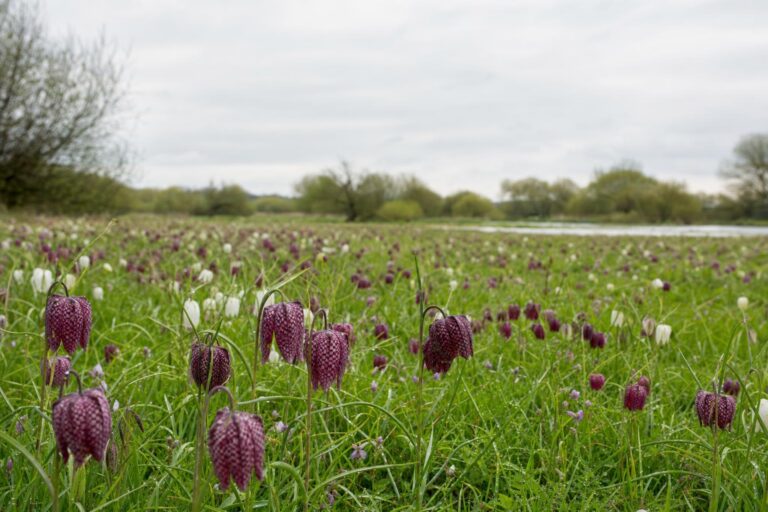
The surviving meadow colonies are concentrated in the upper Thames and its tributaries. Around 80% of Britain’s meadow population grows at one site: North Meadow National Nature Reserve at Cricklade, Wiltshire, with more than 500,000 plants and millions in peak years.
Other notable sites include Ducklington Mead (around 100,000 plants) and Iffley Meadows (30,000–70,000) in Oxfordshire, Clattinger Farm (around 35,000) and Upper Waterhay in Wiltshire, Magdalen College Meadow in Oxford, Lugg Meadow in Herefordshire, and Fox Fritillary Meadow in Suffolk. Oxfordshire chose it as its county flower in 2002.
The losses have been severe. Meadow records fell from 116 ten-kilometre squares in 27 counties before 1930 to 15 squares in nine counties by 1970. Of 53 meadows once holding putative native populations, only 23 survive, a loss of more than 56%. The causes are familiar: land drainage, ploughing, artificial fertiliser driving coarse grasses for silage, and changed cutting and grazing dates.
How floodplain meadows keep fritillaries alive
The fritillary is tied to a specific grassland, the burnet floodplain meadow (MG4), dominated by meadow foxtail and great burnet. Understanding that system is the key to growing fritillaries anywhere.
Water: wet in winter, dry in summer
The Floodplain Meadows Partnership finds fritillaries do best with 10–20 weeks of wet soil a year in winter and spring, then more than 20 weeks of well-drained soil through summer. They cope with summer drought but not with summer waterlogging. Winter floods also deposit silt that tops up nutrients removed in the hay.
Fertility: moderate and kept that way
Fritillary meadows have moderate fertility, around 10–25 mg of phosphorus per kg of soil (phosphorus index 1–2). Fertiliser tips the balance towards competitive grasses, and the fritillaries are shaded out.
Long lives and long sleeps
Plants live at least 25 years. From seed, they take 5–7 years to flower. And most surprisingly, they regularly go dormant: 30% to 99% of a population can stay below ground for more than a year, commonly one to three years and up to seven. Cold springs and wet summers trigger it. After the very wet summer of 2012, North Meadow saw far fewer plants in 2013.
So if your fritillaries skip a year, do not assume they have died.
Seed that travels by water
Seeds float on floodwater for up to a month and germinate within a year. There is no long-lived seed bank, so steady seeding each summer matters.
Wildlife value of fritillary meadows
Fritillaries flower in April and May when few other meadow plants are in bloom. Their bells hold nectar rich in sucrose, glucose and fructose, and accessible pollen. Queen bumblebees, including buff-tailed and red-tailed bumblebees, are the main pollinators, with solitary bees, hoverflies and butterflies also visiting. Small populations depend on these scarce early bees for cross-pollination, which is one more reason fragmented colonies struggle.
The meadows themselves support rich insect life and birds such as curlew, skylark and yellowhammer. Grazing animals generally avoid the fritillary itself because of its bitter alkaloids. See our guide to wildflowers for pollinators for plants that carry the season on.
Managing a fritillary meadow
Good management copies the traditional hay meadow calendar:
- Winter: allow natural wetness or flooding where it occurs.
- Spring: shut the field up. No grazing from emergence until after flowering and seeding.
- Late June to July: take a hay cut once the leaves have yellowed and the capsules have split. In very wet years this can slip into early August.
- Late summer and autumn: aftermath grazing, ideally with cattle, to keep coarse grasses and meadowsweet in check and open small gaps for seedlings.
Long-term Oxford experiments found cattle aftermath grazing produced more botanical diversity than sheep or no grazing. Avoid silage cuts in May and June, fertiliser, heavy machinery that compacts the soil, and drainage that ends winter wetness.
For restoring species-poor floodplain grassland, Wiltshire Wildlife Trust trials showed green hay spread from a species-rich donor meadow in July, followed by annual hay cutting and aftermath grazing, is effective. A loam and alluvial meadow mix suits river floodplain soils, and our guide to wildflowers for loam and alluvial soils explains how to build the sward around bulbs. Add yellow rattle to weaken vigorous grasses.
How to plant snake’s head fritillary
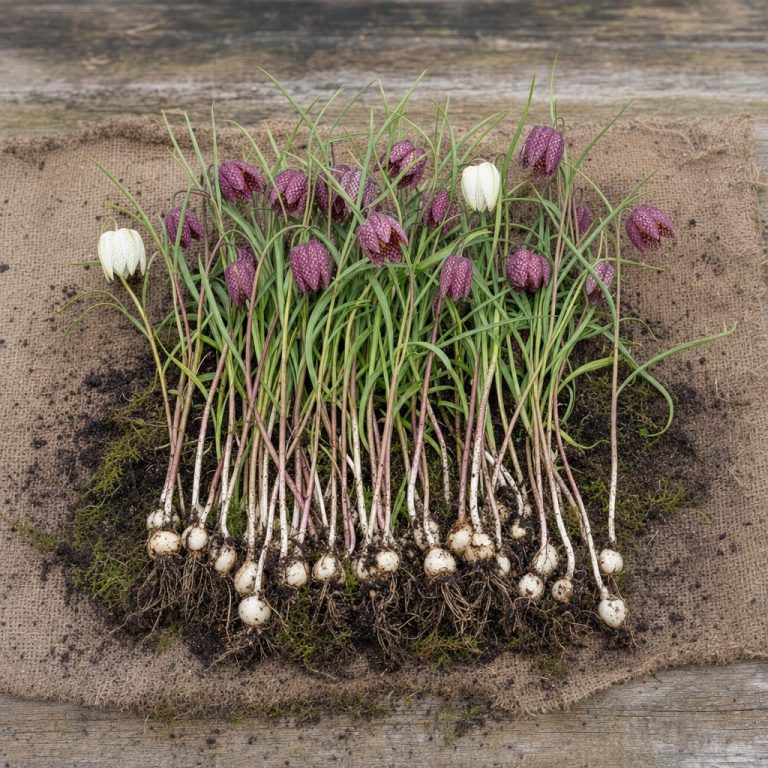
Fritillary bulbs have no protective papery skin. They bruise and dry out quickly, so handle them gently and plant them as soon as they arrive.
- Dry bulbs: plant in autumn, September to November, ideally September or October so roots form before winter.
- In the green: plant growing plants in February or March, at the depth shown by the pale stem base, and water in.
- Depth: the RHS advises four times the bulb’s depth, about 8–10 cm for a 2 cm bulb. Plant slightly deeper on light soils.
- Spacing: 10–15 cm apart in small groups of 3–5 or 10–20.
- Density: suppliers suggest 12–15 per m² for a light meadow scatter, 25–50 per m² for a natural drift, and more for a dense show.
- Position: full sun or light shade, on soil that is wet in winter and spring but drains in summer.
No trial has compared dry and in-the-green fritillaries directly. In-the-green plants show you exactly where they are and avoid the risk of dried-out bulbs. Our guide to what arrives in the box explains the difference for each species.
Growing from seed
Sow fresh seed in autumn, outdoors or in pots in a cold frame. The embryo needs winter cold before it germinates in spring. Expect 5–7 years to flowering. Our guide to growing native bulbs from seed covers the method.
Companions and where to plant
In wild meadows fritillaries grow with great burnet, meadow foxtail, lady’s bedstraw, devil’s-bit scabious, meadow buttercup and yellow rattle. In a garden, try damp grass under fruit trees, the edge of a pond, or a meadow area that stays moist in spring. A wetland and pond wildflower mix works on wetter margins.
Aftercare and problems
- Do not cut until the foliage has completely yellowed and the seed capsules have split, usually late June or July.
- No deadheading. Leave seed to fall.
- Never graze in spring.
- Avoid fertiliser, which feeds the grass at the fritillaries’ expense.
The main pest is the scarlet lily beetle. Its bright red adults and larvae strip leaves and flowers from March to October. Hand-pick them. The RHS advises against mulching around fritillaries, as mulch reduces overwinter survival of a parasitic wasp that kills lily beetle larvae. Slugs graze young shoots.
Fritillaries are otherwise largely disease-free. The main garden failure is summer waterlogging, which rots the bulbs, along with dried-out bulbs at planting and mowing too early. They pose no invasive risk.
Safety, names and folklore
All parts of the snake’s head fritillary are toxic, the bulbs especially. They contain steroidal alkaloids including imperialine, which affects the heart. The RHS advises gloves when handling bulbs. Historical veterinary records describe poisoning in horses, cattle, pigs and dogs. In traditional meadows, livestock are kept off in spring and graze only after the July cut, when the plants have died down.
The name Fritillaria comes from the Latin for a dice box, after the chequered pattern; meleagris means guinea fowl, for its speckling. English names include chequered daffodil, guinea-hen flower, snake-flower, Oaksey lily, leper’s bells and dead man’s bells. Welsh names recorded include britheg and pen y neidr, “snake’s head”. Old country belief held that fritillaries sprang up wherever Roman soldiers walked, but because there are no early wild records, this is folklore that grew up after the plant arrived.
Wildahome fritillary bulbs
Our snake’s head fritillary bulbs (Fritillaria meleagris) are supplied as dry bulbs for autumn planting into damp grass, orchards and garden meadows. For easier placement in existing turf, choose fritillaries in the green, delivered as growing plants between January and April.
For a damp garden pairing, summer snowflake likes similar wet ground. Browse every species in our native bulbs range and bulbs in the green range, and see the native bulb planting calendar for timing.
Planning a damp meadow
If you have a field, orchard or paddock that floods or stays wet in winter, tell us about it. We can suggest a seed mix, a cutting and grazing plan and the right quantity of fritillary bulbs for your site, or a bespoke wildflower seed mix matched to your soil. Use our free advice service or contact us.
Frequently Asked Questions
Is snake’s head fritillary native to the UK?
Officially no. BSBI reclassified the snake’s head fritillary as a neophyte in 2010. It was grown in gardens by 1597 but not recorded wild until 1737, and British plants match northern European stock. Its surviving floodplain meadows remain conservation priorities regardless.
When do snake’s head fritillaries flower in the UK?
Snake’s head fritillaries flower mainly in April and May, occasionally from late March in sheltered gardens. On any one site, peak flowering usually lasts about two weeks.
When should I plant snake’s head fritillary bulbs?
Plant dry bulbs in autumn, ideally September or October, so they root before winter. Plant in-the-green plants in February or March. Handle the bulbs gently because they have no protective skin and dry out quickly.
How deep should snake’s head fritillary bulbs be planted?
The RHS advises planting at four times the bulb’s depth, about 8–10 cm for a typical 2 cm bulb, and 10–15 cm apart. For in-the-green plants, match the pale stem base that shows the previous soil level.
Why didn’t my fritillaries come up this year?
Fritillaries often go dormant. Between 30% and 99% of a meadow population can stay underground for one to three years, and up to seven, after cold springs or wet summers. In gardens, summer waterlogging, dried-out bulbs or early mowing can also be the cause.
When can I mow grass with fritillaries in it?
Wait until the leaves have fully yellowed and the seed capsules have split, usually late June or July. Cutting earlier weakens the bulbs and stops seed setting.
Where can I see wild snake’s head fritillaries in the UK?
The best site is North Meadow at Cricklade, Wiltshire, which holds around 80% of Britain’s meadow population. Others include Ducklington Mead, Iffley Meadows and Magdalen College Meadow in Oxfordshire, Clattinger Farm in Wiltshire, Lugg Meadow in Herefordshire and Fox Fritillary Meadow in Suffolk.
Ready to get started?
Shop: Traditional Wildflower Meadow Mix →Native bulb hub
- All native bulbs for autumn planting, plus every bulb guide
- Bulbs in the green for late-winter and spring planting
- What arrives in the box: bulbs, tubers and bulbs in the green
- How to plant wildflower bulbs
- Native bulb planting calendar
- Native wildflower bulbs by soil type
- How to plant snowdrop bulbs
- Native bluebell bulbs: buying and planting
- Growing wild garlic from bulbs and seed
- Snowdrops in the UK: native status, identification and naturalising
- Winter aconite: identification, planting and where it belongs
- Wild daffodil and Tenby daffodil guide
- Tenby daffodil: history, identification and growing Wales's own daffodil
- Wood anemone: the ancient woodland windflower
- Native bluebell vs Spanish bluebell: identification and law