

Native Bluebell vs Spanish Bluebell: Identification, Law and Planting Guide
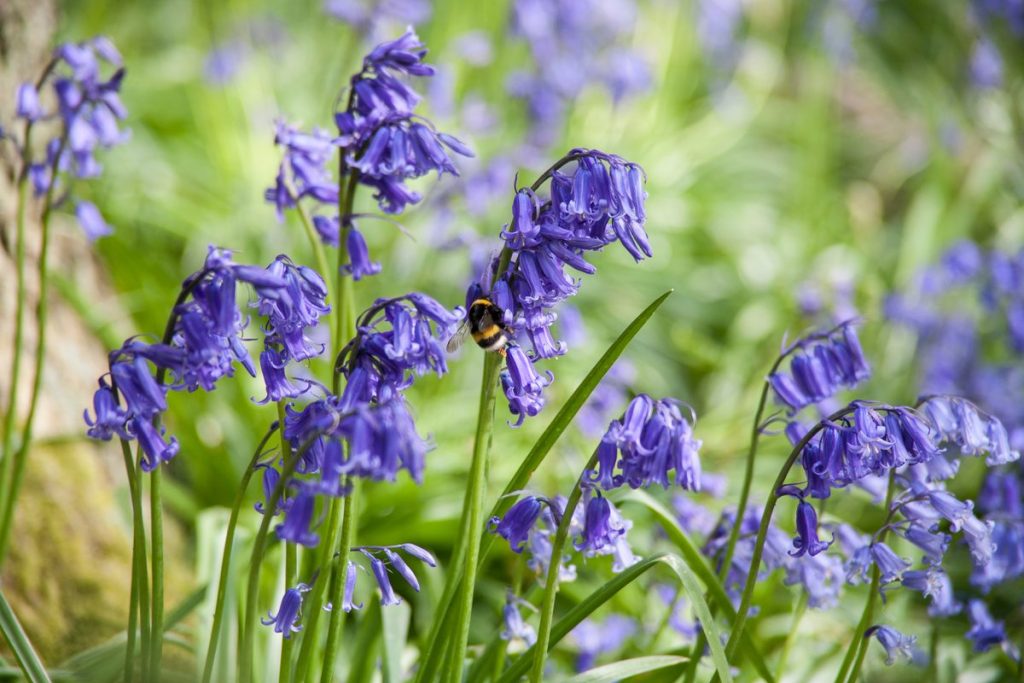
A bluebell wood in May is one of the great sights of the British spring. Britain and Ireland hold a large share of the world’s native bluebells, and the plant is so familiar that most people assume any blue bell-shaped flower in a garden or verge is the real thing. Often it is not.
Most of the “Spanish” bluebells in British gardens are in fact hybrids between the native bluebell and the Spanish bluebell. They are vigorous, they seed freely, and they escape from gardens into hedges and woods. At the same time, wild native bluebells are protected from trade, so how and where you buy bulbs matters.
This guide explains how to tell the native bluebell (Hyacinthoides non-scripta) from Spanish and hybrid bluebells, what the latest research says about the risk from hybrids, what the law actually says, and how to plant bluebells so they establish and do no harm.
Why the native bluebell matters
The native bluebell is a woodland bulb of north-western Europe, from northern Spain and Portugal through France and the Low Countries to Britain and Ireland. UK conservation bodies estimate that the UK holds roughly a quarter to a half of the world population. The exact share is uncertain: the Joint Nature Conservation Committee (JNCC) has noted there is no reliable global census, so treat “half the world’s bluebells” as an estimate.
It is widespread across England, Wales, Scotland (except Orkney and Shetland) and Northern Ireland. BSBI recorded it in 2,438 of roughly 3,900 ten-kilometre squares in Great Britain. Its national distribution is stable, and a long-running UKCEH survey of broadleaved woods found bluebell cover stayed the same or increased over 50 years.
In Wales the native bluebell is especially at home. The mild, damp climate lets it grow well outside woodland, on open hillsides, coastal cliffs and among bracken. Its highest British site is in Wales, at 685 m on Craig-yr-Ysfa in Snowdonia.
Around 71% of native bluebells grow in broadleaved woodland or scrub. The rest grow in hedgerows, shaded banks, field margins and, in the west, open grassland.
How to tell native and Spanish bluebells apart
Three bluebells are found in Britain:
- the native bluebell (H. non-scripta)
- the Spanish bluebell (H. hispanica)
- their fertile hybrid (H. × massartiana)
Pure Spanish bluebells are actually rare in the wild in Britain. In one Cumbria survey, all ten plants sent in as suspected Spanish bluebells turned out to be hybrids. The hybrid varies, sitting anywhere between its parents.
| Feature | Native bluebell | Hybrid bluebell | Spanish bluebell |
|---|---|---|---|
| Stem | Slender, bending over at the tip | Usually upright | Stiff and upright |
| Flowers | Hang from one side of the stem | Around the stem, drooping variably | All around the stem |
| Bell shape | Narrow tube, tips curled right back | Wider, tips less curled | Broad open bell, tips flared |
| Colour | Deep violet-blue, rarely white or pink | Variable | Paler blue, often pink or white |
| Pollen | Creamy white | Variable, often pale blue | Blue |
| Leaf width | Narrow, about 7–15 mm | 10–30 mm | Broad, 10–35 mm |
| Scent | Sweet and noticeable | Faint or none | Faint or none |
Pollen colour and the one-sided, nodding flower spike are the quickest checks. For difficult plants, BSBI recorders look at where the stamen filaments join the three outer tepals: above the middle in the native, below the middle in the Spanish.
One extra point: in Scotland “bluebell” traditionally means the harebell (Campanula rotundifolia), an unrelated summer flower.
Are Spanish bluebells a threat to native bluebells?
Earlier surveys raised real alarm. Plantlife reported that around one in six bluebells in a broadleaved woodland survey were Spanish-type. In south-central Scotland, 10% of native populations grew in mixed stands with non-natives, and more than 40% within about a kilometre, within reach of pollinating bees.
More recent genetic research is more reassuring. A study using nearly 1,900 genetic markers found non-native bluebells in the UK are hybrids at about 16% frequency overall, concentrated in parks, while only 2% of native plants in natural habitats showed hybrid genes. Hybrids also have lower fertility, with pollen fertility of 79% against 94% in the native. BSBI and NatureScot conclude that genetic swamping of the native bluebell across the UK is very unlikely.
That does not mean hybrids are harmless. Locally, especially in woods close to towns, vigorous hybrids can crowd out natives and dilute them. The practical advice is clear:
- Do not plant Spanish or hybrid bluebells in the countryside or near woods and hedgerows.
- Do dig them out of rural gardens near native woodland, getting the deep bulbs too, and replace them with true natives.
- Never put dug-up bulbs in the compost or green-waste bin; they survive. Dry them out or seal them in a black bag for at least a year.
- Relax a little in dense urban gardens far from woodland, where they pose little conservation risk.
Bluebells and the law
The law on bluebells is often misquoted. Here is what it says.
Uprooting
Under Section 13(1)(b) of the Wildlife and Countryside Act 1981, it is an offence in England, Wales and Scotland for anyone other than the landowner, occupier or someone with their permission to intentionally uproot any wild plant, bluebells included. Scotland adds recklessly uprooting. Northern Ireland has an equivalent rule.
Picking
Picking flowers for your own non-commercial use is not in itself an offence under the 1981 Act. But it damages the plant, and many Sites of Special Scientific Interest (SSSIs), nature reserves and byelaws ban it.
Selling
Since 1998 the native bluebell has been on Schedule 8 of the Act for trade purposes. It is illegal for anyone, landowners included, to sell, offer for sale, transport for sale or advertise wild bluebells, bulbs or seed.
Cultivated stock
Section 13(4) presumes any bluebell in trade is wild unless shown otherwise. There is no retail “licence” for selling bluebells. Reputable growers keep propagation records proving their stock is cultivated.
Before you buy, ask:
- Is the stock guaranteed true Hyacinthoides non-scripta?
- Was it grown in cultivation, never dug from woods or wild land?
- Was it grown in the UK? Bulk imports have often turned out to be Spanish or hybrid.
- Once flowering, does it show creamy pollen, one-sided drooping spikes, narrow leaves and scent?
Why bluebell woods take so long to form
The native bluebell is an ancient woodland indicator. Ancient woodland, land wooded since at least 1600 (1750 in Scotland), covers only 2.5% of the UK. A dense bluebell carpet alongside other indicator plants is a strong sign of long continuity, though no single species proves it.
Four things make bluebell woods slow to assemble:
- Slow growth: at least five years from seed to a mature bulb.
- Heavy seed: it drops close to the parent. A 45-year study measured spread of only 6 mm to 6 cm a year.
- Fungal partners: bluebells depend on soil fungi in undisturbed woodland for phosphorus.
- Sensitivity to disturbance: ploughing and compaction break those networks.
Trampling is a particular problem. In a woodland trial, after 500 passes in April, bluebell cover recovered to only 52% after two years and the plots produced no seed for two years. Bracken and bramble bounced back far faster. Stay on paths in bluebell woods, and keep livestock and deer pressure in check. Traditional coppicing, by letting in spring light, benefits bluebell displays.
Bluebells and wildlife
Bluebells flower from mid-April to late May, ahead of most woodland plants, and dense stands are an important early source of nectar and pollen. Visitors include queen bumblebees, solitary bees, honeybees, hoverflies and woodland butterflies. Some short-tongued bumblebees cheat, biting a hole at the base of the flower to steal nectar without pollinating it.
Field voles and mice eat some bulbs and seed. Sheep, cattle and muntjac deer can strip leaves and damage colonies in unfenced woods. For more plants to support early insects, see our guide to wildflowers for pollinators.
How to plant native bluebells
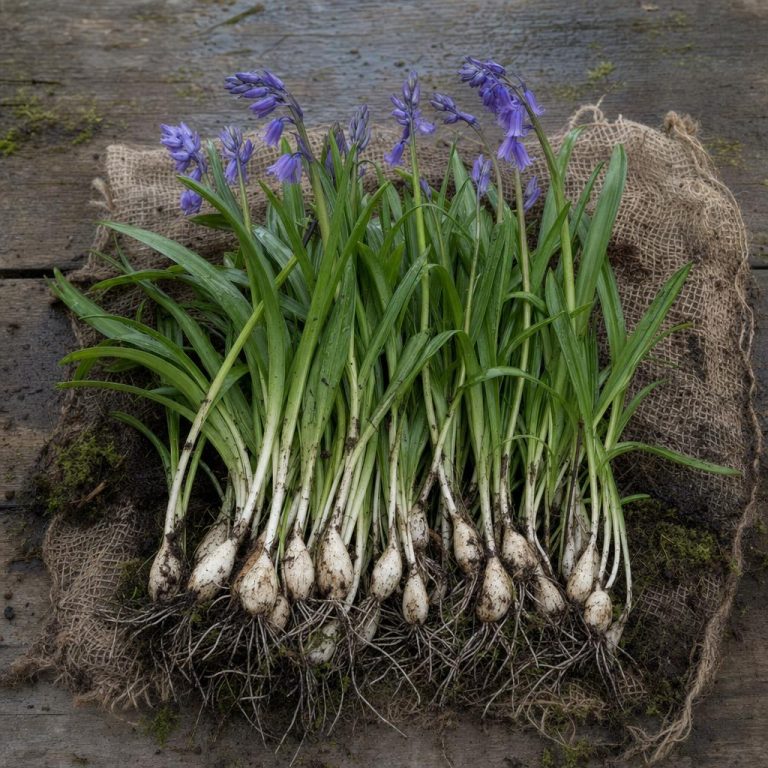
Bluebells want humus-rich, free-draining soil that stays moist in spring. They dislike waterlogging and very thin soil over chalk. Dappled or partial shade under deciduous trees or a hedge suits them best. In damp western Britain and Wales they tolerate more open ground; in the drier east they need shade. Our soil types guide for native bulbs covers this in detail.
Working figures, mostly from horticultural practice:
- Dry bulbs: September to November, planted the day they arrive.
- In the green: March to May, straight after flowering, with leaves intact; water in.
- Depth: 8–10 cm for dry bulbs; match the old soil level for in-the-green plants.
- Spacing: 8–10 cm apart in informal drifts of 5–10.
- From seed: collect ripe seed in July–August and sow in late summer or autumn. Expect at least five years to flowering.
In-the-green plants let you place drifts exactly in existing turf or woodland edges. Dry bulbs are convenient for larger autumn plantings if planted at once. Our dedicated guide to buying and planting native bluebell bulbs goes step by step, and growing native bulbs from seed covers seed raising.
Good native companions include wood anemone, primrose, wood sorrel, yellow archangel and wild garlic, under oak, birch, hazel and hawthorn. Sow a woodland and heavy shade wildflower mix to fill the ground layer, or a hedgerow and banks mix along shaded banks. Our guide to wildflowers for woodland and heavy shade explains species choice.
Aftercare
- Do not mow, cut or trample the leaves until they have turned completely yellow and died back.
- Divide congested garden clumps in the green after flowering and replant at the same depth.
- Protect from heavy grazing where sheep, cattle or deer have access.
Bluebells are killed by repeated mowing or trampling of green leaves, waterlogged ground, deep cultivation and sustained heavy grazing. Pests and diseases are rarely serious.
Are bluebells poisonous?
Yes. All parts, especially the bulbs, contain scillarens, heart-affecting glycosides similar to those in foxglove. Eating them can cause nausea, vomiting, diarrhoea and, in large amounts, an irregular heartbeat. Human poisonings usually happen when bulbs are mistaken for wild onions.
The Veterinary Poisons Information Service reports that the most serious cases involve cattle and horses grazing on bluebells. Cases in dogs and cats have involved only stomach upsets. Keep bagged bulbs away from dogs, consult a vet if any are eaten, and wear gloves if your skin is sensitive.
Names, history and folklore
The name non-scripta means “unlettered”, distinguishing the bluebell from the hyacinth of Greek myth, whose petals were said to carry Apollo’s mournful “AI”. English names include wild hyacinth, wood bell and cuckoo’s boots. In Welsh the bluebell is clychau’r gog, “the cuckoo’s bells”, because it flowers as the cuckoo returns.
Bluebell sap was used to glue feathers to arrows and bind books, and Elizabethans made starch from the bulbs for ruffs. Folklore warned that bluebell woods were enchanted, and that anyone picking the flowers might be led astray by fairies.
Wildahome native bluebells
Our native bluebell bulbs (Hyacinthoides non-scripta) are cultivated stock, never dug from the wild, and supplied as dry bulbs for autumn planting. For exact placement in existing turf or woodland edges, choose bluebells in the green, delivered as growing plants between January and April.
Bluebells also feature in the Wildflower Favourites Bulb Collection and the Woodland Wildflower Bulb Collection. Browse every species in our native bulbs range and bulbs in the green range, and check the native bulb planting calendar.
Planning a bluebell planting
If you are replacing hybrid bluebells, underplanting a young wood or restoring a hedgebank, tell us about the site, its shade and its neighbours. We will help you work out quantities and pair the bulbs with a native ground layer. Use our free advice service or contact us.
Frequently Asked Questions
How do you tell native and Spanish bluebells apart?
A native bluebell has a drooping stem with flowers on one side, narrow deep-blue bells with tips curled back, narrow leaves, a sweet scent and creamy-white pollen. Spanish and hybrid bluebells stand upright with flowers all round the stem, wider open bells, broader leaves, little scent and blue or pale pollen.
When do bluebells flower in the UK?
Native bluebells flower from mid-April to late May, occasionally into June in cooler or later sites. They flower before the tree canopy closes, which is why bluebell woods look best in early May.
Is it illegal to pick bluebells in the UK?
Picking a few native bluebell flowers for personal use is not in itself an offence under the Wildlife and Countryside Act 1981, but uprooting any wild plant without permission is. Selling wild bluebells, bulbs or seed is illegal for everyone, and many reserves and SSSIs ban picking.
Can landowners dig up bluebells on their own land to sell?
No. Schedule 8 of the Wildlife and Countryside Act 1981 makes it illegal for anyone, landowners included, to sell, transport for sale or advertise wild bluebells or their bulbs or seed. Only cultivated stock can be sold.
Are native bluebells being wiped out by Spanish bluebells?
No, not nationally. Recent genetic research found only about 2% of native bluebells in natural habitats carry hybrid genes, and hybrids are less fertile. Local displacement still happens near towns, so avoid planting Spanish or hybrid bluebells near woods.
Should I dig up Spanish bluebells in my garden?
If your garden is near native woodland or rural hedgerows, yes. Dig out the whole clump including deep bulbs, and dry them or seal them in a black bag for a year rather than composting them. Replace them with cultivated native bluebells.
Are bluebells poisonous to dogs and horses?
Yes. All parts of the native bluebell contain toxic glycosides. Serious poisoning is mainly recorded in grazing cattle and horses, while dogs and cats usually suffer stomach upsets. Contact a vet if your animal has eaten bulbs or leaves.
Ready to get started?
Shop: Traditional Wildflower Meadow Mix →Native bulb hub
- All native bulbs for autumn planting, plus every bulb guide
- Bulbs in the green for late-winter and spring planting
- What arrives in the box: bulbs, tubers and bulbs in the green
- How to plant wildflower bulbs
- Native bulb planting calendar
- Native wildflower bulbs by soil type
- How to plant snowdrop bulbs
- Native bluebell bulbs: buying and planting
- Growing wild garlic from bulbs and seed
- Snowdrops in the UK: native status, identification and naturalising
- Winter aconite: identification, planting and where it belongs
- Wild daffodil and Tenby daffodil guide
- Tenby daffodil: history, identification and growing Wales's own daffodil
- Snake's head fritillary: floodplain meadows, planting and care
- Wood anemone: the ancient woodland windflower