

Winter Aconite in the UK: Identification, Planting and Where It Belongs
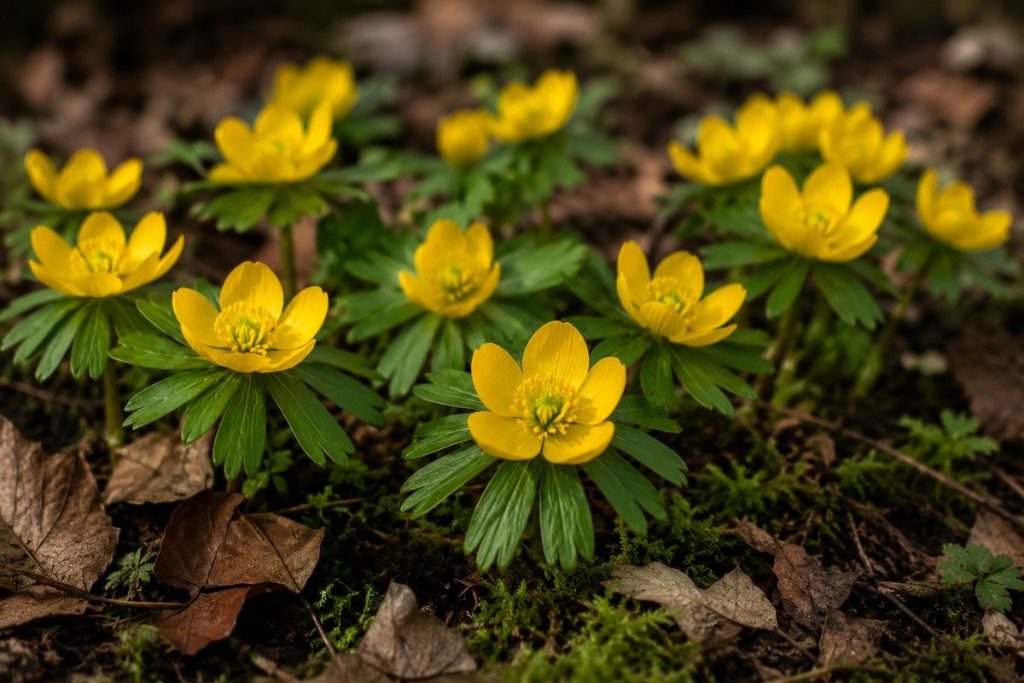
Winter aconite is often the first flower of the year. Low cups of glossy yellow push up through leaf litter in January, sometimes through snow, each sitting on a bright green ruff. For insects waking on a mild winter afternoon, a carpet of winter aconite is one of the few meals on offer.
It is also a plant that frustrates many gardeners. Packets of dry tubers bought in autumn often produce nothing at all. And because it spreads freely once settled, it raises a fair question for anyone managing land with conservation in mind: where should it go, and where should it not?
This guide sets out what winter aconite (Eranthis hyemalis) is, how to tell it from the native lesser celandine, what it gives pollinators, and how to establish it reliably in the green or from fresh seed. It is honest about its status as an introduced plant, and practical about keeping it in the right places: gardens, churchyards, parkland and estate grounds.
What is winter aconite?
Winter aconite is a small tuberous perennial in the buttercup family (Ranunculaceae). It grows to around 10–15 cm and spends most of the year dormant underground as a knobbly tuber.
Despite its name and its history, it is not a true aconite. The old name came from the resemblance of its divided leaves to monkshood (Aconitum). Linnaeus first placed it with the hellebores. DNA work now puts it closest to baneberry (Actaea).
Winter aconite is not native to the UK
Winter aconite is native to southern Europe, from Italy to Bulgaria and south-east France, and to Turkey. It was in British gardens by 1596, and by 1636 John Gerard reported growing “great quantity of it” in London. Secondary accounts date the first wild record in Britain to 1838. BSBI treats it as a naturalised introduction (a neophyte).
It is now widely naturalised in lowland Britain, especially on chalk and limestone in southern and eastern England, and largely absent from western Scotland, the Scottish islands and most of Ireland. In Wales it is scattered, with records from Monmouthshire, the Vale of Glamorgan and Merthyr Tydfil, and it is much sparser on the acidic uplands.
Its recorded range has grown more than sixfold since before 1930, from 119 to 724 ten-kilometre squares in Great Britain. Part of that reflects better recording of naturalised plants, but part looks like genuine spread.
How to identify winter aconite
Look for these features:
- Flowers: upward-facing yellow cups 2–3 cm across, made of six petal-like sepals, with small tubular nectaries and a boss of around 30 stamens inside.
- The ruff: directly beneath each flower sits a whorl of three deeply divided, leaf-like bracts. This collar is the giveaway.
- Leaves: rich green, palmately divided basal leaves appear with or just after the flowers.
- Timing: mainly January to February in the UK, sometimes from late December in mild winters.
Winter aconite or lesser celandine?
The common confusion is with lesser celandine (Ficaria verna), a native buttercup that shares woodland and grassy places. Celandine has star-shaped flowers with 8–12 glossy petals, no leafy ruff beneath the flower, and heart-shaped dark green leaves on long stalks. It also flowers on into April, well after winter aconite has finished.
You may also see the later-flowering Cilician winter aconite (E. cilicica) and the sterile hybrid E. × tubergenii, sold as cultivars such as ‘Guinea Gold’. These have bronze-tinged foliage and do not seed.
Winter aconite and pollinators
Winter aconite is listed under the RHS Plants for Pollinators scheme, and the reason is timing. It flowers in January and February, among the hungriest weeks of the year for insects.
A Polish study of its flowers found each one produced around 1.2 mg of nectar at a striking 72% sugar concentration. Pollen is released gradually over two to three days, peaking around midday when winter afternoons are warmest. The flowers also reflect ultraviolet light that bees can see.
Visitors include honeybees, which need early pollen to restart brood rearing, wild and early bumblebees, and flies including hoverflies. In cool February weather, flies are often the most frequent visitors. It is not known to feed butterflies or moths.
Deer and rabbits leave it alone. That makes it useful in grounds where browsing strips other early flowers, provided it is kept to the right setting.
Where winter aconite belongs, and where it does not
Because winter aconite is introduced and can form dense self-seeding carpets, it needs placing with care. It has been recorded in some ancient woodlands, usually where old estate planting has escaped. Local authority ecological guidance generally recommends buffering semi-natural habitats and keeping ornamental plantings to formal areas.
Do plant it in:
- gardens, under deciduous trees and shrubs
- churchyards, parkland and estate grounds
- short lawns and orchards cut late
- gravel and borders with summer perennials to follow
Avoid planting it in:
- ancient or semi-natural woodland, where wood anemone and lesser celandine belong
- species-rich grassland and hay meadows
- grazed pasture, because all parts are toxic to livestock
If you want an early-spring ground layer in genuinely native woodland, look at native wood anemone and bluebell instead, with a woodland and heavy shade wildflower mix to follow.
Legally, winter aconite is not a protected species and not on the Schedule 9 invasive list. It is still an offence under Section 13 of the Wildlife and Countryside Act 1981 to uproot wild plants without the landowner’s permission, so naturalised colonies are not a free source of tubers.
Why dry winter aconite tubers fail
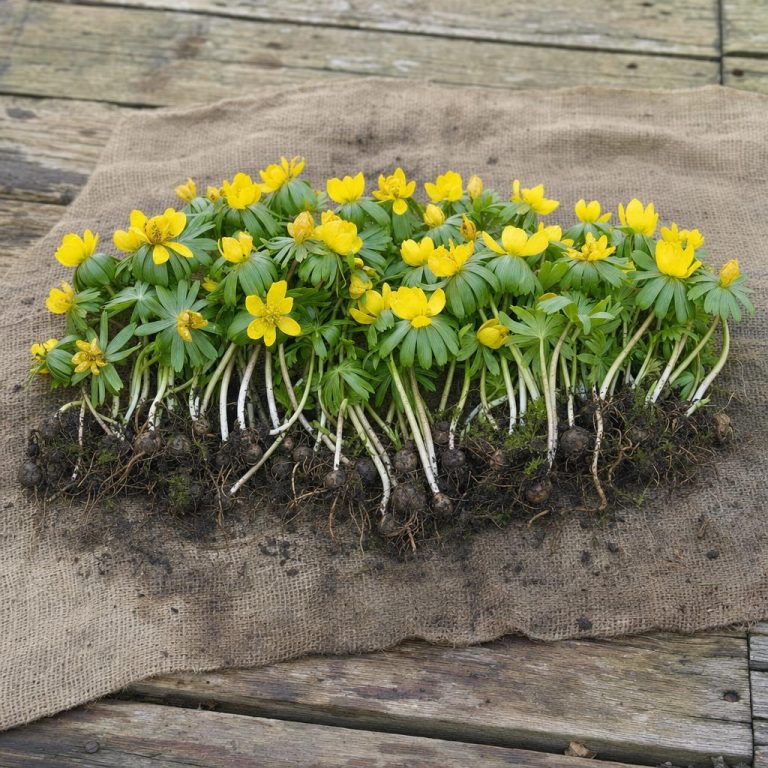
Desiccation is the main reason. Winter aconite tubers lose viability quickly once they dry out, and dry tubers sold in autumn have often been out of the ground for months. The RHS notes they may not establish well. The Botanical Society of Scotland says viability drops sharply if they dry, and the Scottish Rock Garden Club warns dried tubers will not sprout until fully rehydrated.
If you do buy dry tubers:
- Buy them as early in autumn as you can.
- Soak them in lukewarm water for 12–24 hours before planting.
- Plant at once into moist ground, about 5 cm deep.
- Expect some losses and a slow first year.
The more reliable route, recommended by both the RHS and the Botanical Society of Scotland, is planting in the green: growing plants lifted and moved while still in leaf, immediately after flowering. Our guide to what arrives in the box explains how dry and in-the-green stock differ for each species.
How to plant winter aconite
Winter aconite likes humus-rich, moisture-retentive but well-drained soil, and does best on alkaline ground. It grows on chalk, clay, loam and sand, and even tolerates the roots of black walnut. The classic position is full sun in late winter, shaded by deciduous leaves in summer: under trees and shrubs, or on the edge of a lawn. Our soil types guide for native bulbs explains how soil affects each species.
Working figures:
- In the green: late winter to late spring, straight after flowering.
- Dry tubers: from September, soaked overnight first.
- Depth: about 5 cm. Too shallow and tubers dry out or blackbirds turf them up.
- Spacing: 7–10 cm apart in loose groups, scattered by hand for a natural effect.
- Density: roughly 100 tubers per m² at 10 cm spacing for a quick carpet; fewer for a slower drift.
- Time to establish: 2–5 years from tubers to a good drift.
The native bulb planting calendar shows how winter aconite fits alongside snowdrops and other species through the year.
Growing winter aconite from seed
Seed is the cheapest way to build a large colony, but only if it is fresh. The seed is recalcitrant: it loses viability within weeks if stored dry. Collect ripe seed in May or June as the pods split, and sow at once into gritty compost or straight into undisturbed soil under trees.
After summer warmth and winter cold, germination the following spring can be close to 100%. Seedlings produce a single simple leaf in their first year and form tiny 3–4 mm tubers. Expect three to four years to first flower. Our guide to growing native bulbs from seed covers the method in more detail.
Classic companions are snowdrops, early crocus and hellebores. Follow them with hostas, ferns, hardy geraniums or epimediums to cover the ground once the aconites have died down.
Aftercare and common problems
Established winter aconite needs very little help. After flowering, the leaves keep working through spring while the seed pods ripen and split from May. Then everything disappears underground until next winter.
- Do not mow over a colony until the foliage has yellowed and the seed has dropped, usually late May to June.
- Mulch with leaf mould in autumn to keep tubers moist, mimicking woodland litter.
- No deadheading is needed; leaving seed is how the colony thickens.
- Divide congested clumps in the green after flowering and replant at once.
The main disease is winter aconite smut (Urocystis eranthidis). It shows as lead-grey blisters on leaves and stems that burst to release black powdery spores. Cut out early patches and destroy them; dig up and dispose of badly infected plants away from the compost heap.
Slugs graze emerging leaves, and blackbirds uproot shallow tubers. Otherwise, winter aconite fails mainly through early mowing, summer drought on thin soils, or tubers that dried out before planting.
Is winter aconite poisonous?
Yes. All parts are toxic, especially the tubers. One nursery website claims otherwise; it is wrong.
The plant contains cardiac glycosides (eranthin A and B) and a toxic lectin unique among the buttercup family. Eating any part can cause nausea, vomiting, diarrhoea, visual disturbance and a slowed or irregular heartbeat. The RHS lists it as harmful to pets, and a fatal poisoning in a dog has been recorded. Horses and livestock are also at risk.
Keep it away from grazed fields and hay meadows, keep dogs that dig away from new plantings, and wear gloves when collecting seed or handling tubers.
Names and history
The name Eranthis comes from the Greek for “spring flower”, and hyemalis is Latin for “of winter”. Old English names include winter hellebore and winter wolf’s-bane. Plantlife records regional names such as “choirboys”, after the green ruff, and “New Year’s gift”.
In Welsh, winter aconite is bleidd-dag y gaeaf, “winter wolf’s-bane”, echoing the monkshood connection. One folk belief held that it grew only where the blood of Roman soldiers had soaked the ground. Like many such tales, it is folklore, not history.
Wildahome winter aconite
If you want gold under your trees next January, our winter aconite bulbs (Eranthis hyemalis) are sold as dry tubers for autumn planting. Soak them overnight before planting, as above. For the most reliable start, choose winter aconite in the green, delivered as growing plants between January and April.
Winter aconite is also part of the Wildflower Favourites Bulb Collection, with snowdrops and bluebells. Browse the full native bulbs range or the bulbs in the green range, and see our general guide to planting wildflower bulbs.
Planning the right bulbs for your site
If you are unsure whether a site suits introduced bulbs like winter aconite or calls for natives only, ask us before you plant. Tell us what the land is, how it is managed and what grows there now, and we will recommend bulbs and a seed mix that fit. Use our free advice service or contact us directly.
Frequently Asked Questions
Is winter aconite native to the UK?
No. Winter aconite is native to southern Europe and Turkey. It was grown in British gardens by 1596 and has been recorded in the wild since the 1830s. It is now widely naturalised in lowland England but should be kept to gardens, churchyards and parkland rather than semi-natural habitats.
When does winter aconite flower in the UK?
Winter aconite flowers mainly in January and February, occasionally from late December in mild winters. The flowers open in sunshine and close in frost and dull weather, then the foliage dies back by early summer.
Why didn’t my winter aconite tubers grow?
Dry tubers sold in autumn lose moisture and often lose viability before planting. Shallow planting in dry soil and winter aconite smut can also cause failure. Soak dry tubers for 12–24 hours before planting, or plant in the green after flowering for better results.
Should I soak winter aconite tubers before planting?
Yes, if you are planting dry tubers. Soak them in lukewarm water for 12–24 hours, usually overnight, then plant at once about 5 cm deep in moist ground. Plants bought in the green need no soaking.
What is the difference between winter aconite and lesser celandine?
Winter aconite has cup-shaped yellow flowers of six sepals sitting on a ruff of three divided green bracts, and flowers in January–February. Native lesser celandine has star-shaped flowers with 8–12 petals, no ruff, heart-shaped leaves, and flowers into April.
Is winter aconite poisonous to dogs?
Yes. All parts of winter aconite, especially the tubers, contain cardiac glycosides that are toxic to dogs, cats, horses and livestock. A fatal dog poisoning has been recorded. Keep digging dogs away from new plantings and contact a vet urgently if any part is eaten.
When can I mow grass with winter aconite in it?
Wait until the foliage has turned yellow and died back and the seed pods have split, usually late May to June. Mowing earlier weakens the tubers and stops the colony self-seeding.
Ready to get started?
Shop: Traditional Wildflower Meadow Mix →Native bulb hub
- All native bulbs for autumn planting, plus every bulb guide
- Bulbs in the green for late-winter and spring planting
- What arrives in the box: bulbs, tubers and bulbs in the green
- How to plant wildflower bulbs
- Native bulb planting calendar
- Native wildflower bulbs by soil type
- How to plant snowdrop bulbs
- Native bluebell bulbs: buying and planting
- Growing wild garlic from bulbs and seed
- Snowdrops in the UK: native status, identification and naturalising
- Wild daffodil and Tenby daffodil guide
- Tenby daffodil: history, identification and growing Wales's own daffodil
- Snake's head fritillary: floodplain meadows, planting and care
- Wood anemone: the ancient woodland windflower
- Native bluebell vs Spanish bluebell: identification and law