

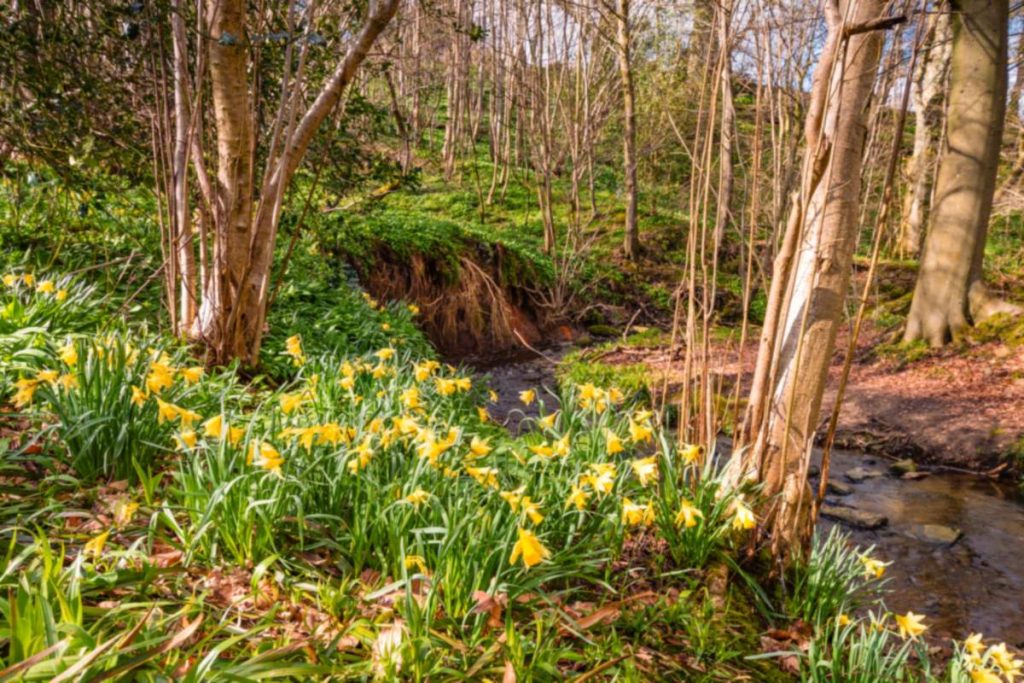
Wild Daffodil and Tenby Daffodil: A UK and Welsh Guide to Native Daffodils
The wild daffodil is smaller and paler than the daffodils on most roadside verges, and it is far more interesting. This is the Lent lily of old woods and damp pastures, the flower Wordsworth saw along Ullswater. Alongside it sits the Tenby daffodil, a compact golden trumpet tied to Pembrokeshire that nearly disappeared from the wild in the 19th century.
Both are worth growing. Both are also easy to get wrong. More than 27,000 daffodil cultivars are registered worldwide, and many are sold under loose “wild” labels. Planted near genuine wild colonies, garden daffodils can cross with them and blur what is native.
This guide covers how to identify the wild daffodil (Narcissus pseudonarcissus subsp. pseudonarcissus) and the Tenby daffodil (Narcissus obvallaris), where they grow in England and Wales, what the law says, and how to naturalise them in grass, orchards and woodland edges so they flower well for decades.
How to identify the wild daffodil
The wild daffodil is native to Great Britain and western Europe. It grows to around 30–35 cm, smaller than most garden daffodils. Look for:
- Narrow grey-green leaves, flat or slightly channelled, with a distinct waxy bloom.
- A single nodding flower 4–6 cm across on each stem.
- Two-tone colouring: pale primrose-yellow outer petals (tepals), often slightly twisted, around a deeper golden trumpet.
- Flowering in March and April, mid to late March in the south, into April further north.
How to tell the Tenby daffodil apart
The Tenby daffodil is sturdier and more compact, usually 20–30 cm, with a smoothly flared trumpet. It flowers early, mainly February to March. Sources differ on its colour: some describe it as evenly golden throughout, while the RHS notes slightly paler outer petals. Its stature, early flowering and close link to south-west Wales are better guides than colour alone.
Garden daffodils and look-alikes
Garden cultivars are usually taller (35–50 cm or more), with broader, brighter green leaves and uniformly coloured, double or multi-headed flowers. ‘King Alfred’ types are a common escape on verges and village approaches.
One look-alike matters for safety. Daffodil shoots and bulbs can be mistaken for onions, shallots or spring onions, and wild daffodils grow in spring woods alongside wild garlic. Foragers need to take care where the two meet.
Where wild daffodils grow in the UK
Wild daffodils were once common enough to be picked by the cartload for city markets. They declined steeply from the 19th century. Plantlife points out that picking rarely harmed the bulbs; the damage came from habitat loss, drainage and fertilising of old pastures, changes in woodland management and the end of traditional orchard economies.
BSBI now records the wild daffodil in around 615 ten-kilometre squares in Great Britain, although mapping its true native range is, in BSBI’s words, “probably now intractable given the extent of planting”. There may have been recent losses at the fringes of core areas in south-west England, the West Midlands and north-west England.
The best-known strongholds are:
- The “golden triangle” around Dymock, Newent and Kempley on the Gloucestershire and Herefordshire border, with the 10-mile Daffodil Way.
- The Lake District, famously along Ullswater in Cumbria.
- Farndale in the North York Moors.
- Woods in south Devon and Wiltshire, including West Woods near Marlborough.
- Welsh woodland and upland fringes, including the Black Mountains.
The Tenby daffodil and Wales
The Tenby daffodil is the subject of a long botanical debate. The RHS and NBN Atlas treat Narcissus obvallaris as a distinct species, while Plantlife treats it as a subspecies of the wild daffodil that may first have been a cultivated form. Victorian bulb-digging for the London trade almost wiped it out in the wild, and it now survives mainly on banks, verges and churchyards in Pembrokeshire, Carmarthenshire and Ceredigion, and in the Springwoods at the National Botanic Garden of Wales.
Its origin, history, 1970s revival and growing needs are covered in full in our dedicated Tenby daffodil guide.
Daffodils, St David’s Day and the Welsh names
In Welsh the daffodil is cenhinen Bedr (plural cennin Pedr), literally “Peter’s leek”. The Tenby daffodil is Cenhinen Bedr Dinbych, after Dinbych-y-pysgod, the Welsh name for Tenby. Older Welsh names include blodyn Mawrth, “March flower”, and croeso’r gwanwyn, “spring’s welcome”.
The leek is the older Welsh emblem. The daffodil seems to have joined it in the early 20th century, helped by the shared cennin name and its flowering around St David’s Day on 1 March. Most daffodils pinned on that day are modern cultivars rather than either wild or Tenby daffodils. Stories linking the leek to St David or to Welsh archers in a leek field belong to folklore.
Wales has another daffodil story. Daffodils produce galantamine, used to ease the symptoms of Alzheimer’s disease. Aberystwyth University’s Yellow Gold project at Pwllpeiran in mid-Wales showed that wild daffodils can be grown within grazed upland grassland as a pharmaceutical crop without losing the grassland’s other benefits.
Habitat, wildlife and the law
Wild daffodils favour deciduous ash and oak woodland, scrubby banks, damp meadows, old pastures and orchards. Tenby daffodils grow on coastal banks, rough grass, orchards and lightly shaded woodland edges. Both grow on chalk, clay, loam and sand, across acid to alkaline soils, provided the ground is moist in spring and does not stay waterlogged. Neither does well in deep year-round shade.
Their foliage and flowers appear in early spring, the leaves feed the bulb until early summer, and the plants spend the rest of the year dormant. Colonies spread by offsets and by seed, and research shows seed is important for keeping genetic diversity in small wild populations.
On wildlife, be cautious with claims. Both daffodils flower early and are often described as good for queen bumblebees, but peer-reviewed UK studies of pollinator visits are thin. One grower noted more insect visits and seed set on wild-type daffodils than on large modern cultivars. Rabbits and deer generally leave them alone.
On the law: neither daffodil is a specially protected species, but Section 13 of the Wildlife and Countryside Act 1981 makes it an offence to uproot any wild plant, including bulbs, without the landowner’s permission. Picking flowers for sale without consent is also illegal, and Sites of Special Scientific Interest (SSSIs), nature reserves and National Trust land commonly forbid any picking.
The hybridisation risk
This is the most important practical point for landowners near wild daffodil colonies. Plantlife warns explicitly that wild daffodils hybridise with cultivated varieties. A 2024 genetic study of the wild daffodil concluded that the risk of hybridisation between wild plants and naturalised cultivars is high. BSBI also notes that the spread of planted daffodils is masking real native losses.
If your land is near an ancient wood, an SSSI or one of the core strongholds:
- Do plant only true species stock, labelled with its full Latin name.
- Do check where your bulbs were propagated.
- Avoid planting garden cultivars, large trumpet forms or unverified “wild-type” mixes within reach of wild colonies.
- Avoid dumping surplus garden bulbs in hedges and woodland edges.
Away from wild populations, in gardens, churchyards and orchards, the risk is far lower, and a small-flowered daffodil is still a better choice for wildlife and character than a large modern hybrid. If you are unsure which applies to your land, ask before you plant.
How to plant and naturalise wild daffodils
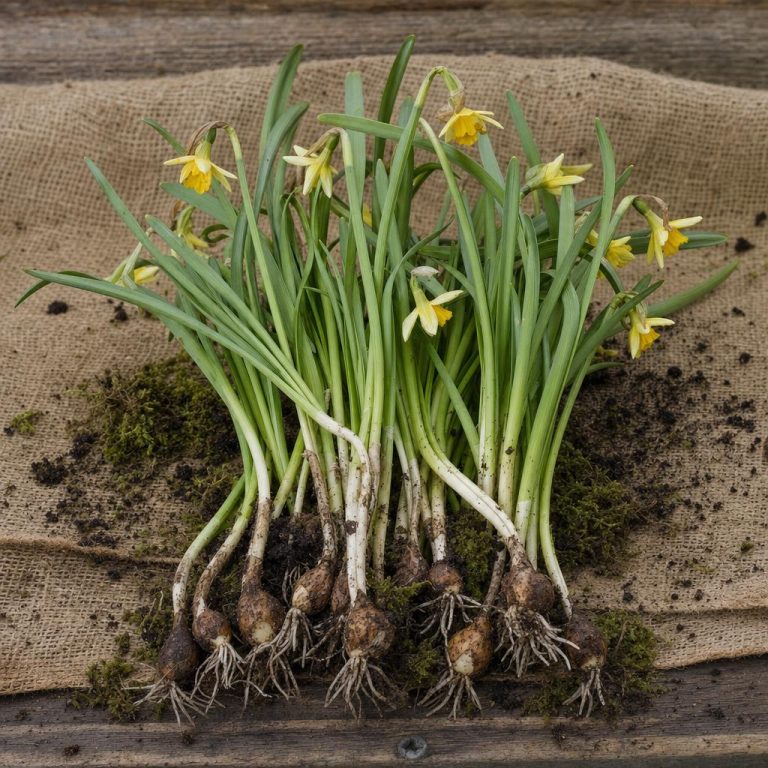
Both species naturalise well in rough grass, orchards, wildflower meadows and woodland edges, in full sun or light shade.
- Planting window: dry bulbs in early autumn, ideally September; in the green straight after flowering in spring.
- Depth: about 10–15 cm for dry bulbs, roughly three times the bulb’s height. For in-the-green plants, set them to the top of the pale stem base.
- Spacing: 7–12 cm apart in irregular drifts. Scatter and plant where they land rather than in rows.
- Density: suppliers suggest 75–100 bulbs per m² for a full display; fewer for a sparse meadow effect.
- Time to establish: the RHS gives 2–5 years for the wild daffodil and 1–2 years for the Tenby daffodil.
Expect a thin first year. One grower saw a single flower from 200 wild daffodil bulbs in year one before strong flowering in year two. That is normal for bulbs settling into grass.
In meadow plantings, wild daffodils sit well with primroses and cowslips, then meadow buttercup and yellow rattle in the summer sward. Where you are creating a meadow around them, a traditional meadow mix or a hedgerow and banks mix for verges and field edges gives summer flowers after the daffodils fade. See our guides to planting wildflower bulbs and the native bulb planting calendar for timing across the year.
Aftercare: leaves, mowing and blind daffodils
Long-term success depends almost entirely on letting the leaves do their work.
- Leave the foliage at least six weeks after flowering, until it yellows, usually late May or June. A mid to late summer hay cut clears this window easily.
- Never knot or tie the leaves. The RHS warns this cuts photosynthesis and causes blindness.
- Do not deadhead in grass. Leave spent flowers to set seed, which spreads the colony and keeps it genetically varied. Deadhead only in borders.
- Divide overcrowded clumps as the leaves fade in early summer and replant at once.
“Blind” daffodils, which produce leaves but no flowers, are usually caused by cutting leaves too early, knotting them, overcrowding, shallow planting, deep shade or dry spring soil.
Pests and diseases
The large narcissus bulb fly is the main pest. The adult, a bumblebee mimic, lays eggs near the necks of dying leaves in May and June. A single fat larva up to 18 mm then hollows out the bulb over winter. Firm the soil around fading stems after flowering, lift and destroy soft bulbs (do not compost them), and net high-value plantings in May and June. Basal rot in wet soils, narcissus eelworm, leaf scorch and slugs also cause problems.
Are daffodils poisonous?
Yes. All parts of wild, Tenby and garden daffodils are toxic, the bulbs most of all, along with leaves, flowers and even vase water. They contain lycorine and other alkaloids. Kew has documented human poisonings from bulbs mistaken for onions or shallots, so store and label daffodil bulbs well away from edible alliums. Sap can cause “daffodil itch”, so wear gloves when handling large numbers.
Daffodils are poisonous to dogs, cats and horses, causing drooling, vomiting, diarrhoea and, in severe cases, fits or heart rhythm problems. Contact a vet straight away if you suspect poisoning; the Animal PoisonLine is on 01202 509000. Keep livestock away from dug-up bulbs and cut debris.
Wildahome daffodils for naturalising
Our Tenby daffodil bulbs (Narcissus obvallaris) are the natural choice for a Welsh planting, an early display or a coastal garden. They are also available as Tenby daffodils in the green, delivered as growing plants between January and April.
For drifts in orchards, churchyards and rough grass, our wild daffodil bulbs and wild daffodils in the green give the small, two-tone Lent lily look. If you are planting close to a known wild daffodil colony, talk to us first so we can confirm the right stock for that setting.
Browse every species in our native bulbs range and bulbs in the green range, or read about local provenance and why it matters.
Planning a daffodil planting
Whether you are restoring an old orchard, planting a churchyard or adding spring colour to a Welsh holding, tell us about the site, its soil and what grows nearby. We will help you choose between wild and Tenby daffodils and plan a meadow or hedgerow seed mix around them. Use our free advice service or contact us with a few photos.
Frequently Asked Questions
How can you tell a wild daffodil from a garden daffodil?
The wild daffodil is shorter, up to 30–35 cm, with narrow grey-green leaves and a smaller nodding flower: pale yellow outer petals around a deeper yellow trumpet. Garden daffodils are usually taller, with broader leaves and larger, evenly coloured, double or multi-headed flowers.
What is the difference between a wild daffodil and a Tenby daffodil?
The Tenby daffodil is more compact, usually 20–30 cm, flowers earlier in February–March, and has a smoothly flared golden trumpet. It is closely tied to south-west Wales, while the wild daffodil grows in old woods and pastures across England and Wales.
Is the Tenby daffodil native to Wales?
Sources disagree. The RHS and NBN Atlas treat it as a distinct species, while Plantlife suggests it may have begun as a cultivated form that naturalised in south-west Wales, possibly before 1796. Either way, it is strongly associated with Pembrokeshire and was almost lost to Victorian bulb-digging.
Is it illegal to dig up wild daffodils in the UK?
Yes, without permission. Under Section 13 of the Wildlife and Countryside Act 1981, only the landowner, occupier or someone they authorise may uproot a wild plant, including wild daffodil bulbs. Picking flowers for sale without consent is also illegal, and many protected sites ban picking altogether.
When should you plant wild daffodil bulbs?
Plant dry wild daffodil bulbs in early autumn, ideally September, about 10–15 cm deep. Plants bought in the green go in straight after flowering in spring, at the same depth they grew before. Expect light flowering in the first year.
How long should you leave daffodil leaves before mowing?
Leave the leaves at least six weeks after flowering, until they turn yellow, usually late May or June. Do not knot or tie them, as this reduces flowering the following year.
Can you plant garden daffodils near wild daffodils?
It is best not to. Plantlife and recent genetic research warn that garden cultivars can hybridise with wild daffodil populations. Near ancient woods, SSSIs or known colonies, plant only true species stock and avoid large garden hybrids.
Ready to get started?
Shop: Traditional Wildflower Meadow Mix →Native bulb hub
- All native bulbs for autumn planting, plus every bulb guide
- Bulbs in the green for late-winter and spring planting
- What arrives in the box: bulbs, tubers and bulbs in the green
- How to plant wildflower bulbs
- Native bulb planting calendar
- Native wildflower bulbs by soil type
- How to plant snowdrop bulbs
- Native bluebell bulbs: buying and planting
- Growing wild garlic from bulbs and seed
- Snowdrops in the UK: native status, identification and naturalising
- Winter aconite: identification, planting and where it belongs
- Tenby daffodil: history, identification and growing Wales's own daffodil
- Snake's head fritillary: floodplain meadows, planting and care
- Wood anemone: the ancient woodland windflower
- Native bluebell vs Spanish bluebell: identification and law