

Snowdrops in the UK: Native Status, Identification and Naturalising Guide
Few plants are as tied to the British winter as the snowdrop. Drifts of nodding white flowers under bare trees in January and February are part of how many of us mark the turn of the year. Yet snowdrops in the UK have a more complicated story than most people assume, and knowing it changes how and where you should plant them.
This guide covers what the common snowdrop (Galanthus nivalis) actually is, where it came from, how to tell it from the many garden snowdrops now sold, and what it offers wildlife in the leanest weeks of the year. It also sets out the practical side: why dry bulbs so often fail, when to plant in the green, how to naturalise snowdrops in grass and woodland edges, and how to buy without feeding the trade in wild-dug bulbs.
If you manage a churchyard, an estate, an orchard or a large garden, the aim is simple. You want snowdrops that establish well, spread steadily on their own, and sit sensibly alongside genuinely native plants rather than crowding them out.
Are snowdrops native to the UK?
The short answer is no, although they have been here a very long time. The Botanical Society of Britain and Ireland (BSBI) and the Royal Botanic Gardens, Kew both treat the common snowdrop as a naturalised introduction (a neophyte) rather than a native wildflower.
The evidence is historical. Snowdrops were grown in British gardens by 1597, when John Gerard described them in his Herball. But they were not recorded growing wild until 1778. A conspicuous plant flowering in midwinter would have been hard for early herbalists and botanists to overlook for nearly two centuries, so the conclusion is that wild colonies descend from garden and estate plantings.
Opinion has shifted over time. Mid-20th-century floras described the snowdrop as “probably native”, and many people still assume the big drifts in remote valleys must be ancient. Popular stories credit the Romans or medieval monasteries. Those remain stories; the documentary record points to later introduction.
The natural range of Galanthus nivalis runs across central and southern Europe, from the Pyrenees through Italy and northern Greece east to Ukraine. In Britain it is now widespread, recorded from sea level to 510 m in County Durham. BSBI mapping shows it in more than 2,000 ten-kilometre squares, although BSBI attributes much of the apparent increase to better recording of naturalised plants rather than rapid spread.
In Wales, snowdrops are well naturalised along river valleys such as the Wye catchment, together with other Galanthus species and hybrids escaped from gardens.
None of this makes snowdrops unwelcome. It does mean they belong in gardens, churchyards, parkland, orchards and estate grounds, not in ancient woodland or high-value semi-natural habitat where the priority is the native ground flora.
How to identify the common snowdrop
The common snowdrop grows to around 10–15 cm (occasionally 20 cm). Each bulb produces two, sometimes three, narrow strap-shaped leaves no more than 1 cm wide, with a grey-green waxy bloom you can rub off with a thumb.
The most reliable feature is where the leaves emerge. In G. nivalis the two leaves face each other flat, like hands pressed together. Botanists call this applanate vernation. Larger garden snowdrops wrap one leaf around the other at the base.
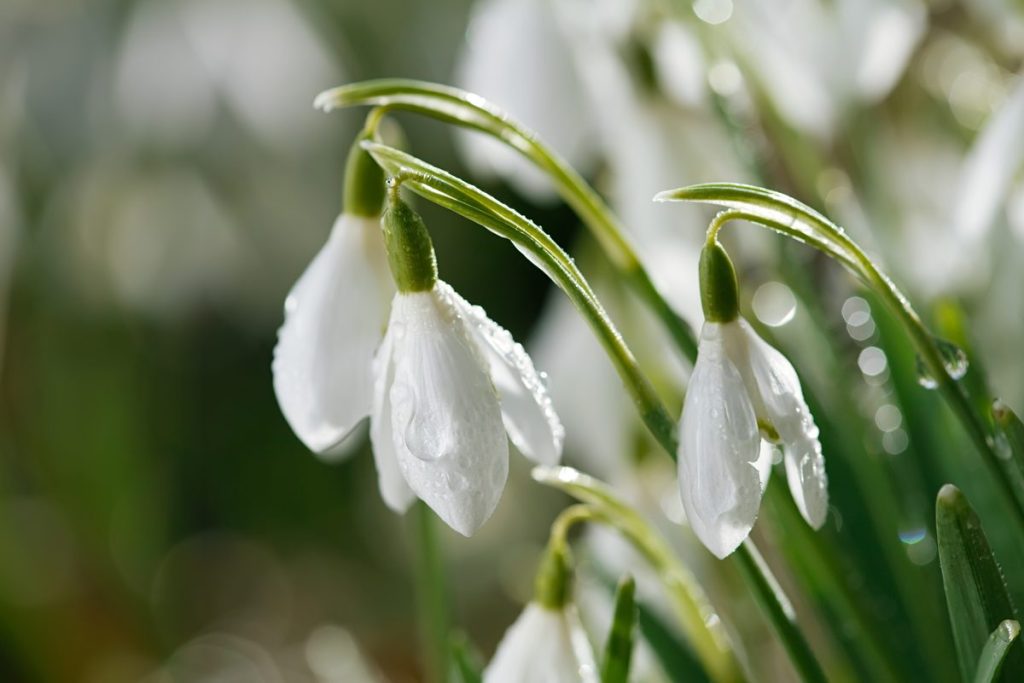
Each stem carries a single nodding, often honey-scented flower. There are three larger outer tepals that flare open and three smaller inner tepals, each marked with a single green inverted V or bridge shape at the tip. Flowering runs from January to March, usually peaking in February, earlier in mild coastal gardens and later in cold northern sites.
Snowdrop look-alikes you will meet
Older estates and churchyards often hold a mix of snowdrops. These are the ones to know:
- Double snowdrop (G. nivalis ‘Flore Pleno’): the same leaves, but a ruffled centre of extra inner tepals. It is sterile, so it spreads only by bulb offsets.
- Giant snowdrop (G. elwesii): taller (15–30 cm) with broad blue-green leaves over 2 cm wide, one wrapped around the other, and usually two green marks on each inner tepal.
- Pleated snowdrop (G. plicatus): broad leaves with the edges folded back. It crosses freely with the common snowdrop to give the vigorous hybrid G. × valentinei, now recorded in around 150 squares in Britain.
- Green snowdrop (G. woronowii): shiny bright green leaves with no grey bloom.
- Snowflakes (Leucojum): a different genus with six equal tepals, each tipped green, and glossy dark leaves.
For a traditional naturalised drift, single-flowered G. nivalis is the sensible choice. It sets seed, it offers pollen and nectar, and it looks right in grass and under deciduous trees.
Snowdrops and wildlife in late winter
Snowdrops flower when almost nothing else does. On mild days, honeybees, early bumblebees and hoverflies visit single flowers for pollen and nectar. Honeybees tend to fly once temperatures reach around 8 °C, gathering pollen to feed the first brood of the year.
Research gives a useful picture of what the flower provides. A 2024 study of wild snowdrops found the nectar is sugar-rich and contains high levels of proline, an amino acid bees value, with secretion peaking in the morning. A 2020 study with buff-tailed bumblebees found both the downward-facing flower and the green marks on the inner tepals help attract them.
Be realistic about scale, though. Some UK beekeepers note snowdrop nectar can be modest in cold weather, and many bumblebee queens are still hibernating in January. Snowdrops are a useful early stepping stone rather than a main food source. They work best as part of a planting that carries on into spring with native wildflowers for pollinators.
Deer, rabbits and voles generally leave snowdrops alone because of their alkaloids, although squirrels sometimes dig up freshly planted bulbs.
The law, CITES and buying snowdrops responsibly
The snowdrop is not a protected species in Britain, but two rules matter to anyone buying or moving bulbs.
First, under Section 13 of the Wildlife and Countryside Act 1981, it is an offence for anyone except the landowner, occupier or someone with their permission to uproot any wild plant. That covers naturalised snowdrops in woods, verges and churchyards. Spring demand for snowdrops in the green has, in the past, encouraged illegal digging, so provenance matters.
Second, the whole Galanthus genus has been listed on CITES Appendix II since 1990 because of the scale of wild bulb collection. Turkey exported tens of millions of wild-dug bulbs in the 1990s, and Georgia still exports green snowdrops under a quota. International trade now needs CITES permits.
Before you buy, ask your supplier five things:
- Are the bulbs nursery-propagated rather than wild-collected?
- If imported, what is the country of origin, and is there CITES paperwork?
- For in-the-green plants, were they lifted from cultivated stock rather than woods or churchyards?
- For dry bulbs, are they current-season stock stored cool so they have not dried out?
- Have they been checked for grey mould and bulb fly damage?
Snowdrops in the green versus dry bulbs
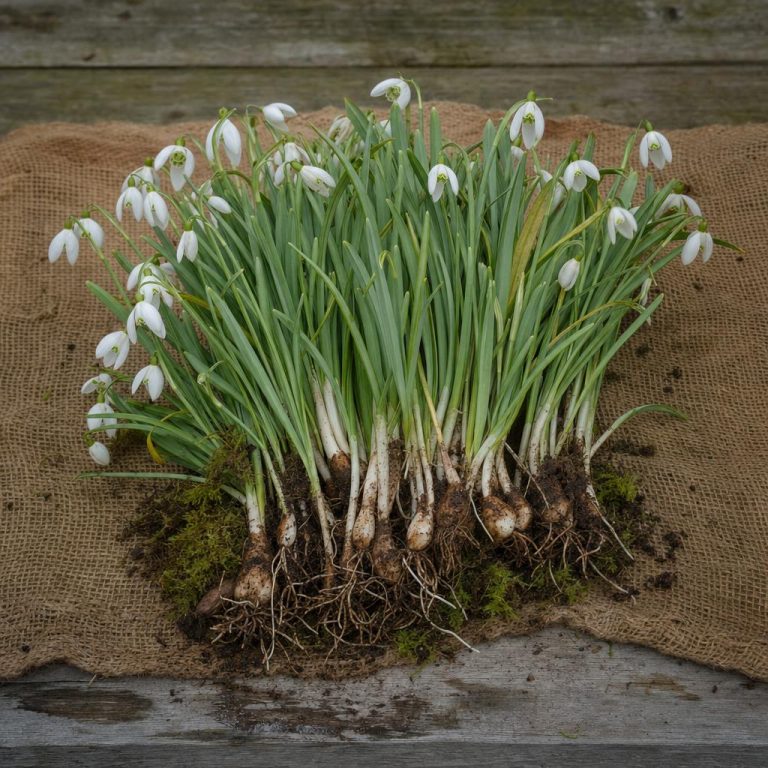
This is where most snowdrop plantings succeed or fail. Snowdrop bulbs have very thin outer skins and dry out quickly once lifted. A dry bulb that has shrivelled in a warm shop often fails to root, sits dormant for a year or two, or rots.
Research at Warwick HRI found dry bulbs keep well only when stored cool (13–17 °C) in sand or loosely closed polythene. Few retail bulbs get that treatment. That is why the Royal Horticultural Society (RHS) recommends planting snowdrops in the green, as growing plants straight after flowering, or buying dry bulbs as soon as they appear in autumn and planting them at once.
There is no peer-reviewed trial comparing the two methods directly, so treat the common claim that in-the-green plants flower a year sooner with some caution. The practical logic is sound, though: a plant in leaf with live roots is far less likely to have dried out. Plant on the day it arrives. For a fuller comparison across species, see our guide to what arrives in the box.
How to plant and naturalise snowdrops
Snowdrops are not fussy about soil type. They grow on chalk, clay, loam and sand across acid, neutral and alkaline conditions, provided the ground stays moist in summer and does not sit waterlogged in winter. Partial shade under deciduous trees and shrubs is ideal; full sun works if the soil stays moist. Our soil types guide for native bulbs covers the differences site by site.
Working figures, mostly from horticultural practice rather than formal trials:
- Planting window: dry bulbs in September–October as soon as available; in the green from February to March, or late spring as leaves yellow.
- Depth: 5–8 cm for dry bulbs; in the green, match the pale band on the stem showing the old soil level.
- Spacing: 5–8 cm apart in loose clusters of 15–25, with clusters scattered rather than in rows.
- Density: around 10 bulbs per m² as a starting scatter, or 25–50 per m² for a quicker drift.
- Time to establish: 2–5 years to a good clump; seedlings take 3–5 years to flower.
In turf, slit planting keeps disturbance low. Cut an H or a wedge with a sharp spade, lift the flap, set a small cluster in, and firm the turf back down. Step-by-step instructions are in our snowdrop planting guide, and the native bulb planting calendar shows how snowdrops fit the year alongside other species.
One finding from the Warwick trials is worth taking to heart: over-sowing snowdrops with vigorous rye-grass sharply cut their growth. Snowdrops do best in a thin, low-fertility sward or under trees, not in dense agricultural grass.
Good companions include winter aconite, hellebores, primroses and lungwort, followed by later woodland-edge plants. Where you want a fuller ground layer under trees, a woodland and heavy shade wildflower mix carries interest on after the snowdrops die back.
Aftercare: mowing, dividing and what goes wrong
Once established, snowdrops need very little. The one rule that matters is to protect the leaves after flowering. They are rebuilding the bulb for next winter’s flower.
- Leave foliage at least six weeks after flowering, until it yellows and collapses naturally, before mowing or strimming.
- Divide congested clumps as the leaves yellow in late spring, or straight after flowering. Ease the clump out, split it into small groups, and replant at once at the same depth.
- Mulch lightly with leaf mould on dry sites. Trials found a straw mulch also helped by delaying leaf die-back.
Common snowdrop problems
The main disease is snowdrop grey mould (Botrytis galanthina), which is specific to snowdrops and worst in mild winters. Shoots collapse under grey fuzz and small black sclerotia form on the bulbs. There is no garden treatment: lift and destroy affected bulbs and do not replant in that spot.
Narcissus bulb fly also attacks snowdrops. Its larva hollows the bulb from the base. Firming the soil around dying foliage in May–June makes egg-laying harder. Narcissus leaf scorch, slugs and swift moth caterpillars cause occasional damage.
Most failures trace back to four things: bulbs that dried out before planting, summer drought on thin sandy soils, waterlogged winter ground, or mowing too early.
Snowdrop safety, names and history
All parts of the snowdrop are toxic if eaten, the bulbs especially, because they contain alkaloids including lycorine and galantamine. Eating bulbs or leaves causes nausea, vomiting and diarrhoea. The PDSA and Blue Cross list snowdrops as poisonous to dogs, cats and rabbits. Poisoning in cattle, horses and sheep has been recorded but is rare. Wear gloves when handling bulbs and keep new plantings out of reach of dogs that dig; the PDSA suggests wire mesh until established.
The name Galanthus comes from the Greek for “milk flower”; nivalis means “of the snow”. The English name “snowdrop” first appeared in 1633. In Welsh the snowdrop is eirlys, from eira (snow) and llys (plant), with older names such as blodyn yr eira, “flower of the snow”, and cloch maban, “baby bell”. Candlemas on 2 February is the date most often linked to snowdrops in folklore.
Snowdrops also gave medicine galantamine. Bulgarian scientists standardised it in 1959, and since 2000 it has been used to ease the symptoms of mild to moderate Alzheimer’s disease. The Victorian craze for collecting snowdrop varieties, “galanthomania”, is still going strong.
Wildahome snowdrops for naturalising
If you want a traditional drift under trees or in a churchyard or orchard, start with the single common snowdrop. Our snowdrop bulbs (Galanthus nivalis) come from established British growers and are sold as dry bulbs for autumn planting. Plant them as soon as they arrive.
For more reliable establishment, choose snowdrop bulbs in the green, delivered between January and April as growing plants. If you want the ruffled double form for a garden setting, there are double snowdrops in the green too, with dry bulbs of the double snowdrop and the larger giant snowdrop available for autumn.
For a mixed late-winter display, the Wildflower Favourites Bulb Collection combines snowdrops with bluebells and winter aconites. You can browse every species in our native bulbs range or the bulbs in the green range.
Planning a larger planting?
If you are planning snowdrops across a churchyard, estate drive or orchard, it pays to think about the whole year, not just February. Tell us about your site, its soil and shade, and what grows there already, and we will suggest how to combine bulbs with a ground layer that suits it. Start with our free advice service or get in touch with a few photos.
Frequently Asked Questions
Are snowdrops native to the UK?
No. BSBI and Kew classify the common snowdrop as a naturalised introduction. It was grown in British gardens by 1597 but not recorded in the wild until 1778. It is now widespread across Britain, but it should be kept to gardens, churchyards and parkland rather than planted into ancient woodland.
When do snowdrops flower in the UK?
Snowdrops in the UK flower from January to March, usually peaking in February. They open earlier in mild coastal and southern gardens and later in cold, exposed or northern sites. Each flower lasts several weeks in cool weather.
Why didn’t my dry snowdrop bulbs come up?
Most likely they dried out before planting. Snowdrop bulbs have thin skins and lose moisture quickly in warm storage. Desiccated bulbs often fail to root, stay dormant for a year or two, or rot. Plant dry bulbs the day they arrive, or plant in the green instead.
When should I plant snowdrops in the green?
Plant in the green straight after flowering while the leaves are still green, usually February to March, or as the foliage begins to yellow in late spring. Plant on the day of delivery, at the same depth they grew before, and water in if the soil is dry.
How deep and how far apart should I plant snowdrop bulbs?
Plant dry snowdrop bulbs 5–8 cm deep and 5–8 cm apart, pointed end up, in informal clusters of 15–25. For in-the-green plants, match the pale band on the stem that shows the previous soil level.
Is it illegal to dig up wild snowdrops in the UK?
Yes, without permission. Under Section 13 of the Wildlife and Countryside Act 1981, only the landowner, occupier or someone authorised by them may uproot a wild plant, including naturalised snowdrops. Always buy nursery-propagated bulbs rather than digging from woods or churchyards.
Are snowdrops poisonous to dogs and cats?
Yes. Snowdrops in the UK are listed by the PDSA and Blue Cross as poisonous to dogs, cats and rabbits. The bulbs are most toxic and can cause vomiting, diarrhoea and drooling. Cover new plantings with mesh if your dog digs, and contact a vet if you suspect bulbs have been eaten.
Ready to get started?
Shop: Traditional Wildflower Meadow Mix →Native bulb hub
- All native bulbs for autumn planting, plus every bulb guide
- Bulbs in the green for late-winter and spring planting
- What arrives in the box: bulbs, tubers and bulbs in the green
- How to plant wildflower bulbs
- Native bulb planting calendar
- Native wildflower bulbs by soil type
- How to plant snowdrop bulbs
- Native bluebell bulbs: buying and planting
- Growing wild garlic from bulbs and seed
- Winter aconite: identification, planting and where it belongs
- Wild daffodil and Tenby daffodil guide
- Tenby daffodil: history, identification and growing Wales's own daffodil
- Snake's head fritillary: floodplain meadows, planting and care
- Wood anemone: the ancient woodland windflower
- Native bluebell vs Spanish bluebell: identification and law