

Tenby Daffodil: History, Identification and Growing Wales’s Own Daffodil
Every spring, on hedgebanks and road verges in south-west Wales, a short, sturdy golden daffodil opens weeks before most others. This is the Tenby daffodil, Narcissus obvallaris, a plant so closely tied to Pembrokeshire that it carries the town’s name in English and in Welsh: Cenhinen Bedr Dinbych, the daffodil of Dinbych-y-pysgod.
It is also one of the more mysterious plants in the British flora. Nobody knows for certain where it came from. It was dug almost to extinction in the wild to feed the Victorian bulb trade, then forgotten for most of a century, and only rediscovered because a teenager on holiday asked where he could buy some.
This guide covers the Tenby daffodil’s history and origin, how to identify it, where to see it, and how to grow it well in gardens, orchards, churchyards and rough grass. If you are planting in Wales, or want an early, compact daffodil with real character, it is hard to beat.
How to identify the Tenby daffodil
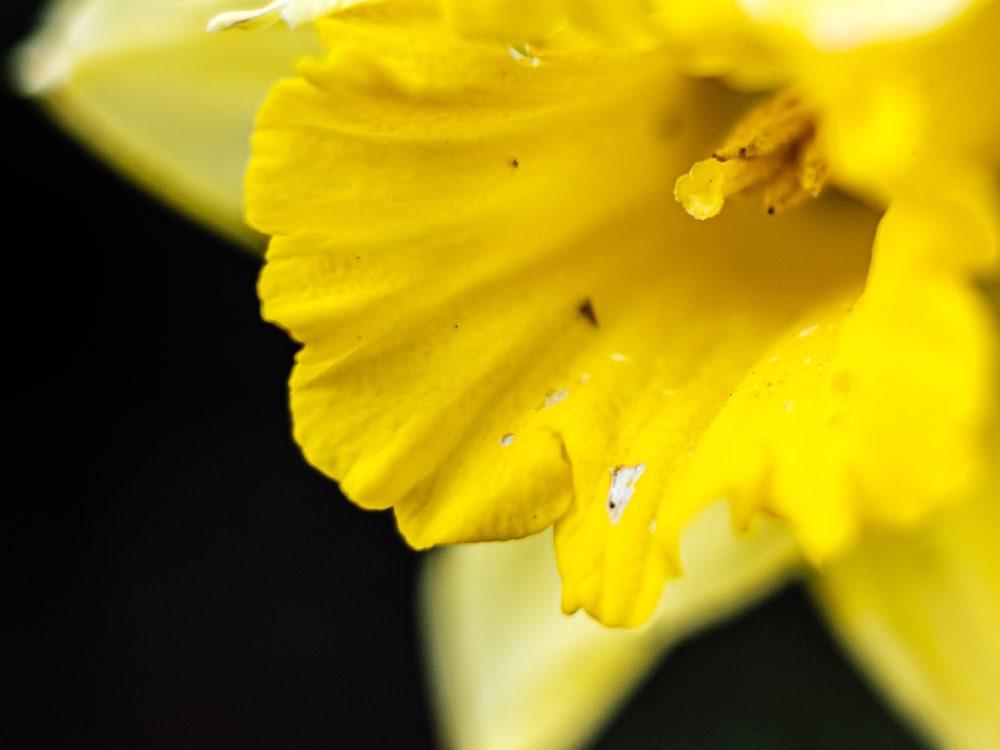
The Tenby daffodil is a dwarf trumpet daffodil, usually 20–30 cm tall. The RHS describes it as a bulbous perennial to 30 cm with glaucous, strap-shaped leaves and solitary bright yellow flowers with flared trumpets.
Look for:
- Short, stiff stems that hold the flower up well in wind and rain.
- Narrow grey-green leaves with a waxy bloom.
- A single golden flower on each stem, with a smooth-textured, flared trumpet. Richard Mabey describes the outer petals as held at right angles to the trumpet.
- Early flowering, mainly February to March, often around St David’s Day on 1 March.
Sources differ on colour. Country Life and many growers describe it as uniformly bright yellow. The RHS notes slightly paler outer petals, and the National Botanic Garden of Wales describes pale yellow petals around a darker trumpet. In practice, its short stature, stiff stems, early flowering and neat proportions identify it better than colour alone. The great daffodil expert E. A. Bowles praised exactly those proportions.
Tenby daffodil or wild daffodil?
The native wild daffodil, or Lent lily (N. pseudonarcissus subsp. pseudonarcissus), is a slightly taller, more delicate plant of old woods and pastures. It flowers later, in March and April, and has a softer, nodding, distinctly two-tone flower: pale primrose outer petals around a deeper golden trumpet. The Tenby daffodil is stockier, earlier and bolder.
Tenby daffodil or garden daffodil?
Most garden daffodils are taller (35–50 cm or more), with broader, brighter green leaves and larger flowers, often double or multi-headed. The Tenby daffodil is smaller and neater. Its RHS horticultural classification is Division 13, the group for wild species and their natural forms.
Where did the Tenby daffodil come from?
The honest answer is that nobody knows. The plant was first described and named Narcissus obvallaris by the botanist R. A. Salisbury in 1796. The meaning of obvallaris is unclear; the Welsh botanist T. B. Rhys took it to mean “well protected”, after the sturdy crown of the flower.
Its status is still debated. The RHS and NBN Atlas treat it as a species in its own right. Plantlife and others treat it as a subspecies of the wild daffodil, N. pseudonarcissus subsp. obvallaris, and suggest it may first have been a cultivated plant that went wild. The National Botanic Garden of Wales notes that its claimed uniqueness to Britain is disputed. A 1924 botanical report logged it as an “alien” collected at Tenby.
Several theories have been put forward for how it reached Pembrokeshire, none proven:
- Medieval monks may have brought it from the continent to Pembrokeshire’s religious houses, as an ornamental or medicinal plant. Against this, no matching colonies are known in France or Italy.
- Flemish settlers, who arrived in south Pembrokeshire in the early 12th century, are sometimes credited.
- A local hybrid of an introduced daffodil that became dominant has also been suggested.
- Phoenician traders sheltering at Saundersfoot, swapping bulbs for anthracite, is the most romantic story and the least likely.
Treat all of these as possibilities and folklore rather than history. What is certain is that by the early 19th century the Tenby daffodil grew in great numbers in the fields around the town.
The Victorian bulb trade and the Tenby daffodil’s near loss
As Victorian gardening boomed, the Tenby daffodil became a commercial crop dug from the wild. According to accounts gathered by Country Life, a Tenby nurseryman named Shaw, who probably coined the name “Tenby daffodil”, supplied huge quantities to London bulb wholesalers and Covent Garden. He employed collectors who scoured much of south Pembrokeshire for several seasons. A heaped cartload after three days’ collecting could sell for £160 or more. Local farmers, who regarded the plants as weeds, often parted with them for very little.
By the turn of the 20th century, few wild plants remained. The National Botanic Garden of Wales describes it as having almost become extinct when wild bulbs were dug up across Wales to satisfy the late-Victorian craze.
For most of the following century the Tenby daffodil was largely forgotten, even in Tenby. Interest revived in the early 1970s, when a teenage boy on holiday asked the town’s tourist information office where he could buy Tenby daffodil bulbs for his aunt. The local tourism director had never heard of it, discovered the town had its own daffodil, and made it part of local celebrations. Replanting has since brought it back to verges and banks around Tenby.
Where to see Tenby daffodils
Today the Tenby daffodil survives mainly as a planted and naturalised flower in south-west Wales, scarce as a truly wild plant. The RHS lists its range as Pembrokeshire, Carmarthenshire and Ceredigion. Good places to look in February and March include:
- Around Tenby itself, including Castle Hill.
- Village hedgebanks in south Pembrokeshire and west Carmarthenshire, for example between Meidrim and Narberth.
- Roadside banks, churchyards and approach roads in Ceredigion.
- The Springwoods at the National Botanic Garden of Wales in Carmarthenshire, which runs a daffodil trail each spring.
Isolated records also exist in Shropshire, the Isle of Wight and County Wexford in Ireland.
The Tenby daffodil and Welsh identity
The leek (cennin) is the older Welsh emblem. The daffodil joined it in the early 20th century, helped by its Welsh name, cenhinen Bedr, “Peter’s leek”, and by flowering around St David’s Day. The RHS describes the Tenby daffodil as the variety most often cited as the Welsh daffodil.
In fact, most daffodils worn on 1 March are modern garden cultivars. Planting Tenby daffodils is a way of putting the real Welsh daffodil back into the landscape, whether on a farm bank, a village green, a school ground or a churchyard. Other Welsh names recorded for daffodils include blodyn Mawrth, “March flower”, and croeso’r gwanwyn, “spring’s welcome”.
Growing Tenby daffodils
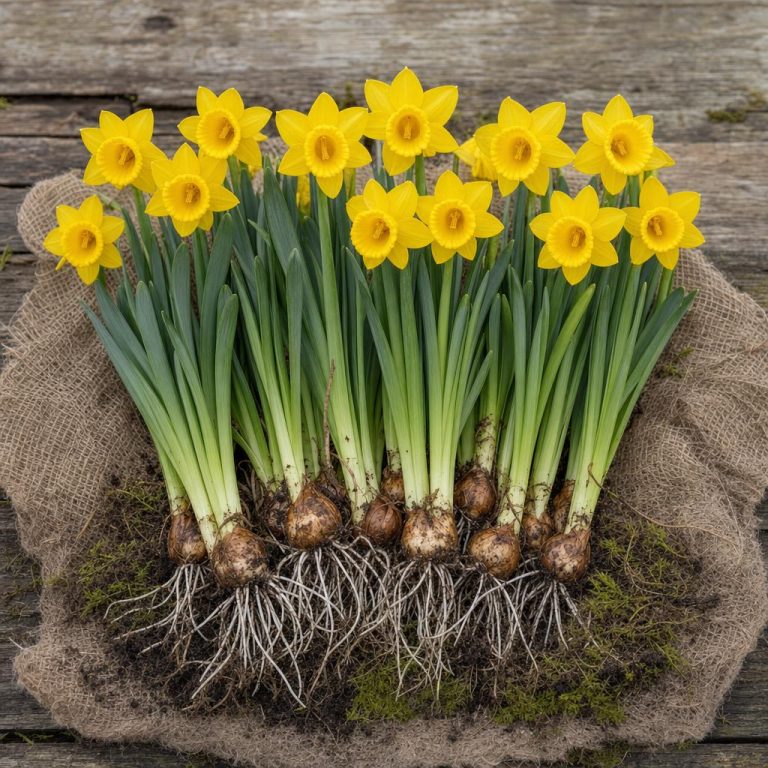
The Tenby daffodil is one of the easiest daffodils to naturalise. The RHS gives a time to maturity of just 1–2 years, faster than the 2–5 years it gives for the wild daffodil, and the plant holds the RHS Award of Garden Merit.
Where to plant
Tenby daffodils grow in full sun or light shade, on chalk, clay, loam or sand, across acid to alkaline soils. They want ground that stays moist in spring and drains well, and they dislike permanent waterlogging and deep shade. Their short, stiff stems make them a good choice for exposed and coastal sites where taller daffodils flop.
Good places include:
- rough grass, orchards and paddock edges
- hedgebanks and road verges on your own land
- churchyards, village greens and school grounds
- the front of borders and under deciduous trees
When and how to plant
- Dry bulbs: plant in early autumn, ideally September, as soon as they arrive.
- In the green: plant growing plants straight after flowering in spring, at the depth shown by the pale stem base, and water in.
- Depth: about 10–15 cm for dry bulbs, roughly three times the height of the bulb.
- Spacing: 7–12 cm apart in irregular groups. Scatter a handful and plant where they fall for a natural look.
- Density: suppliers suggest 75–100 bulbs per m² for a full display, fewer for a sparse meadow effect.
Our native bulb planting calendar shows how Tenby daffodils fit the year, and the guide to what arrives in the box explains dry and in-the-green stock.
Companions
On Welsh banks and in meadows, Tenby daffodils sit naturally with primroses, cowslips and lesser celandine, followed by summer meadow flowers. A hedgerow and banks wildflower mix or a coastal meadow mix carries the season on once the daffodils fade, and yellow rattle helps keep the grass open in meadow areas.
Aftercare
- Leave the leaves for at least six weeks after flowering, until they yellow, before mowing or cutting.
- Never knot or tie the foliage. It reduces flowering the following year.
- Leave spent flowers in grass so they can set seed; deadhead only in borders.
- Divide crowded clumps as the leaves fade in early summer and replant at once.
The RHS lists narcissus basal rot, narcissus leaf scorch and daffodil viruses as possible problems. Narcissus bulb fly also attacks daffodils: firm the soil around fading stems in May and June, and lift and destroy soft bulbs rather than composting them. Our general guide to planting wildflower bulbs covers aftercare across species.
Buying Tenby daffodils responsibly
The Tenby daffodil was nearly lost because wild bulbs were dug for sale. Do not repeat that. Under Section 13 of the Wildlife and Countryside Act 1981, it is an offence to uproot any wild plant without the landowner’s permission, and colonies on verges and banks are not free stock.
Buy nursery-propagated bulbs labelled Narcissus obvallaris. If you are planting close to a native wild daffodil colony, such as an old wood with Lent lilies, keep a sensible distance to avoid crossing the two, or plant the wild daffodil there instead.
Is the Tenby daffodil poisonous?
Yes. Like all daffodils, every part of the Tenby daffodil is toxic if eaten, the bulbs especially. They contain lycorine and other alkaloids. Daffodil bulbs have been mistaken for onions, so store and label them well away from edible bulbs. Sap can irritate skin, so wear gloves when handling large numbers.
Daffodils are poisonous to dogs, cats and horses. Contact a vet straight away if you suspect poisoning; the Animal PoisonLine is on 01202 509000. Keep livestock away from dug-up bulbs and cut flower debris.
Wildahome Tenby daffodils
Our Tenby daffodil bulbs (Narcissus obvallaris) are sold as dry bulbs for autumn planting. For the quickest start and exact placement in existing turf, choose Tenby daffodils in the green, delivered as growing plants between January and April.
For later flowers in woods and old pasture, see our wild daffodil bulbs. Browse every species in our native bulbs range and the bulbs in the green range, or read why local provenance matters.
Planting for a Welsh site
Whether it is a farm bank in Pembrokeshire, a churchyard in Ceredigion or a community project anywhere in Wales, we can help you plan Tenby daffodils alongside a native seed mix that suits your soil and exposure. Use our free advice service or get in touch with a few photos of the site.
Frequently Asked Questions
What is a Tenby daffodil?
The Tenby daffodil (Narcissus obvallaris) is a dwarf, early-flowering golden trumpet daffodil, 20–30 cm tall, closely associated with Tenby and south-west Wales. It was named in 1796 and is often described as the true Welsh daffodil.
Is the Tenby daffodil native to Wales?
Its origin is uncertain. The RHS and NBN Atlas treat it as a distinct species, while Plantlife suggests it may have begun as a cultivated form that naturalised in south-west Wales. Theories involving monks, Flemish settlers and traders remain unproven.
When does the Tenby daffodil flower?
The Tenby daffodil flowers early, mainly in February and March, often in time for St David’s Day on 1 March. It opens a few weeks before the native wild daffodil, which flowers in March and April.
How tall does the Tenby daffodil grow?
Usually 20–30 cm. Its short, stiff stems hold the flower upright in wind and rain, which makes it a good choice for exposed, coastal and hedgebank sites.
Why is the Tenby daffodil rare in the wild?
In the 19th century wild bulbs around Tenby were dug in huge quantities and sent to London’s bulb trade. By 1900 few wild plants remained. Replanting since the 1970s has brought it back to verges and banks in Pembrokeshire.
When should I plant Tenby daffodil bulbs?
Plant dry Tenby daffodil bulbs in early autumn, ideally September, about 10–15 cm deep and 7–12 cm apart. Plants bought in the green go in straight after flowering in spring. The RHS gives 1–2 years to maturity.
Where can I see Tenby daffodils?
Look around Tenby, including Castle Hill, on village hedgebanks in south Pembrokeshire and west Carmarthenshire, on verges in Ceredigion, and in the Springwoods at the National Botanic Garden of Wales. They flower in February and March.
Ready to get started?
Shop: Traditional Wildflower Meadow Mix →Native bulb hub
- All native bulbs for autumn planting, plus every bulb guide
- Bulbs in the green for late-winter and spring planting
- What arrives in the box: bulbs, tubers and bulbs in the green
- How to plant wildflower bulbs
- Native bulb planting calendar
- Native wildflower bulbs by soil type
- How to plant snowdrop bulbs
- Native bluebell bulbs: buying and planting
- Growing wild garlic from bulbs and seed
- Snowdrops in the UK: native status, identification and naturalising
- Winter aconite: identification, planting and where it belongs
- Wild daffodil and Tenby daffodil guide
- Snake's head fritillary: floodplain meadows, planting and care
- Wood anemone: the ancient woodland windflower
- Native bluebell vs Spanish bluebell: identification and law