

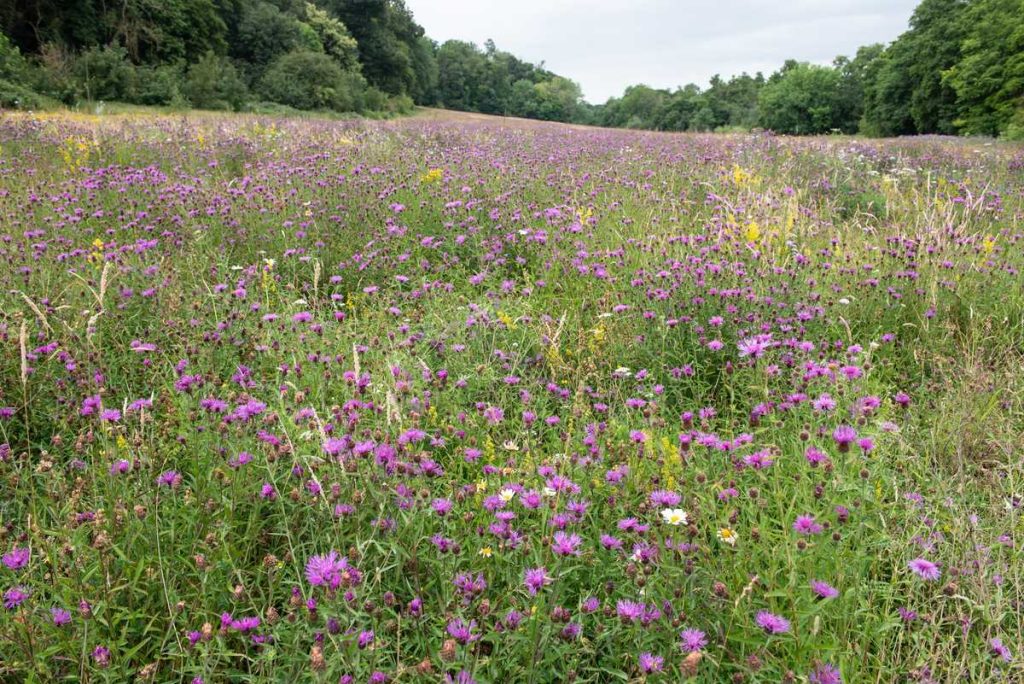
Wildflower to Grass Ratio: Choosing Between 100%, 80/20 and 50/50
Quick answer: The wildflower to grass ratio is the share of a seed mix, by weight, that is wildflower seed rather than meadow grass seed. An 80/20 mix (20% wildflowers) suits most meadows and larger areas. A 100% wildflower mix suits small areas and over-sowing existing grass. In-between ratios such as 50/50 give more flowers in the early years at a moderate cost. After three to five years, soil fertility and cutting have more effect on the balance than the ratio you sowed.
The question we’re asked most often after "which mix?" is "how much grass should be in it?". Customers look at an 80/20 meadow mix, see that four-fifths of it is grass, and wonder whether they’re paying for a lawn. Others buy a 100% wildflower mix for a big area and get a shock at the price.
The wildflower to grass ratio matters, but not always in the way people expect. It shapes cost, first-year appearance, how the ground holds together and how the meadow behaves while it settles. It does not, on its own, decide what the meadow looks like in year five.
This guide explains what the numbers mean, why most meadow mixes are 80/20, when 100% is the better choice, and when an in-between ratio such as 70/30 or 50/50 earns its place. It also shows how we blend those in-between ratios and the sowing rate for each.
What a wildflower to grass ratio actually means
The ratio describes the seed in the bag, not the meadow you’ll see. An 80/20 mix is 80% grass seed and 20% wildflower seed by weight. A 100% wildflower mix contains no grass seed.
Two things trip people up.
It is measured by weight, not by number of seeds
Seeds vary enormously in size. A gram of a small-seeded flower such as ox-eye daisy (Leucanthemum vulgare) holds far more seeds than a gram of a large-seeded one such as yellow rattle (Rhinanthus minor) or a meadow grass. So a mix that is 20% wildflower by weight can contain a much larger share of wildflower seeds by count.
Some specialist and direct-harvest mixes quote percentages by seed number instead. Two mixes labelled "40% wildflowers" can therefore be quite different. When you compare suppliers, check which measure they use. All Wildahome percentages are by weight.
It is not the ratio of flowers to grass you’ll see
Grasses and wildflowers germinate and grow at different speeds. Annuals flower in the first Summer, while many perennials take two or three years. Grass from the surrounding sward moves in whatever you sow. The visible balance changes year by year and settles according to fertility and management.
Why most meadow mixes are 80/20
The 80/20 wildflower mix became the standard for good reasons. Traditional hay meadows are grassland first: a fine-leaved sward with flowers threaded through it. The grass is part of the habitat, not filler.
- Structure. Fine grasses give the sward body, so taller flowers are supported and the meadow stands through Summer rain.
- Insect food. The caterpillars of several common meadow butterflies, including meadow brown and marbled white, feed on grasses. A meadow without grass loses them.
- Ground cover. Grass closes the gaps between slower wildflower seedlings, which keeps out docks, thistles and other weeds.
- Erosion and wear. On banks, verges and anywhere people walk, grass roots hold the soil.
- Cost. Grass seed is far cheaper per kilo than wildflower seed, which matters across larger areas.
The grasses in a good meadow mix are not lawn or agricultural grasses. They are slow-growing, fine-leaved species such as crested dog’s-tail (Cynosurus cristatus), red fescues and bents, chosen because they don’t overwhelm the flowers on low-nutrient ground. Ryegrass has no place in a meadow mix.
Our 80/20 mixes sow at 5 g/m² (50 kg per hectare).
When a 100% wildflower seed mix is the better choice
A 100% wildflower seed mix contains no grass and sows at 3 g/m² (30 kg per hectare). It is the better choice in four situations.
- Over-sowing existing grassland. If you’re adding wildflowers to an existing sward, the grass is already there. Adding more grass seed makes no sense. Scarify until at least half the surface is bare and sow a 100% mix, ideally with yellow rattle.
- Small areas. In a garden bed, a strip along a path or a few square metres by a pond, the cost difference is small and the flower display is noticeably stronger.
- Strips next to grass. Where a bed borders mown grass or an existing meadow, grasses will spread in from the edges anyway.
- Maximum flower in the early years. Where the point of the area is display, such as a school garden or a visible verge, more wildflower seed means more flowers sooner.
The trade-offs are cost per square metre on large areas, and ground that stays more open in the first year. Open ground gives weeds a chance unless the seedbed was properly prepared. A 100% area also won’t stay grass-free. Within a few years grasses arrive from the surroundings, which is normal and, within limits, healthy.
The middle ground: 70/30, 60/40 and 50/50 mixes
Many customers sit between the two. They want a proper meadow with grass in it, but they want it to look like a wildflower meadow from the second Summer, not the fourth. That is where in-between ratios come in.
A 70/30 wildflower mix (30% wildflowers) gives a modest step up in flower from an 80/20. A 50/50 wildflower and grass seed mix is the most popular in-between choice: noticeably more flowery in the early years, while keeping enough grass to hold the ground and support grass-feeding insects.
In-between ratios tend to suit:
- visible areas, such as the front of a property, a village green edge or a holiday park entrance, where the early impression matters
- ground that is already fairly poor in nutrients, where a grassier mix may look thin for longer than you’d like
- people who sowed an 80/20 before and found it too grassy for their taste
- medium-sized areas, roughly a few hundred square metres to a quarter of a hectare, where 100% is a big jump in cost
How we make an in-between ratio
We make in-between ratios by blending the 100% and 80/20 versions of the same habitat mix by weight. Because the 80/20 is already 20% wildflower, the wildflower share of the blend is 20% plus 80% of the share taken from the 100% mix.
| Wildflower : grass | 100% mix | 80/20 mix | Per 1 kg of seed |
|---|---|---|---|
| 20 : 80 (standard) | 0% | 100% | 1,000 g of 80/20 |
| 30 : 70 | 12.5% | 87.5% | 125 g + 875 g |
| 40 : 60 | 25% | 75% | 250 g + 750 g |
| 50 : 50 | 37.5% | 62.5% | 375 g + 625 g |
| 60 : 40 | 50% | 50% | 500 g + 500 g |
| 100 : 0 | 100% | 0% | 1,000 g of 100% |
Blending two versions of the same habitat keeps the species suited to the soil. One caution: our 100% and 80/20 versions of a habitat don’t always carry identical flower lists, so a blend contains species from both. We’ll tell you exactly what’s in yours. Not every mix contains yellow rattle, so where a blend has little or none, we can add it, or add extra on grassier ground. You can order any of these ratios as a bespoke wildflower seed mix.
Sowing rates for each ratio
Sowing rate falls as the wildflower share rises, because a 100% mix needs less seed per square metre.
| Ratio | Sowing rate (about) | Per hectare (about) |
|---|---|---|
| 20 : 80 | 5 g/m² | 50 kg |
| 30 : 70 | 4.75 g/m² | 47.5 kg |
| 40 : 60 | 4.5 g/m² | 45 kg |
| 50 : 50 | 4.25 g/m² | 42.5 kg |
| 60 : 40 | 4 g/m² | 40 kg |
| 100 : 0 | 3 g/m² | 30 kg |
Add up to 30% on slopes, exposed sites and when over-sowing. Mix the seed with three to four parts dry sand to one part seed so it spreads evenly. Sow on the surface, no deeper than about 5 mm, and roll or tread it in.
What success looks like over time at each wildflower to grass ratio
Whatever the ratio, a meadow takes three to five years to settle. Here is what to expect.
Year one
Annuals such as common poppy and cornflower flower where they’re in the mix, and yellow rattle appears in late Spring if it went in the previous Autumn. Perennials are building roots and may only show as rosettes. A 100% or 50/50 area looks more open and more flowery. An 80/20 can look mostly green, which is normal. Cut to 50–60 mm whenever growth reaches 100–150 mm, and remove the cuttings.
Year two
The perennials start to flower. This is often the year the ratio shows most clearly, with higher-wildflower sowings giving a denser display. It is common for one species, often ribwort plantain or ox-eye daisy, to dominate for a season. That is part of the settling process, not a failure.
Years three to five
The differences between ratios narrow. Fertility, the timing of the hay cut, whether cuttings are removed and whether yellow rattle has taken now decide the balance. A well-managed 80/20 on poor ground can end up more flowery than a neglected 100% sowing on rich soil.
That is the honest message of this guide. Ratio buys you a head start and a particular early character. Management decides the meadow you keep.
Matching the ratio to your site and how you’ll manage it
Do this
- Choose a higher wildflower share for small or highly visible areas, for over-sowing, and where you can’t wait for an 80/20 to fill out.
- Stay at 80/20 for larger areas, slopes, verges and anywhere people walk or animals graze.
- Match the habitat first, then the ratio. The wrong mix for your soil fails at any ratio. Pick the habitat (clay, chalk, loam, wet, acidic, shade) before you think about the ratio.
- Plan for yellow rattle in any meadow with grass in it, sown in Autumn and on the ground by the end of November.
- Commit to cut and remove. An annual hay cut in late July or August to 50–75 mm, with the cuttings taken off, keeps fertility falling and the flowers competitive.
Avoid this
- Buying a high-wildflower mix to make up for fertile ground. On rich soil, grasses and weeds win whatever you sow. Reduce fertility first.
- Adding compost, manure, topsoil or fertiliser. It favours grass and weeds over wildflowers at every ratio.
- Sowing 100% wildflower on a steep or bare bank that needs holding together quickly.
- Expecting the sown ratio to hold. It won’t, and it doesn’t need to.
Common mistakes when choosing a ratio
Comparing percentages across suppliers without checking the measure. By weight and by number give very different figures for the same mix.
Judging an 80/20 in its first Summer. It often looks grassy in year one and fills out in years two and three.
Assuming more wildflower always means more biodiversity. A meadow needs its grasses. Many insects depend on the sward as well as the flowers.
Paying for 100% across a large area when the ground isn’t ready. The money is better spent on reducing fertility and preparing a clean seedbed.
Ignoring the habitat. A 50/50 general purpose mix on wet clay will do worse than an 80/20 matched to wet clay.
Choosing your mix
All of our habitat mixes come in two standard formats: 100% wildflower at 3 g/m² and 80/20 grass and wildflower at 5 g/m². They cover heavy clay, chalk and limestone, loam and alluvial soils, wetland and pond margins, acidic ground, hedgerows and banks, woodland and heavy shade, coastal sites, and general purpose and traditional meadows.
If you want something in between, such as a 50/50 Heavy Clay mix or a 60/40 Traditional Meadow, we’ll blend it for you from those same mixes. That way the species stay matched to your soil, and you get the balance of flowers and grass you’re after.
Get the ratio right for your site
If you know your soil and your area, start with the standard 100% or 80/20 version of the right habitat. If you want a different balance, or your site sits between two mixes, ask us for a bespoke blend through the Ask Us form. Tell us the area, the soil, the light and how you’ll manage it. We’ll recommend a ratio and quantity and price it for your project. Before sowing, read our complete guide to establishing a wildflower meadow.
Frequently Asked Questions
What is the best wildflower to grass ratio for a meadow?
For most meadows and larger areas, 80/20 (80% grass, 20% wildflower by weight) is the best starting point. It gives structure, ground cover and habitat for grass-feeding insects at a sensible cost. Choose 100% wildflower for small areas and over-sowing existing grass, or an in-between ratio such as 50/50 where you want more flowers in the early years.
What does 80/20 mean on a wildflower seed mix?
It means the mix is 80% meadow grass seed and 20% wildflower seed by weight. Because many wildflower seeds are small, the share of wildflower seeds by number is usually higher than 20%. The grasses are fine, slow-growing native species, not lawn or agricultural grasses. An 80/20 mix sows at about 5 g/m².
Is a 50/50 wildflower and grass seed mix better than 80/20?
Not better, but different. A 50/50 gives a more flowery first few years and costs more per kilo, though it sows at a lower rate of about 4.25 g/m². An 80/20 is grassier early on but cheaper and more robust on slopes and well-used ground. After three to five years, management matters more than the starting ratio.
Do I need grass in my wildflower meadow?
In most cases, yes. Meadows are grassland habitats. Fine grasses support the flowers, cover bare ground, hold soil on banks and feed the caterpillars of butterflies such as meadow brown. Leave grass out when you’re over-sowing an existing sward or sowing a small area next to grass, which will spread in anyway.
How much 100% wildflower seed do I need per square metre?
Sow a 100% wildflower seed mix at 3 g/m², which is 30 kg per hectare. A 100 g pack covers about 33 m². Add up to 30% on slopes, exposed sites or when over-sowing into existing grass. Mix the seed with three to four parts dry sand for an even spread.
Can I make my own wildflower to grass ratio by mixing two products?
Yes, as long as both are the same habitat. Blending the 100% and 80/20 versions by weight gives any ratio between 20% and 100% wildflowers. For a 50/50, use 375 g of the 100% mix to 625 g of the 80/20. We can also blend it for you as a bespoke mix.
Why does my 80/20 meadow look mostly grass in the first year?
That is normal. Grasses establish quickly, while most perennial wildflowers spend their first year building roots. Keep cutting to 50–60 mm whenever growth reaches 100–150 mm and remove the cuttings. The wildflowers usually show strongly from the second Summer, especially if yellow rattle has taken.
Ready to get started?
Shop: Traditional Wildflower Meadow Mix →