

Wildflower Seeds for Bedfordshire: Native Mixes for the Greensand Ridge, Chalk and Ouse Valley Clay
Wildflower Seeds for Bedfordshire: Native Mixes for the Greensand Ridge, Chalk and Ouse Valley Clay
Bedfordshire packs three genuinely different landscapes into a small county. The Greensand Ridge runs through the middle from Leighton Buzzard to Gamlingay, chalk downland rises in the south around Dunstable and Luton, and heavy clay dominates the Ouse valley to the north around Bedford. A mix built for one of those zones will struggle badly on either of the other two, which makes working out where your land sits the first real decision in choosing wildflower seeds for Bedfordshire.
This guide works through Bedfordshire’s soils, the species and mixes suited to each, sowing windows and ground preparation, and the long-term management that keeps a meadow going. It also covers what’s changed for anyone working at field or development scale — the mandatory Biodiversity Net Gain requirement now applying across all three of the county’s unitary authorities, the county’s Local Nature Recovery Strategy currently in development, and where the new Tempsford growth corridor fits in. Whether you’re planting a garden meadow near Ampthill, restoring a paddock outside Bedford, or scoping a site as part of Central Bedfordshire’s growth plans, the starting point is the same: work out what your ground actually is before you order wildflower seeds for Bedfordshire.
Understanding Bedfordshire’s soils before you sow
Bedfordshire splits into three clear bands, each suiting a different mix type.
North Bedfordshire — Ouse valley clay vale. Around Bedford itself and villages like Pavenham, Thurleigh and Yelden, the underlying geology is Oxford Clay and glacial boulder clay, producing heavy, poorly-drained neutral soils. Sites like Yelden Meadows preserve a rare example of unimproved flood-meadow grassland on this clay, and Tilwick Meadow, near Thurleigh, sits on unimproved grassland over chalk boulder clay — both a clear signal this zone needs a heavy clay mix rather than anything built for chalk.
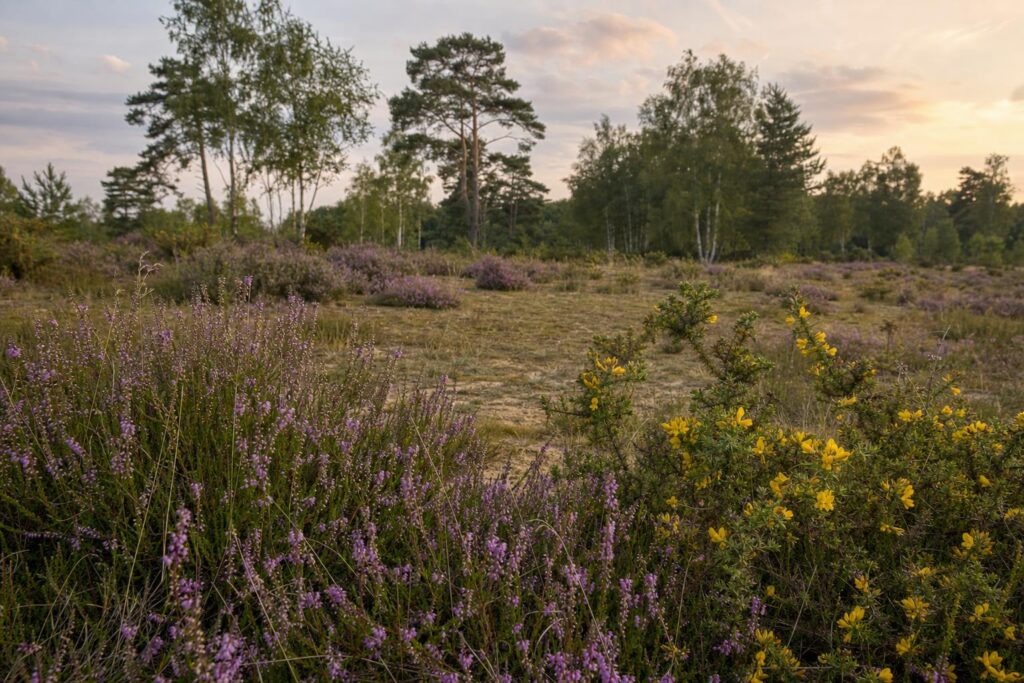
Central Bedfordshire — the Greensand Ridge. Running roughly from Leighton Buzzard and Sandy through Ampthill, Flitwick, Woburn and Clophill towards Gamlingay, this band sits on Lower Greensand, overlain in places by glacial clay, sand and gravel. Soils here are acidic and free-draining, historically poorer and less fertile than the clay vale, and known for silver sand extraction around Heath and Reach. This is acidic soils mix territory — heathland species rather than chalk calcicoles.
South Bedfordshire — chalk, the Chilterns dip-slope. Around Dunstable, Luton, Barton-le-Clay, Whipsnade, Pegsdon and Totternhoe, Cretaceous chalk forms the classic Chiltern scarp and downland. This is prime chalk and limestone mix territory, and it’s where Bedfordshire’s best-known wildflower sites cluster.
Ouse floodplain. Alongside the clay vale, the river itself has laid down genuinely alluvial ground in places, suited to a loam and alluvial mix rather than the heavier vale clay further from the water.
North of the county means heavy clay/neutral meadow mix; the middle Greensand Ridge means acidic/sandy or heathland mix; south means chalk/limestone mix. Whatever the reading, check our note on why locally sourced, provenance-matched seed really matters before ordering — matching seed to soil chemistry does more for establishment than almost any other decision you’ll make.
Choosing the right wildflower seeds for Bedfordshire’s habitats
With three distinct soil zones in one small county, the right mix depends heavily on exactly where in Bedfordshire you’re sowing.
Chalk downland (south). Our chalk and limestone mix is built for this ground. Barton Hills National Nature Reserve, near Barton-le-Clay, is Bedfordshire’s principal site for pasque flower (Pulsatilla vulgaris) — over a thousand flowers in a good year — alongside field fleawort and dwarf hairy violet, and shows plainly what happens without active management: grazing lapsed for roughly fifty years from the 1930s, allowing scrub and woodland to encroach on the western slopes, before seasonal grazing with Dartmoor ponies was reintroduced. Totternhoe Knolls, a former medieval chalk quarry whose stone was used in Westminster Abbey, now carries five orchid species — common spotted, musk, man, bee and twayblade — plus kidney vetch and horseshoe vetch, jointly managed by the National Trust and the Wildlife Trust for Beds, Cambs and Northants.
Heavy clay meadows and paddocks (Ouse vale). Our heavy clay soils mix is selected to hold its own against the vigorous grasses this ground naturally favours, the same approach that keeps sites like Yelden Meadows going as unimproved flood-meadow grassland on clay.
Acidic and sandy ground (Greensand Ridge). Our acidic soils mix suits the free-draining, naturally poorer ground running through the centre of the county, historically the site of Bedfordshire’s remaining heathland fragments.
River valley and damp ground. Along the Ouse floodplain, a loam and alluvial mix suits the damper, more fertile ground, while genuinely wet margins need the specialist species in a wetland and pond mix instead.
A genuinely good example of what’s possible even on unpromising ground: Sallowsprings, near Whipsnade, is a former caravan park restored to a traditional hay meadow by the Wildlife Trust for Beds, Cambs and Northants — proof that even heavily disturbed sites can be brought back with the right approach.
Sowing wildflower seeds in Bedfordshire: timing and ground preparation
Bedfordshire sits in a fairly typical inland southern English climate, though the free-draining Greensand Ridge and chalk behave differently from the Ouse vale’s heavier ground.
Sowing windows. Autumn (August to October) is the more reliable window across the county, letting seed go through a proper winter chill before germinating in spring — essential for species like Yellow Rattle, which won’t germinate at all without it. A spring window (March to April) works too, particularly on the free-draining Greensand Ridge and chalk, but is a harder call on Ouse vale clay, where a wet spring can leave ground unworkable. See our note on the best times to sow wildflower seeds for more detail.
Ground preparation on clay. On Ouse vale clay, preparation is the single biggest determinant of success. Strip existing vegetation back to bare ground and resist the temptation to dig deep or add compost — both just bring more clay to the surface or add fertility that favours grass over wildflowers. A firm, fine seedbed matters more on clay than almost any other soil type; our full guide to establishing a wildflower meadow covers the process step by step.
Ground preparation on chalk and sand. Both the chalk downland and the Greensand Ridge are generally easier to work and often genuinely low in fertility already. On steeper chalk slopes, a seed mat holds seed in place and gives more even establishment than broadcast sowing alone.
Managing your Bedfordshire wildflower meadow long-term
Establishment is a three-year process wherever you sow in Bedfordshire: mostly leaf and root growth in year one, a partial flowering display in year two, and a proper meadow display from year three onward. Ouse vale clay in particular tests patience — don’t judge a Bedford-area meadow by its first summer.
Cutting and removal. Cut and remove arisings after flowering, typically in late summer, on every soil type Bedfordshire offers. This matters most on the Ouse vale’s fertile clay, where leaving cuttings in place returns nutrients to already reasonably fertile ground and lets coarse grasses regain the upper hand within a season or two.
Yellow Rattle. On any Bedfordshire ground with a grassy start, Yellow Rattle is worth introducing early. It’s semi-parasitic on grass roots and does more than almost any other single species to check grass dominance, particularly on the county’s naturally fertile clay ground.
Grazing. Where livestock access is possible, light grazing after the main flowering period echoes the management that’s kept sites like Barton Hills and Totternhoe Knolls species-rich for decades. As summers trend drier, it’s also worth building resilience into a new meadow from the outset — our guide to building a climate-resilient wildflower meadow covers deeper-rooting species mixes and management that copes better through dry spells.
Wildflower seeds for larger-scale projects and Biodiversity Net Gain in Bedfordshire
Bedfordshire sits inside the Oxford–Cambridge growth corridor and is facing some of the most significant new development pressure anywhere in England — exactly the context that makes Biodiversity Net Gain a live, practical concern for landowners and developers across the county.
The mandatory 10% requirement. All three of Bedfordshire’s unitary authorities — Central Bedfordshire, Bedford Borough and Luton — apply the national mandatory 10% biodiversity net gain requirement, in force for major developments since 12 February 2024 and minor developments since 2 April 2024. Central Bedfordshire Council has gone further with a published Biodiversity Net Gain Strategy, naming six specific sites with development or habitat-creation potential and setting out a clear trading hierarchy — on-site first, then off-site within the same local planning authority area, with statutory credits as a last resort. Bedford Borough Council applies BNG through interim guidance under its Local Plan, requiring applicants to demonstrate the 10% minimum using Defra’s Biodiversity Metric.
Local Nature Recovery Strategy. Bedfordshire’s Local Nature Recovery Strategy is being developed jointly by all three unitary authorities. Public consultation closed in September 2025, and the strategy is currently in the post-consultation drafting phase — worth checking for its eventual publication before committing to a BNG habitat creation site, since land inside a mapped priority area typically attracts stronger planning support.
Developers and councils. If you’re working through a BNG obligation in Bedfordshire, our pages for housing and development and civic institutions set out what wildflower grassland delivery looks like project by project, and BNG beyond the baseline covers how to get more than minimum-compliance value from a site. A restoration mix is usually the right starting point for ex-arable or degraded BNG delivery land.
Development pressure. The standout current story is Tempsford — a proposed new town in Central Bedfordshire, built around a new East West Rail station, shortlisted by government with up to 40,000 homes proposed. A related eastward expansion of Milton Keynes into Central Bedfordshire adds a further estimated 40,000 homes to the same growth push. This is exactly the scale of development where mandatory BNG, thirty-year habitat management commitments and genuinely local seed provenance become practically important rather than theoretical. Farmers across the county, meanwhile, have their own route to wildflower income through England’s Sustainable Farming Incentive, particularly pollen and nectar flower mix (CAHL1) and flower-rich grass margins (CIPM2), both well suited to Bedfordshire’s arable clay vale and greensand farmland.
Locally sourced wildflower seeds for Bedfordshire
Wildahome’s own seed is harvested from donor meadows in Devon and Powys, not from Bedfordshire itself — we’d rather say that plainly than imply otherwise. For Bedfordshire, that means matching you to species genuinely suited to the county’s greensand-to-chalk-to-clay range and to lowland southern England’s provenance zone, rather than a mix sourced from a different part of the country and sold as local.
That’s the same principle behind why locally sourced, provenance-matched seed really matters: plants adapted to a similar climate, similar day length and similar soil chemistry establish faster and hold on longer than seed with no real connection to the region.
If you’re restoring or creating habitat at real scale in Bedfordshire — a farm, an estate, a BNG habitat bank, a large landholding — and want a mix built specifically around your site rather than one of our standard 80/20 blends, that’s a bespoke wildflower seed mix conversation worth having directly.
Ready to choose the right mix?
If you’re not sure whether you’re standing on Ouse vale clay, Greensand Ridge sand or southern chalk — or you’re scoping something bigger than a garden meadow, a BNG habitat bank, a council-owned green space, a farm-scale SFI project — talk to us before you order seed. We’d rather help you specify the right mix once than sell you the wrong one and watch it fail on ground it was never suited to. Get in touch, or browse the full range, including the chalk, heavy clay and acidic soils mixes covered above, in the shop.
Frequently Asked Questions
What are the best wildflower seeds for Bedfordshire?
It depends on which part of the county you’re in. Southern Bedfordshire’s chalk around Dunstable and Luton suits a chalk and limestone mix; the Ouse valley clay vale in the north needs a heavy clay mix; and the Greensand Ridge running through the centre, around Ampthill and Woburn, does better with an acidic soils mix. There’s no single mix that fits every Bedfordshire site.
When should I sow wildflower seeds in Bedfordshire?
Autumn, ideally August to October, is the more reliable window across the county — it lets seed go through a proper winter chill before germinating, which species like Yellow Rattle need. A spring window between March and April works too, particularly on the free-draining Greensand Ridge and chalk, but is a harder call on the Ouse vale’s heavier clay.
Can wildflowers grow on Bedfordshire’s clay soil?
Yes, though it takes more patience than on chalk or sandy ground. Ouse vale clay favours vigorous grasses, so success depends on stripping vegetation without deep cultivation, avoiding any added fertility, and choosing species that can compete. Yellow Rattle is particularly valuable on clay, weakening grass roots to give wildflowers room to establish over two to three years.
What is Bedfordshire’s biodiversity net gain requirement?
All three of Bedfordshire’s unitary councils — Central Bedfordshire, Bedford Borough and Luton — apply the England-wide mandatory 10% biodiversity net gain on qualifying developments, in force for major applications since 12 February 2024 and minor applications since 2 April 2024, secured for at least 30 years. Central Bedfordshire has published its own Biodiversity Net Gain Strategy naming specific sites with habitat-creation potential.
Is there a Local Nature Recovery Strategy for Bedfordshire?
Yes, one is being developed jointly by Bedfordshire’s three unitary authorities. Public consultation closed in September 2025 and the strategy is currently being finalised — worth checking before committing to a BNG habitat creation site, since land inside a mapped priority area tends to attract stronger planning support.
Is Bedfordshire seed the same as seed from other counties?
Not exactly, but it’s closely matched. Wildahome’s seed is harvested from donor meadows in Devon and Powys, then selected specifically as wildflower seeds for Bedfordshire’s greensand-to-chalk-to-clay soil range and lowland southern England’s climate, rather than sold as one generic UK mix. For most gardens, paddocks and BNG sites, that regional matching gives noticeably better establishment than seed with no connection to the county’s conditions at all.
How long does it take to establish a wildflower meadow in Bedfordshire?
Budget three years for a proper result, whichever part of Bedfordshire you’re in: mostly leaf and root growth in year one, a partial flowering display in year two, and a full meadow from year three onward. Ouse vale clay in particular tests patience — don’t judge a new meadow’s success by its first summer alone.
Ready to get started?
Shop: Traditional Wildflower Meadow Mix →Frequently asked questions
What are the best wildflower seeds for Bedfordshire?
It depends on which part of the county you're in. Southern Bedfordshire's chalk around Dunstable and Luton suits a chalk and limestone mix; the Ouse valley clay vale in the north needs a heavy clay mix; and the Greensand Ridge running through the centre, around Ampthill and Woburn, does better with an acidic soils mix. There's no single mix that fits every Bedfordshire site.
When should I sow wildflower seeds in Bedfordshire?
Autumn, ideally August to October, is the more reliable window across the county — it lets seed go through a proper winter chill before germinating, which species like Yellow Rattle need. A spring window between March and April works too, particularly on the free-draining Greensand Ridge and chalk, but is a harder call on the Ouse vale's heavier clay.
Can wildflowers grow on Bedfordshire's clay soil?
Yes, though it takes more patience than on chalk or sandy ground. Ouse vale clay favours vigorous grasses, so success depends on stripping vegetation without deep cultivation, avoiding any added fertility, and choosing species that can compete. Yellow Rattle is particularly valuable on clay, weakening grass roots to give wildflowers room to establish over two to three years.
What is Bedfordshire's biodiversity net gain requirement?
All three of Bedfordshire's unitary councils — Central Bedfordshire, Bedford Borough and Luton — apply the England-wide mandatory 10% biodiversity net gain on qualifying developments, in force for major applications since 12 February 2024 and minor applications since 2 April 2024, secured for at least 30 years. Central Bedfordshire has published its own Biodiversity Net Gain Strategy naming specific sites with habitat-creation potential.
Is there a Local Nature Recovery Strategy for Bedfordshire?
Yes, one is being developed jointly by Bedfordshire's three unitary authorities. Public consultation closed in September 2025 and the strategy is currently being finalised — worth checking before committing to a BNG habitat creation site, since land inside a mapped priority area tends to attract stronger planning support.
Is Bedfordshire seed the same as seed from other counties?
Not exactly, but it's closely matched. Wildahome's seed is harvested from donor meadows in Devon and Powys, then selected specifically as wildflower seeds for Bedfordshire's greensand-to-chalk-to-clay soil range and lowland southern England's climate, rather than sold as one generic UK mix. For most gardens, paddocks and BNG sites, that regional matching gives noticeably better establishment than seed with no connection to the county's conditions at all.
How long does it take to establish a wildflower meadow in Bedfordshire?
Budget three years for a proper result, whichever part of Bedfordshire you're in: mostly leaf and root growth in year one, a partial flowering display in year two, and a full meadow from year three onward. Ouse vale clay in particular tests patience — don't judge a new meadow's success by its first summer alone.
More county guides
Find the right native wildflower mix for your county, or browse our full list by region.