

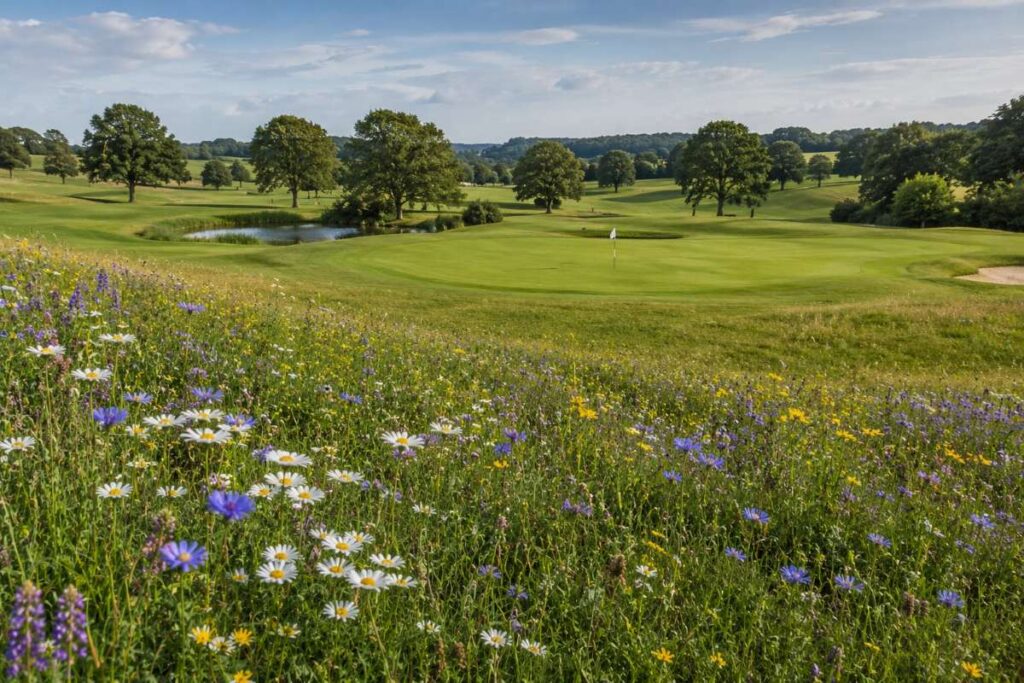
Nature-Friendly Golf Courses: Using Wildflower Seeds to Support Biodiversity
A typical 18-hole course occupies 50 to 60 hectares, of which perhaps 40% is actively played. The rest — deep rough, boundary strips, woodland edges, banks, pond surrounds, the ground behind tees and between holes — is managed largely for appearance. That out-of-play land is one of the largest habitat opportunities in British amenity management, and on many courses it is currently doing very little.
Nature-friendly golf courses are not a compromise on playing quality. The best examples of habitat work in UK golf sit alongside excellent surfaces, because the areas involved are ones nobody wants a ball in anyway. Done well, wildflower areas sharpen the definition of a hole, add seasonal interest and give the club something substantial to say about its environmental practice.
Done badly, they cause genuine problems: lost balls, slow play, member complaints and rank grass that looks worse each year than the mown rough it replaced. The difference is almost entirely down to where the areas are placed and how they are managed afterwards.
This is written for club and course managers, greenkeepers, estate teams and golf resorts, and it assumes the constraints are real — pace of play, member expectations, presentation standards and a maintenance budget that will not grow to accommodate this.
Why nature-friendly golf courses matter for habitat
Golf courses have three characteristics that make them ecologically valuable, and they are worth understanding before deciding what to sow.
Scale and connectivity. Courses are large, continuous blocks of green space, often on the edge of towns and frequently linked to woodland, farmland or watercourses. They function as corridors in landscapes where habitat is otherwise fragmented.
Undisturbed ground. Out-of-play areas are walked on rarely, sprayed rarely and cultivated almost never. Some course roughs, particularly on links and heathland sites, hold plant communities that have been continuous for a century or more.
Varied conditions in a small area. A single course may contain dry sandy banks, damp pond margins, shaded woodland edge, exposed slopes and open grassland. That variety supports a far wider range of species than uniform farmland.
Many links and heathland courses already sit on habitats of national importance — acid grassland, dune systems, lowland heath. On those sites the priority is protecting and restoring what is there rather than sowing anything new, and specialist ecological advice should come before seed.
Roughs, out-of-play areas and where habitat sits
Understanding the zones is the basis of a sensible scheme.
Primary rough immediately outside the fairway is played from regularly and needs to stay playable. It is generally the wrong place for wildflowers.
Secondary and deep rough further out is where most habitat work belongs. On many courses this is currently rank, thatchy grass — often Yorkshire Fog and coarse species — which is neither good habitat nor good golf, since a ball disappears into it completely.
Out-of-play areas between holes, behind tees and greens, along boundaries and in corners are the easiest wins. Nothing is played there and nobody looks for a ball in them.
Water margins around ponds, ditches and streams support species found nowhere else on the course and are usually difficult to mow.
Woodland edges are among the richest habitats available. A graded margin from trees through scrub to open grass beats a hard mown line every time.
Banks and slopes that are awkward or unsafe to mow suit wildflower establishment well.
Clubhouse, entrance and car park areas are the visible face of the scheme, and members and visitors judge the whole programme by them.
What wildflower areas support
Diverse swards on a golf course support the same range of species as any meadow, with the advantage of scale.
Bumblebees and solitary bees need continuous forage from March to September; Knapweed, Bird’s-foot Trefoil, the vetches and Wild Marjoram carry that succession. Butterflies need larval food plants as well as nectar — most of which are the native grasses and forbs of unimproved sward, so Meadow Brown, Ringlet, Gatekeeper and Common Blue all respond to changed rough management. Hoverflies favour open flowers such as Yarrow and Wild Carrot, and their larvae consume aphids.
Ground beetles and other invertebrates depend on tussock structure at the base of the sward, which is why leaving areas uncut over Winter matters as much as what flowers in July. Birds benefit through both seed and insects — finches on Autumn seed heads, Skylark on open rough where the sward is not too dense, and raptors hunting the small mammals that tussocky grass supports.
What none of this comes with is a guarantee. Which species arrive depends on what is already in the surrounding landscape, on soil and on how consistently the area is managed. A course three years into a scheme will see change; the specific outcomes are not something anyone can promise in advance.
Where wildflowers should not go
Placement is the whole discipline. Keep sown areas well clear of:
- Greens, greens surrounds and approaches, where presentation standards and turf health come first.
- Tees and landing areas, and the primary rough flanking them.
- Fairways and any ground where a reasonable shot might finish.
- Bunker surrounds, where seed heads, debris and drifting material contaminate sand.
- Drainage channels, swales and ditch lines that must carry water freely.
- Anywhere visibility is essential — blind shots, crossing points, path junctions, road boundaries and locations where a warning must be visible from the tee.
- Within a sensible margin of any line of play. A buffer of mown or lightly managed rough between the fairway and any wildflower area lets a slightly errant ball be found.
The practical test: walk each hole and ask where a mid-handicap player’s poor shot actually finishes. Anything within that envelope stays mown.
Rough management, naturalised areas and sown meadow
There are four distinct approaches, and choosing the right one saves money.
Managed rough means changing how existing grass is cut — reducing frequency, raising or lowering height, and starting to remove clippings. On many courses this alone, sustained over three to five years, produces a thinner, wispier, more diverse rough. It costs almost nothing beyond the collection work.
Naturalised areas are existing rough left largely alone with an annual cut and removal. Species arrive from the surrounding seed bank. Slow, cheap, and unpredictable.
Formal planting — annual displays, plug planting, ornamental beds — belongs around the clubhouse and entrance rather than on the course. It gives immediate colour where colour is wanted, and it needs annual work.
Purpose-created wildflower meadow means full ground preparation and sowing with a native mix. It is the most expensive and the most reliable route to a species-rich sward, and it is worth doing where the existing vegetation is rank and unproductive.
Most successful programmes use all four in different places. The common mistake is going straight to sowing on ground where three years of changed rough management would have produced a better and cheaper result.
Choosing seed for the conditions
The mix has to suit the ground, and on a golf course it also has to suit the height you want.
Soil and drainage come first — sand, chalk, clay, loam or peat each need a different species list, and links, heathland and parkland courses are ecologically distinct. Damp margins need a wet-ground mix.
Fertility is the constraint that catches parkland courses. Decades of fertiliser and returned clippings leave rough areas far too rich, so grasses dominate and forbs fail. Reducing fertility, by scarifying hard, removing thatch and taking clippings off, is a precondition rather than an optional extra.
Aspect and exposure matter on banks and links sites, where wind and drought limit what will establish.
Height and habit deserve specific thought. Tall species — Meadowsweet, Teasel, Common Hogweed — create real playability problems near lines of play. Lower-growing communities based on fine fescues and bents with Bird’s-foot Trefoil, Lady’s Bedstraw, Small Scabious and Harebell give colour at a height that keeps a ball findable.
Fine native grasses should form the base of any wildflower roughs. Sheep’s Fescue, Red Fescue, Common Bent and Crested Dog’s-tail produce the thin, upright, wispy sward that both plays reasonably and supports invertebrates. Avoid anything vigorous.
Regionally sourced native seed is the right specification, matching your soils and the pollinators already present, and avoiding genetic dilution of nearby semi-natural grassland — a real consideration on courses adjoining designated sites.
Preparation, sowing and establishment
- Reduce fertility and competition. Cut the existing sward hard and collect. Scarify aggressively, in more than one direction, and remove the thatch. On rank areas this may need repeating over a season.
- Expose bare soil across at least half the area — more for a full restoration. Scarify, harrow, rotovate or strip turf depending on scale and equipment.
- Add nothing. No fertiliser, no topdressing, no imported soil.
- Allow a fallow period where the programme permits, take out the weed flush, then produce a firm, fine seedbed.
- Sow in the autumn window — late August to early October across most of the UK — which fits the renovation programme on most courses. March to early May is the alternative on heavy ground.
- Broadcast onto the surface, seed mixed with dry sand for even coverage, in two passes at right angles. Do not bury it.
- Roll or tread. Seed-to-soil contact decides germination.
- Protect the area through Winter with markers or rope, and brief the whole greenkeeping team.
Year one needs two or three cuts to 5–7cm from May, arisings removed each time, to control annual weeds and stop grass shading the perennial seedlings. From year two, take a single cut between late July and early September once seed has set, leave the arisings a few days to shed seed, then remove them completely.
Removing arisings is the operation that decides success. Clippings left in place raise fertility, thicken the grass and lose you the flowers within three or four seasons. It is more work than a mowing pass, and it needs to be in the budget from the outset.
Pace of play, lost balls and golfer safety
This is where schemes succeed or fail politically, and it deserves as much attention as the agronomy.
Keep areas back from play. A buffer of mown or lightly managed rough between fairway and wildflower area is the single most effective measure. Where a ball can be found and played, complaints stop.
Choose low-growing communities near play. Height matters more than area. Fine fescue-based swards with low forbs are visually distinct without swallowing balls.
Define edges cleanly. A crisp mown edge tells a player where the area starts, looks deliberate and helps with local rules. Ragged transitions read as neglect.
Consider local rules. Many clubs mark established wildflower areas as penalty areas or provide a drop, which removes the pace-of-play argument entirely. Agree this with the committee before the first season, not after the first complaint.
Maintain sightlines and safety. Vegetation must never obscure a blind shot, a crossing point, a warning sign or a bell. Keep paths, steps and buggy routes mown to full width.
Phase the work. Introducing wildflower areas on three or four holes in year one lets members see what they look like before the scheme extends. It also lets you correct placement cheaply.
Watch the total area. Habitat enthusiasm has occasionally produced courses where too much ground is out of play. Keep an eye on the aggregate, not only the individual areas.
Communicating with members and supporting environmental policy
Biodiversity on golf courses is now a live subject in club governance, and wildflower work is straightforward to evidence.
Recognised programmes such as GEO Foundation certification and the R&A’s sustainability guidance ask for exactly this kind of habitat work, and a documented scheme with dated records, photographs and species lists supports an application well. Local authority and environmental permissions occasionally require it too, particularly where a course adjoins a designated site.
With members, be specific and be early. Explain before the ground is cultivated, not after. Say which areas are changing, why those areas were chosen, what will happen to pace of play, and what the first two years will look like — including the fact that year one looks unimpressive. Use the noticeboard and the newsletter, and put small signs on the course itself.
Report results. A short annual note — species recorded, area under management, photographs from fixed points — turns a maintenance decision into a programme members can take pride in. Involving members who are keen naturalists in recording is worth more than any amount of communication from the office.
What to avoid is overclaiming. Do not describe an area as a meadow in its first year, do not attribute wildlife to it that was already there, and do not present reduced mowing on rank rough as habitat creation when it is only reduced mowing.
Combining wildflowers with other habitat work
Ponds and water margins. Shallow, planted margins with a graded profile support amphibians, dragonflies and marginal plants. Fence or define them where footfall is heavy.
Hedgerows and boundaries. Cutting on a two or three-year rotation and letting hedges thicken adds nesting habitat and screens boundaries.
Trees and woodland. Thin dense plantations to let light reach the floor, and create graded scrub edges rather than hard mown lines. Native species, appropriate to the site.
Deadwood. Standing deadwood where a tree inspection confirms it is safe, and log piles of untreated timber in out-of-play corners. Both support species that nothing else on the course will.
Reduced mowing generally. Car park verges, boundary strips, the ground behind maintenance buildings. Cheap, quick and cumulative.
Together these give the structural variety that decides whether wildlife uses a course or passes over it.
Common mistakes on nature-friendly golf courses
- Sowing where three years of rough management would have worked better — the most expensive error, and common on courses with existing fine-grass rough.
- Not removing arisings. The scheme fails slowly and looks like bad luck. It is not.
- Cutting too early or too often. Cutting before seed set removes next year’s sward. Cutting to a fixed calendar date rather than reading the sward has the same effect.
- Treating areas as maintenance-free. They are lower-frequency, not zero. The annual cut-and-collect is a real operation requiring real machine time.
- Placing areas too close to play. Generates complaints that can end a scheme in its first season.
- Choosing tall species near lines of play.
- Expecting a display in year one. Perennials flower in year two and three.
- Adding topsoil or fertiliser “to help it establish”. It helps the grass instead.
- Failing to brief the team. One machine going through in May undoes a year.
Comparing habitat zones on a golf course
| Zone | Habitat opportunity | Playability consideration | Recommended approach | Cutting regime |
|---|---|---|---|---|
| Course rough (secondary and deep) | Large-scale sward diversity; invertebrates; small mammals | Ball findability; pace of play; height near lines of play | Change rough management first; sow low, fescue-based mixes where rank | Annual cut after seed set; arisings removed; buffer strips cut more often |
| Out-of-play areas (between holes, behind tees) | Highest-value easy wins; undisturbed refuge | Minimal — check sightlines and safety | Sow perennial meadow mix suited to soil | One cut late July–September; leave 10–20% uncut on rotation |
| Water margins | Amphibians, dragonflies, marginal plants | Access for retrieval; bank safety; drainage function | Damp-ground mix; graded margin profile | Cut sections on rotation every 2–3 years, never all at once |
| Woodland edges | Richest habitat on many courses; graded structure | Shade affects establishment; leaf litter | Shade and woodland-edge mixes; create scrub transition | Cut every 1–3 years on rotation; remove arisings |
| Clubhouse and entrance planting | Visible, member-facing; pollinator forage | Presentation standards are high | Annual displays, plugs or seed mats; defined edges | Cultivate annually or cut as needed to keep tidy |
An implementation plan for clubs
- Map potential sites. Walk all 18 holes with a course plan in mid-Summer when growth is at its heaviest. Mark existing habitat, rank rough, water margins, woodland edges and out-of-play ground. Photograph fixed viewpoints.
- Consult the course manager and greenkeeping team. They know where machinery goes, which areas already carry fine grasses, and what the cut-and-collect will actually cost in hours. Their agreement decides whether the scheme survives.
- Assess safety and playability. Walk each candidate area against the shot patterns on that hole. Check sightlines, blind shots, crossing points and buggy routes. Remove anything questionable from the list at this stage.
- Select appropriate seed. Match mixes to soil, drainage, aspect and required height, using regionally sourced native stock. Where existing rough already holds fine grasses, consider management change instead of sowing.
- Prepare and sow. Reduce fertility, scarify and remove thatch, expose bare soil, allow a fallow period where the programme permits, produce a firm seedbed and sow in the autumn window. Roll afterwards.
- Manage the first year. Two or three cuts to 5–7cm from May, arisings removed each time. Protect areas from machinery and mark them on the maintenance schedule. Expect no display.
- Monitor biodiversity and member response. Record species with help from members who are keen naturalists. Track complaints and pace of play honestly. Photograph from the same points each July.
- Expand or adjust. Extend into new areas where the scheme is working, pull back where placement caused problems, overseed thin ground, and move cutting dates by a fortnight where seed set is running early or late.
Choosing seed for a course
Wildahome supplies regionally sourced native mixes selected by soil type and habitat — sandy and free-draining ground for links and heathland sites, chalk and limestone, heavy clay and loam for parkland courses, damp mixes for pond and ditch margins, and shade blends for woodland edges. For wildflower roughs near lines of play, mixes based on fine native grasses with lower-growing forbs keep the sward thin enough for a ball to be found while still supporting invertebrates. Yellow Rattle is worth including on any area with an established grass sward, since reducing grass vigour is usually the first problem to solve on a parkland course. Seed mats suit banks, bunker-face surrounds and the defined areas around the clubhouse where broadcasting is impractical.
Talk to us before you specify
If your club is planning wildflower seeds for golf courses this season, the conversation worth having is about the specific zones — soil type, how rank the existing rough is, what collection equipment you have, and how close each area sits to a line of play. Send us a course plan and a description of the ground and we will advise on which mixes suit each zone, what height to expect, and where changed rough management would deliver more than sowing. Where an area needs a season of fertility reduction first, we will tell you that.
Frequently Asked Questions
Do wildflower areas on nature-friendly golf courses slow down play?
They can if placed too close to lines of play or sown with tall species. Well-designed schemes keep a buffer of mown rough between fairway and wildflower area, use low-growing fescue-based mixes near play, and define edges cleanly. Many clubs also agree a local rule for established areas, which removes the issue entirely.
Will wildflower roughs reduce our maintenance costs?
Not reliably. Mowing frequency drops, but the annual cut-and-collect is a bigger operation than a mowing pass, and removing arisings is essential rather than optional. Most clubs find costs broadly similar with the work redistributed across the season. The gains are habitat, definition and environmental credentials, not a smaller budget.
Can we create wildflower areas without cultivating the ground?
Often, yes. On courses where the rough already holds fine grasses, three to five years of changed management — reduced cutting frequency, cutting after seed set and removing all arisings — produces a thinner, more diverse sward at low cost. Sowing is worth the expense where existing rough is rank, thatchy and unproductive.
Which species suit biodiversity on golf courses without affecting playability?
Communities based on fine native grasses — Sheep’s Fescue, Red Fescue, Common Bent, Crested Dog’s-tail — with lower-growing forbs such as Bird’s-foot Trefoil, Lady’s Bedstraw, Small Scabious and Harebell. These give colour and habitat at a height that keeps a ball findable. Avoid Meadowsweet, Teasel and Hogweed near play.
When should we sow wildflower seeds for golf courses?
Late August to early October across most of the UK, which fits the autumn renovation programme and uses natural rainfall. March to early May is the alternative on heavy ground. Follow the guidance supplied with your specific mix and judge local soil conditions rather than fixing a date in advance.
How do we handle member complaints about long grass?
Communicate before the work, not after. Explain which areas are changing and why, be honest that year one looks unimpressive, keep edges crisp and mown, phase the scheme across a few holes first, and agree local rules in advance. Reporting recorded species annually turns the scheme into something members take an interest in.
Do nature-friendly golf courses need ecological advice first?
On links, heathland and dune courses, yes. Those sites often hold habitats of national importance where the priority is protecting and restoring existing plant communities rather than sowing anything new. Parkland courses on improved grassland have more scope, but a survey before work still identifies what is already present and worth keeping.
Ready to get started?
Shop: Traditional Wildflower Meadow Mix →