

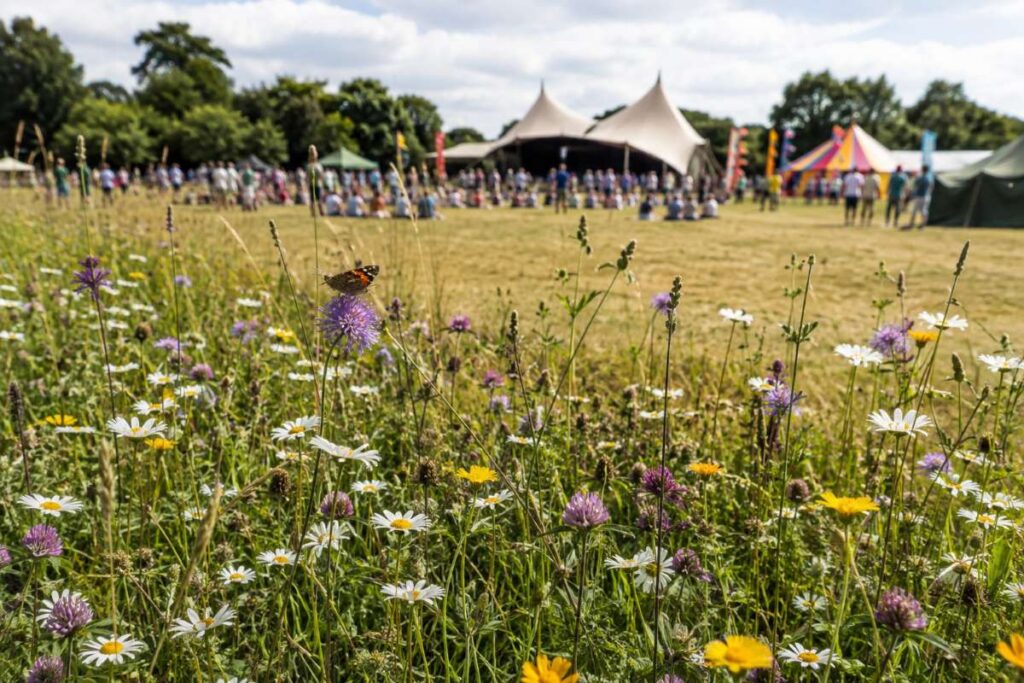
Nature-Friendly Festival Sites: Using Wildflower Seeds to Support Biodiversity
A festival field takes a beating no other piece of amenity land experiences. Tens of thousands of people, HGVs, telehandlers, generators, stages, temporary trackway, three weeks of build and strike either side of the event — and then it is expected to be a field again.
The visible damage is litter, and litter is the part everyone plans for. Anyone building nature-friendly festival sites has to start with the other kind. The lasting damage is invisible: compacted soil, a stripped sward, and a nutrient profile pushed the wrong way. Surface hydrology can recover within a season; soil structure does not. Research on compacted loam found no measurable recovery in bulk density within two years, with full recovery estimated to need at least a decade.
That is the honest starting point, and it is also why the opportunity is real. Most of a festival site is not arena — it is boundaries, margins, corners, verges, screening banks and land that sits empty for eleven months of the year. Nature-friendly festival sites are built on that ground, not on the ground the crowd stands on.
It is written for festival organisers, event production companies, landowners, venue managers, estate owners and sustainability teams, and it does not pretend a meadow is maintenance-free or establishes in one season.
Why biodiversity at outdoor events is worth the effort
Because almost none of it is required. An event running under permitted development — the 28-day rule in the General Permitted Development Order — triggers no Biodiversity Net Gain obligation, since permitted development sits outside BNG’s scope. Habitat work at most event sites is genuinely voluntary, which is what makes doing it well worth something.
Because the sector now has a standard that asks for it. The Green Events Code of Practice, version 2.3 dated 17 September 2025, carries a Biodiversity and Ecological Management theme asking organisers to assess wildlife on site and identify risks, mitigate the event’s impact, and take measures to enhance habitats. Older summaries of the Code omit this theme, so cite the current versioned document. A Greener Future runs genuine third-party certification with on-site assessors and a Local Environments category, though its detailed criteria are not published. ISO 20121:2024 is a management system standard: it asks an organiser to identify their own material issues rather than setting a biodiversity requirement.
Because the land is usually somebody’s livelihood. Most greenfield sites are working farms or estates, and margins that improve soil structure, reduce runoff and support pollinators serve the landowner as much as the event. They also change how a site feels: a mown boundary reads as municipal, a flowering margin reads as landscape.
What wildflower areas actually support
Diverse swards support a longer food chain than the flowers alone suggest. Bees need continuous forage from March to September rather than one flush in July, which is why Knapweed, Bird’s-foot Trefoil, the vetches and Wild Marjoram matter more than a showy annual. Butterflies need larval food plants as well as nectar, and most of those are the native grasses and forbs of unimproved sward. Structure counts as much as flowering: tussocky grass holds beetles and carries invertebrates through Winter, seed heads feed finches, and rough grass supports the small mammals that Barn Owls hunt. What none of it comes with is a guarantee — which species arrive depends on the surrounding landscape, the soil and consistent management, and nobody can promise a particular butterfly.
Opportunities and challenges for nature-friendly festival sites
The opportunity is that event sites already produce two things wildflower establishment needs: bare ground, and a work window in late Summer and Autumn coinciding almost exactly with the best UK sowing period. Plantlife puts the main window between August and October and recommends exposing roughly half the area as bare soil. A post-event field hands you that for nothing.
The challenges are the two conditions that work hardest against a species-rich sward, and an event delivers both.
Compaction. A rootable profile is generally taken as bulk density below 1.5 g/cm³. Trampled ground on recreational trails has been measured at 1.46–1.51 g/cm³ under moderate to heavy use, at or beyond that threshold, to around 20cm depth. Small-seeded native forbs have little reserve for pushing through a capped surface.
Fertility. Wildflower diversity depends on low nutrient status, and phosphorus is the key indicator — Natural England guidance puts the target for developing botanical diversity at soil P index 0 or 1. The Park Grass Experiment at Rothamsted, running since 1856, shows how durable fertility is: nineteenth-century treatment effects remain visible in the sward today, and added nitrogen consistently pushes plots towards grass dominance at the expense of species number.
Both favour the coarse, competitive, ruderal species — creeping bent, rough meadow-grass, docks, thistles — that you are trying to keep out.
There is a third challenge a seed supplier ought to say out loud. Grass-dominated turf is among the most trampling-resistant vegetation there is; herb-rich vegetation is markedly less so. Experimental work shows a roughly thirty-fold difference in vulnerability between vegetation types, and the strongest predictor of recovery is how resistant the vegetation was to begin with. A species-rich meadow is the wrong surface for an arena, a camping field or a vehicle route. Putting it elsewhere is not a compromise — it is the correct answer.
Permanent wildflower areas versus temporary event landscaping
These are different projects, and conflating them causes most of the disappointment.
Permanent wildflower areas are sown once into prepared ground and managed for years: boundaries, banks, verges around permanent facilities, retained corners, pond and ditch margins. A perennial sward gives leaf and root in year one, a partial display in year two, and something worth photographing from year three. This is a wildflower meadow for event venues in the real sense — an asset the site keeps.
Temporary event landscaping is decoration: annual displays near an entrance for a single season’s colour. Cornfield annuals flower in their first Summer, which perennials will not, but they thin out from year two as grasses move in and need the ground cultivating again to return.
Both are legitimate. The failure mode is sowing a temporary display, calling it a meadow, then abandoning it — leaving rank grass, docks and a visible reminder that the commitment stopped after the press release.
Where Wildflowers Can Work on a Festival Site
The rule is straightforward: sow where the crowd is not, and where nobody needs a clear line of sight.
| Potential location | Biodiversity or visual benefit | Event-related risk | Management consideration |
|---|---|---|---|
| Site boundaries and hedge bottoms | Connects to the wider landscape; nesting and overwintering cover; provides the quiet, dark refuge that displaced wildlife needs | Fly-tipping, wind-blown litter, trespass through the boundary | One cut a year after seed set, arisings removed; fence-line litter sweep before cutting |
| Field margins and headlands | High habitat value for minimal loss of usable ground; pollinator forage through the season | Vehicles cutting corners; contractor parking; cable runs | Mark physically before build begins; keep a mown strip between margin and working ground |
| Camping-field edges | Softens a large mown area; visible to guests at close range | Trampling, guy lines, tent pegs, wild toileting | Set back from pitching; robust species only; expect some damage and plan overseeding |
| Retained corners and unused ground | Refuge habitat; costs nothing operationally | Storage creep — corners attract pallets and plant | Add to the site plan as a no-storage zone and brief crew |
| Walkway margins | Puts flowers at eye level on the busiest routes | Footfall spread, litter, dog fouling at path edges | Keep the walkway itself cut hard and wide; accept a scuffed edge |
| Car-park margins and islands | Breaks up a large hard area; visible on arrival | Compaction, vehicle overrun, oil and fuel | Low-growing mix; kerbs or posts to define; sightlines at junctions stay clear |
| Entrance and reception areas | First impression; the visible face of the scheme | Presentation expectations; heavy footfall pinch points | Small, tidily edged; annual display acceptable here if cultivated each year |
| Pond, ditch and wet margins | Species found nowhere else on site; dragonflies and amphibians | Drainage function must not be impeded; safety fencing | Damp-ground mix; cut sections on rotation, never all at once |
| Screening banks and slopes | Awkward to mow anyway; warm, dry habitat | Erosion once bare; seed washing downhill | Cultivate on the contour; seed mats worth considering on gradients |
| Around permanent facilities | Year-round amenity value at a working venue | Service access, meter reading, maintenance | Keep working access mown; plant beyond it |
Where wildflowers do not belong
This list matters more than the one above, and safety comes before ecology every time.
- Emergency access routes, fire lanes and turning areas. These must stay clear, legible and passable at all times.
- Vehicle tracks and service areas. Compaction and fuel spill make establishment futile.
- High-footfall zones — arena, front of stage, main thoroughfares, bar and food queues.
- Anywhere visibility is essential — junctions, crossing points, road exits, and any location where signage, a fire point or a marshal must be seen.
- Around lighting columns, water points, hydrants and waste points.
- Drainage channels and swales that must carry water freely.
- Ground scheduled for temporary structures. Point loads from staging strip sward down to mineral soil.
If a marshal needs to see it, or a fire appliance needs to drive on it, keep it mown.
Designing planting so it looks intentional
On a site the public walks through, the difference between habitat and neglect is usually presentation rather than substance.
Give every area a defined edge — a mown surround, a post-and-rope line, a clean boundary against a track. Ragged transitions read as ground someone forgot. Keep the routes people actually use cut hard and generously wide, since a narrow path pushes footfall into the sward, and treat all the areas consistently so they read as a scheme rather than accumulated tidying-up.
Mark every area on the site plan, in the CAD drawing and on the ground before build begins. The most common cause of failure is not weather — it is a contractor parking a telehandler on it because nothing told them not to.
Choosing a seed mix for the conditions
Work through the site before looking at any pictures. Soil type comes first — chalk and limestone, heavy clay, sandy free-draining ground, loam and acid soils each support different plant communities. Drainage decides whether an area needs a damp-ground mix or a dry one, aspect matters on banks and open boundaries, and the maintenance regime you can actually deliver should shape species choice: if an area must be cut in July, choose species that flower earlier. Regionally sourced native seed is the right specification. Worth knowing: UK wildflower seed is not subject to statutory certification, so provenance rests on what a supplier can tell you about where the seed came from. Ask.
Five approaches for one site
A festival site rarely needs one mix.
- A perennial meadow around a permanent venue. Full preparation, a native grass-and-forb mix matched to the soil, one hay cut a year with arisings removed. Slowest to establish, best long-term value.
- A short-term annual display near an entrance. Cornfield annuals for first-Summer colour, accepting that the ground needs cultivating again each year.
- A low-maintenance margin around camping fields. Robust, low-growing species tolerant of a scuff, sown as a defined band and cut once after seed set.
- A species-rich area around a pond or wet margin. A damp-ground mix on land that is hard to mow anyway, cut in sections on rotation.
- A dry, free-draining mix for an exposed boundary. Deep-rooted, small-leaved species for thin soil on a bank or windward edge, where a general blend would struggle.
Preparing the ground and timing the sowing
Preparation decides more than seed choice does.
- Clear physical contamination first. Tent pegs, guy lines, cable ties, bottle caps, shredded plastic. Everything after this step cultivates whatever is left into the profile you are about to sow.
- Deal with compaction. Diagnose the depth by digging inspection pits. Footfall compaction sits in the top 10cm and responds to slitting or aeration; damage from HGVs, cranes and telehandlers reaches 10–35cm and needs sward lifting with tines set below the base of the compacted layer. Slitting a field with 30cm compaction achieves nothing.
- Do not enrich. No fertiliser, no imported topsoil, no compost. On event sites this instinct is strong, and it is the most common mistake.
- Expose bare soil across at least half the area by scarifying, harrowing or cultivating, then allow a fallow period where the calendar permits — four to six weeks, letting the weed flush germinate, then removing it with a shallow pass.
- Firm the seedbed. Rake to a tilth, then roll or tread.
- Sow onto the surface, mixing seed with dry sand for even coverage, in two passes at right angles. Do not bury it — most native seed is small and many species need light. Roll again afterwards; seed-to-soil contact decides germination.
Timing. Late August to early October is the main window across most of the UK, using natural rainfall, giving species that need a cold period the winter they require, and falling after the season ends on most sites. March to early May is the alternative on heavy ground that waterlogs. Allow at least six weeks after mechanical decompaction before machinery returns, and follow the guidance supplied with your specific mix rather than fixing a date months ahead.
Managing the area before, during and after an event
Before. Fence or rope every sown area and mark it on every plan the crew will see, briefing production, security, traffic management and contractors directly rather than by email. Year-one areas need two or three cuts to 5–7cm from May, arisings removed each time, to control annual weeds and stop grass shading out perennial seedlings.
During. Give one person responsibility for the protection measures, because ropes migrate and signs fall over.
After. Take the main cut once most species have set and shed seed, usually late July to early September. Leave the arisings a few days to drop seed, then remove them completely — this keeps fertility low, and it decides whether the sward improves or slides backwards. Leaving 10–20% uncut on rotation carries invertebrates through Winter.
Responsible event management around habitat
Wildflower areas sit inside a wider set of decisions, several of which have real evidence behind them.
Waste and litter. UK music festivals generate roughly 26,000 tonnes of waste a year, about a third of it recycled, and more than 250,000 tents are abandoned annually. For a future meadow the material that matters is not the bin-bag litter but the shredded plastic and hardware worked into the top few centimetres — precisely the horizon you must cultivate.
Soil compaction. Diagnose the depth, match the tool, work in the right moisture window, and rest the ground at least six weeks before machinery returns.
Temporary trackways. Trackway is a trade-off, not a solution: it spreads load and prevents rutting and deep compaction, at the cost of light, heat and moisture to the sward beneath. Industry practice ranks solid dark panels as most damaging, translucent as better and open-cell matting as best, with solid cover down for as short a period as possible and the ground irrigated afterwards, since boards block rainfall. These are trade rules of thumb rather than published research.
Lighting and wildlife. The recognised UK reference is the Institution of Lighting Professionals’ Guidance Note 08/23, produced with the Bat Conservation Trust: warm spectrum at 2700K or lower, zero upward light with no tilt, sharp cut-off, and dark corridors retained along hedgerows. Bollard luminaires are strongly discouraged for glare and upward scatter — directly relevant to festival waymarking. One caution: recent work on moths found amber LEDs suppressed activity as much as white at the same intensity, so warm spectrum alone does not solve it. Intensity and direction matter more.
Noise and disturbance. A UK study playing festival-level music at woodland edges recorded around a 47% reduction in nightly activity for some bat species, with others displaced away from the source. Note that UK event noise control is built entirely around human receptors — the recognised code of practice for concerts sets limits at dwellings and does not address wildlife at all. There is no UK noise limit for wildlife at festivals. The practical levers are standoff between stages and hedgerows, and quiet, dark boundary habitat retained deliberately.
Fire safety. Dry standing vegetation near fire points, catering, generators, fuel stores or campfire areas is a hazard. Keep a cut, clear buffer between long grass and anything that burns, and agree it with the site safety officer rather than deciding it independently.
Dog access, where relevant. Two evidenced issues. Dogs provoke a disturbance response at greater distances and for longer than people alone, and studies on lowland heath found the great majority off-lead despite signage. And dog fouling deposits, on average, around 11kg of nitrogen and 5kg of phosphorus per hectare per year, rising to roughly 73kg of phosphorus per hectare per year in path-edge hotspots. Against a target of soil P index 0–1 for meadow creation, dogs concentrated at entrances and along desire lines can foreclose species-rich grassland exactly where you would want it. Picking up faeces cut phosphorus input by around 97% in that study, so bins at entrances and on-lead zones are cheap and effective.
Post-event reinstatement. Clear first, diagnose second, treat third, rest fourth — then review honestly.
A practical planning process for nature-friendly festival sites
- Survey the site. Walk it in mid-Summer with a plan, marking soil type, drainage, aspect, existing habitat and every piece of ground that never gets used.
- Identify permanent and temporary areas. Decide what is sown once and kept, and what is seasonal decoration.
- Consider safety, access and visibility. Remove anything on an emergency route, fire lane, sightline or service area.
- Assess soil and drainage. A basic soil test on any area intended for meadow is worth the cost — phosphorus status tells you whether the project is realistic.
- Choose the seed mix. Match to soil, drainage, aspect, height and the cutting regime you can deliver. Expect to need more than one.
- Prepare the ground. Clear contamination, relieve compaction, expose bare soil, allow a fallow period, firm the seedbed. Add nothing.
- Establish clear protection measures. Physical barriers, marked drawings, briefed crew, named responsibility.
- Communicate the project to visitors. Small factual signs, the areas marked on the site map, a short accurate note on the website.
- Manage the site during the event. Someone owns the barriers and checks them daily.
- Restore and review afterwards. Litter, decompaction, overseeding, and a written record of what worked.
Interpretation and involving visitors
Wildflower areas give you programme content. Simple boards at path junctions work well — one species, one fact, one reason it matters — and marking habitat areas on the site map costs nothing. Where a festival already runs a talks or wellbeing area, a short guided walk at a quiet hour, a children’s pollinator activity or a seasonal note on what is flowering all fit naturally. Citizen science adds external validity: pollinator counts take minutes, can be done by guests, and become your strongest evidence over several years. Match the ambition to the audience — a poorly attended nature walk is worse than none.
Talking about it without greenwashing
The test is whether what you say matches what a visitor can walk over and verify.
Be specific. “A 0.6ha margin was sown in September with a locally sourced mix and is cut once a year in August” is credible. “We are passionate about biodiversity” is not.
Say what is not finished. A sign explaining that an area was sown last Autumn and will look thin this Summer builds more trust than a photograph of somebody else’s meadow.
Keep claims proportionate. Say what you sowed and what you have recorded, not what you hope will arrive, and if you have one hectare of margin against thirty of arena and camping, describe it that way.
Be precise about frameworks. If you align to the Green Events Code, say which version and which themes; if you hold a certification, name it and its tier. Do not imply a certification assesses soil condition or land restoration — none published does.
Where regulation actually bites
Do not treat general guidance as a substitute for checking your own position. If any part of your site is a Site of Special Scientific Interest, an event is likely to require Natural England consent, and carrying out or allowing a listed operation without it carries an unlimited fine plus the cost of repairing damage — decisions can take up to four calendar months, so this is not a late-stage item. Where public safety, protected habitats, drainage or land restoration are involved, consult the relevant professionals and check current local requirements.
Choosing seed for an event site
Wildahome supplies regionally sourced native mixes selected by soil type — chalk and limestone, heavy clay, loam and alluvial, acid and sandy ground, damp and pond margins, hedgerow and bank, woodland edge — which matters on a festival site, where one boundary can run from a dry windward bank to a wet ditch corner in a hundred metres. The 80/20 mixes set fine native grasses around a wildflower component, suiting margins that take occasional use; the 100% wildflower mixes suit defined areas where flowers are the point. Seed mats are worth considering on banks and slopes, where broadcast seed migrates before it germinates. Every mix is supplied with sowing and first-year management guidance — which matters when the work will be done by a contractor rather than by whoever ordered it.
Talk to us before the seed is ordered
If you are planning wildflower areas on a festival site, the useful conversation happens before the ground is touched — soil type, how the site drains, where vehicles and crowds actually go, and what equipment you have for cutting and clearing. Send us a site plan and a description of the ground and we will advise on which mixes suit which zones, realistic quantities, and whether the timing works for this season’s sowing window. Where an area needs a year of decompaction and fertility reduction first, we will say so.
Frequently Asked Questions
Can nature-friendly festival sites have a meadow on a field used every year?
Not on the ground the crowd occupies. Grass-dominated turf is far more trampling-resistant than herb-rich sward, so a meadow in an arena or camping field will not survive. Nature-friendly festival sites put wildflower areas on boundaries, margins, corners, verges and banks — land the event does not use — and keep the working ground as robust grass.
When should I sow wildflower seeds for festivals?
Late August to early October suits most of the UK and falls conveniently after the season on most sites. March to early May is the alternative on heavy ground. Allow at least six weeks after any mechanical decompaction before sowing or bringing machinery back. Follow the guidance supplied with your specific mix rather than fixing a date in advance.
How long does compacted festival ground take to recover?
Longer than it looks. Surface infiltration can improve within months, but soil structure is slower — research on compacted loam found no measurable recovery in bulk density within two years and estimated at least a decade for full recovery. Mechanical decompaction speeds this up considerably, provided the tool matches the depth of the damage.
Do wildflower areas count towards Biodiversity Net Gain at an event?
Generally not. Events running under permitted development are outside the scope of mandatory BNG, so habitat work at most festival sites is voluntary. That is exactly why it carries weight with frameworks such as the Green Events Code, which asks organisers to assess, mitigate and enhance — and why it should be described accurately rather than presented as compliance.
Do nature-friendly festival sites cost more to maintain?
Not necessarily. Mowing frequency drops, but the annual cut-and-collect is a bigger operation than a mowing pass, and removing arisings is essential rather than optional. Budget for it from the outset. The gains are habitat, landscape character and a defensible sustainability story, not a smaller maintenance bill.
Will lighting and music damage the wildlife our wildflower areas attract?
They can. Recognised UK lighting guidance recommends warm spectrum, zero upward light and retained dark corridors along hedgerows, and a UK study found festival-level music reduced nightly activity for some bat species by around 47%. There is no UK noise limit for wildlife at events. Standoff distance between stages and boundary habitat, and deliberately quiet dark margins, are the practical levers.
How do we stop crew driving or storing equipment on a new wildflower area?
Physical barriers and drawings, not instructions. Fence or rope the areas, mark them on every site plan and CAD drawing the crew sees, brief production, traffic management and contractors directly, and give one named person responsibility for checking the barriers daily during build and strike.
Ready to get started?
Shop: Traditional Wildflower Meadow Mix →