

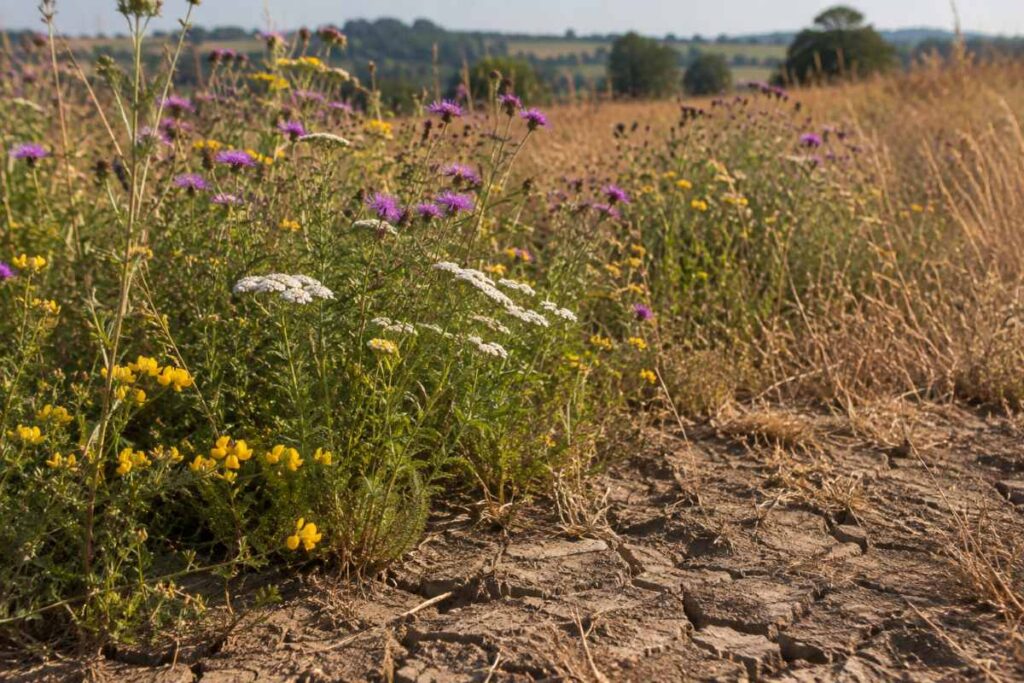
Choosing Wildflower Seeds for Hotter and Drier UK Summers
Anyone who has managed land through the past few UK summers has watched the same thing happen: a wet, late Spring, then six or eight weeks with almost no rain, then heavy downpours that run off ground too hard to absorb them. Establishment windows have become narrower and less predictable, and sowings that would have taken reliably twenty years ago now sometimes fail.
Choosing wildflower seeds for hotter summers is part of the answer, but only part. Species choice matters less than most people assume; site conditions, ground preparation and timing matter far more. A well-chosen mix on badly prepared, compacted, over-fertile ground will do worse than a mediocre mix on a properly made seedbed sown at the right moment.
This is written for people responsible for real acreage — caravan parks, campsites, golf courses, equestrian venues, farms, estates, grounds teams and councils — where watering an area through a dry August is neither practical nor defensible. The aim is a sward that holds together through a difficult Summer, recovers afterwards, and does not need rescuing every year. Nothing here promises a drought-proof meadow; there is no such thing. What there is, is a set of decisions that shift the odds in your favour.
Why climate matters when choosing wildflower seeds for hotter summers
Wildflower establishment depends on a narrow sequence: seed reaches soil, absorbs moisture, germinates, and puts down enough root to survive its first dry period. Break the sequence at any point and the sowing fails.
Warmer average temperatures lengthen the growing season at both ends, which sounds helpful and often is. The problem is what happens in between. Longer dry spells in May, June and July catch seedlings before their roots reach depth, and heavy rain falling on baked ground runs off rather than soaking in, so a month’s rainfall in two days does far less good than the figures suggest.
There is also a management effect. Hot weather brings growth to a standstill, then the recovery flush arrives at an awkward moment, often clashing with peak visitor season or competition dates. The cutting regime that worked ten years ago may now need moving by two or three weeks. The practical response is not to abandon what works, but to prepare ground more thoroughly, sow when moisture is most likely, and choose plant communities varied enough that something in the sward suits the conditions of any given year.
Drought tolerance, drought avoidance and merely surviving
These three things get lumped together, and the distinction matters when you are reading a seed description.
Drought tolerance means a plant keeps functioning under water stress. Deep tap roots reach moisture below the drying zone, and small, waxy, hairy or grey-green leaves reduce water loss. Bird’s-foot Trefoil (Lotus corniculatus), Wild Marjoram (Origanum vulgare), Viper’s Bugloss (Echium vulgare) and Kidney Vetch (Anthyllis vulneraria) work this way, which is why they are common on thin chalk and sand.
Drought avoidance means sidestepping the dry period entirely. Annuals complete their cycle and set seed before the worst of Summer, then return from the seed bank. Some perennials shut down early, brown off, and reappear after autumn rain. An avoider looks dead in August and is not.
Surviving a dry spell is what most established perennials do given a decent root system. A three-year-old sward with a metre of root behind it comes through a drought that would kill the same species sown last Autumn.
So the drought-tolerant wildflowers UK growers rely on are worth including, but establishment age is a bigger factor than species choice.
Why locally appropriate native species still matter
There is a temptation, faced with warmer summers, to reach for Mediterranean species or bright ornamental mixes marketed as heat-loving. It rarely pays off.
Native species from your own region are adapted to your rainfall pattern, soil chemistry and winter conditions — and UK winters are still wet, still cold in places, and still capable of killing anything from a genuinely dry climate. A plant that copes with a dry August is no use if it rots in a wet January.
Local provenance also matters ecologically. Native forbs support the invertebrates that evolved alongside them, and many pollinators are tied to particular plant families. Introduced ornamentals may provide nectar but do not support larval stages, and they can hybridise with or displace wild populations nearby.
There is genuine variation within native species too. Seed collected from a dry, free-draining donor site in the South East carries different adaptations from the same species collected on a damp northern pasture — one of the strongest arguments for regionally sourced seed over a generic national mix.
How your site holds moisture
Before choosing anything, work out what your ground actually does with water. Two fields a mile apart can behave completely differently.
Soil type. Sandy and gravelly soils drain fast and hold little — they dry out first but rarely waterlog. Clay holds a lot of water but locks much of it away from roots, and when it dries it shrinks, cracks and sets hard. Chalk and limestone soils are thin and free-draining, yet the rock beneath can hold moisture that deep-rooted species reach. Loam sits in the middle.
Drainage and compaction. Compacted ground sheds water. Vehicle tracks, old hardstanding and heavily used ground all reduce infiltration, so rain that falls is lost. A soil that takes water in is worth more than one that receives more rain.
Aspect and slope. South and south-west facing ground dries fastest; north-facing slopes stay cooler and moister and carry species that struggle elsewhere on the same site. Water runs off gradients rather than soaking in, the top of a slope is always drier than the bottom, and steeper ground erodes once bare.
Organic matter. Organic matter holds water — a percentage point of increase raises available water capacity measurably. This creates a genuine tension: wildflowers want low nutrients, but soil structure wants organic matter. The resolution is to build structure through root growth and careful management rather than by importing compost or muck, which raises fertility and hands the advantage to grasses.
Walk the site after a dry fortnight and after heavy rain. Where the grass browns first and where the water sits will tell you more than a soil analysis alone.
Choosing wildflower seeds for hotter summers by conditions, not by picture
The most common mistake in climate-resilient wildflower planting is selecting a mix from a photograph. Those photographs are usually taken in year three, in a good season, on ideal ground.
Work through it in this order: soil type first, then drainage and moisture, then aspect and exposure, then the cutting regime you can commit to, and only then appearance. If the shortlist that survives those filters is less colourful than you hoped, that is information rather than a reason to override the filters.
Diversity within the mix is worth paying for. A sward of twenty species has a far better chance of always having something in flower and something rooting deeply than one of eight. In a dry year the deep-rooted forbs carry the display; in a wet one, others do.
Include a proportion of fine, non-vigorous native grasses. Species such as Common Bent, Crested Dog’s-tail and Sheep’s Fescue bind the surface, reduce erosion and shade the soil without out-competing forbs the way Perennial Ryegrass does. On dry ground that shading effect measurably reduces surface moisture loss.
Yellow Rattle (Rhinanthus minor) deserves a place in most schemes on existing grassland, because reducing grass vigour reduces competition for the water that is available.
Why ground preparation matters more than watering
If you take one thing from this article: preparation determines drought performance far more than irrigation does.
A seed on a firm, fine, weed-free seedbed makes contact with soil moisture immediately and germinates. The same seed on loose, cloddy ground sits in air pockets that dry within hours. No realistic amount of watering compensates for that.
- Firm the ground. Roll or tread after raking. Firm soil wicks moisture upwards to the seed by capillary action; loose soil breaks the connection.
- Relieve compaction first. On compacted ground, subsoiling or aeration before cultivation lets roots and water go deeper. Deep roots are the entire drought strategy.
- Remove competition before sowing, not after. A fallow period after cultivation, allowing the weed flush to germinate and then removing it, means seedlings are not competing for water in their first Summer.
- Do not enrich. Adding compost or topsoil to help with moisture retention pushes grasses and docks ahead of everything else. On dry sites this backfires badly.
- Sow shallow. Most native seed needs light and should sit on the surface, rolled in. Burying it deeper than a few millimetres, in the hope of finding moisture, prevents germination.
Attend to those five and a sowing will handle a dry spell that would kill a poorly prepared one.
Timing sowing to use natural rainfall
The point of timing is to hand the work to the weather.
Late August to early October is the main window across most of the UK. Soil is still warm, autumn rain is arriving, and seedlings have Autumn and the following Spring to root before their first real Summer. On free-draining ground and in the drier east, this is much the strongest option.
March to early May works, and is often preferable on heavy clay that is unworkable in Autumn or floods over Winter. The risk is a dry May or June catching seedlings with shallow roots. Sow at the early end of the window where you can.
Watch the forecast rather than the calendar. Sowing three days before a settled wet spell is worth more than sowing on a date fixed a month in advance. If the ground is bone dry and no rain is coming, hold the seed — it keeps.
Avoid sowing into midsummer heat, into saturated ground, or into hard frost. Follow the guidance supplied with your specific mix; regional variation across the UK is substantial, and a window that suits Kent will not suit Cumbria.
When temporary watering helps, and when it doesn’t
Watering can bridge a gap. It cannot substitute for preparation or timing.
It is worth doing on small, defined, high-visibility areas — entrance beds, reception planting, ground around buildings — where a hose or bowser can reach and appearance matters commercially, and on a Spring sowing that has germinated and then hit an unexpected dry fortnight, because losing seedlings at that stage means losing the sowing.
It is not worth attempting across a hectare of meadow. The volumes are impractical, the cost is significant, and the effect is often counterproductive: light, frequent watering encourages shallow rooting, leaving the sward more vulnerable when watering stops. Where you do water, water heavily and infrequently, early or late in the day — and check your position on abstraction and hosepipe restrictions before committing to a schedule you may not be allowed to keep.
Managing expectations in year one and after extreme weather
Say this to whoever signs off the budget, before the seed goes in. Year one is roots and leaf, with limited flowering unless the mix contains annuals. Year two shows a partial display, often dominated by two or three vigorous species. Year three is when a perennial meadow starts to look like the photographs, and it continues improving for years after that.
A drought in year one can set a sowing back by a full season, but rarely destroys it outright — much of the seed bank remains and germinates after autumn rain. Resist the urge to plough it up in the same year; assess the following Spring instead.
An established meadow will brown off in a serious drought and look finished by mid-August. It generally is not. Growth resumes with autumn rain and the sward returns the following Spring, sometimes with a different balance of species — normal, and the mechanism by which a diverse community persists. Extreme wet is equally disruptive: a waterlogged Winter can kill species suited to dry ground. Both directions are now part of the picture.
Deep roots, diverse communities and what they realistically deliver
Deep-rooted perennials reach moisture that shallow-rooted grasses cannot. Chicory, Yarrow, Wild Carrot, Field Scabious and the vetches all put roots well down, and their root channels improve infiltration for everything around them, so heavy rain soaks in rather than running off.
Diverse communities spread risk across species that respond differently to the same weather. Research on grassland diversity consistently associates greater species richness with more stable productivity across variable seasons; on the ground, that means a diverse meadow rarely looks catastrophic even when a monoculture alongside it does.
What none of this delivers is immunity. Deep roots do not help a seedling with no roots yet, and diversity limits how bad losses get rather than preventing them.
Reducing competition from vigorous grasses and weeds
In a dry Summer, competition for water decides which plants survive. Reducing it is one of the highest-value things you can do.
- Sow Yellow Rattle in existing grassland — it reduces grass biomass substantially over two to three seasons.
- Keep fertility low. No fertiliser, no muck, no imported topsoil. High nitrogen favours vigorous grasses that use the available water first.
- Remove arisings after every cut. Left in place they act as a slow-release fertiliser and smother the fine species you want.
- Deal with the weed flush before sowing, not afterwards.
- Spot-treat docks, creeping thistle and ragwort by hand or targeted application rather than blanket spraying an area you want to be diverse.
- Do not over-sow with vigorous agricultural grasses to fill gaps.
Cutting, arisings and letting seed mature
The standard meadow regime still applies in a warmer climate, with more attention to timing.
Take the main cut once most species have set and shed seed — usually late July to early September, but read the sward rather than the calendar. In a hot year plants may set seed two or three weeks early, and cutting to a fixed date can remove seed before it is ripe.
Cut to around 5–7cm, not lower. A very short cut on dry ground exposes soil, raises surface temperature and increases moisture loss. Leave arisings on the surface for a few days to shed seed, then remove them entirely — the mechanism that keeps fertility low, and more important on stressed sites, not less.
Consider leaving 10–20% uncut each year on rotation. Uncut patches carry invertebrates through Winter, hold seed, provide shelter and retain moisture at the soil surface. Rotate which section stays uncut so nothing becomes rank.
Additional measures worth taking
- Mulching suits defined planting areas rather than meadows. Around new plugs, shrubs or hedge whips, a gravel or bark mulch reduces evaporation considerably. Never mulch over a sown meadow.
- Shelter. Hedges and tree lines reduce wind speed, and wind dries ground faster than heat alone. A hedge shelters ground for roughly ten times its height downwind.
- Water conservation. Swales, shallow scrapes and interrupted drainage runs slow water down and let it infiltrate rather than leave the site. On sloping ground this is often the single most effective intervention.
- Habitat diversity. Ponds, damp hollows, log piles, tussocky margins, scattered scrub and areas of bare ground each buffer conditions differently. Nature-friendly landscaping UK sites do well when they offer varied microclimates rather than one uniform treatment.
Choosing an approach for your site conditions
Dry, free-draining soil
Sand, gravel and thin chalk or limestone. Naturally low in nutrients, which is an advantage — the flora suited to it is among the richest in the UK. Choose calcareous or sandy-soil mixes with Bird’s-foot Trefoil, Wild Marjoram, Kidney Vetch, Lady’s Bedstraw, Viper’s Bugloss and Small Scabious. Sow in early Autumn to use the whole wet season. Do not attempt to improve the soil. Accept early browning in Summer as normal.
Heavy clay soil
Holds water in Winter, sets like concrete in Summer, and cracks. The main challenge is workability and timing rather than moisture as such. Prepare when the soil is neither wet nor baked — usually early Autumn or Spring. Avoid working it wet, which destroys structure. Choose clay-tolerant species such as Meadowsweet, Common Knapweed, Bird’s-foot Trefoil, Oxeye Daisy and Meadow Buttercup. Deep-rooted species help open the profile over time.
Thin or disturbed soil
Construction ground, subsoil, restored sites and areas stripped of topsoil. Low fertility is a genuine advantage here, so do not import topsoil. The priorities are relieving compaction and stabilising the surface. A nurse of fine native grasses helps hold the ground while forbs establish. Expect slow, patchy establishment and plan for overseeding in year two.
Exposed slopes
Runoff, erosion and rapid drying. Cultivate along the contour, not up and down it. Sow at a slightly higher rate to allow for seed movement, and consider a light netting or jute mat on steep ground. Seed mats are worth considering here — they hold seed in place on a gradient where broadcast seed washes to the bottom. Aspect matters: a south-facing bank needs the driest-tolerant end of your species list.
Urban or compacted ground
Verges, car park margins, amenity land and areas subject to foot and vehicle traffic. Compaction is the limiting factor, so aerate or subsoil before anything else. Fertility is often high from years of mowing with cuttings left in place, so scarify hard and remove the thatch. Choose robust species and expect to manage litter and trampling as ongoing issues.
Areas with occasional drought but generally higher rainfall
Much of the west and north. Conventional meadow mixes remain the right choice; there is no need to move to a dry-ground species list. The adjustments are marginal: include a few deep-rooted species as insurance, keep fertility low, and be prepared to move the cutting date. Waterlogging in Winter remains the greater risk on most of these sites.
Site conditions at a glance
| Site condition | Likely challenge | Preparation priority | Management consideration |
|---|---|---|---|
| Dry, free-draining (sand, gravel, chalk) | Rapid moisture loss; early summer browning | Firm seedbed; no soil improvement; autumn sowing | Cut later once seed has set; expect dormancy in August |
| Heavy clay | Waterlogging in Winter; hard-setting and cracking in Summer | Work only at correct moisture; avoid compaction | Time cuts to avoid rutting; deep-rooted species to open profile |
| Thin or disturbed soil | Low water holding; poor structure; erosion | Relieve compaction; do not import topsoil | Overseed gaps in year two; accept slow establishment |
| Exposed slope | Runoff; seed movement; rapid drying | Cultivate on the contour; consider seed mats or netting | Monitor for erosion channels; avoid cutting when ground is soft |
| Urban or compacted ground | Poor infiltration; high fertility; trampling | Aerate or subsoil; scarify and remove thatch | Keep arisings removed; manage edges and access routes |
| Occasional drought, higher rainfall | Winter waterlogging more limiting than Summer drought | Standard preparation; ensure drainage is functioning | Move cutting date to suit the season; retain uncut refuges |
Choosing seed that suits your ground
Wildahome supplies regionally sourced native mixes selected by soil type rather than by picture — chalk and limestone, sandy and free-draining, heavy clay, loam, thin and disturbed ground, damp margins and shade. On sites where Summer moisture is the limiting factor, the free-draining and calcareous mixes carry a high proportion of deep-rooted, small-leaved species that hold up under water stress, alongside fine native grasses that shade the soil surface without competing hard for water. Seed mats are worth considering for banks and slopes where broadcast seed migrates downhill before it germinates, and Yellow Rattle is available separately for adding to existing grassland where grass vigour is the main obstacle. Every mix comes with sowing guidance for the conditions it is intended for.
Tell us what your ground does
If you are planning wildflower seeds for dry soil, an exposed bank, or a site that has struggled through recent summers, the conversation worth having is about your specific ground — soil type, aspect, fertility history, compaction, and what equipment you have for cutting and clearing. Send a description of the site and we will advise on which mixes suit it, realistic sowing timing for your region, and whether the ground needs work before seed goes anywhere near it. If a site needs a year of preparation first, we will tell you that.
Frequently Asked Questions
Are there wildflower seeds for hotter summers that won’t need watering?
Established perennial meadows on well-prepared ground generally need no watering, even in a dry Summer — they brown off and recover with autumn rain. New sowings are different, and a Spring sowing hitting a dry spell during germination may need temporary watering. No mix is drought-proof, and any that claims to be should be treated cautiously.
Which UK native wildflowers cope best with dry conditions?
Bird’s-foot Trefoil, Wild Marjoram, Kidney Vetch, Lady’s Bedstraw, Viper’s Bugloss, Small Scabious, Wild Carrot, Yarrow and Field Scabious all cope well, largely through deep roots or reduced leaf water loss. Most are associated with chalk, limestone and sandy soils, which is why calcareous mixes suit dry ground.
Should I sow wildflower seeds for hotter summers in Autumn or Spring?
Autumn, in most cases. Late August to early October uses natural rainfall, gives species needing cold stratification the winter they require, and puts seedlings ahead of the following Summer. Spring sowing suits heavy clay that is unworkable or waterlogged in Autumn. Watch the forecast rather than fixing a date.
Can I improve my soil so it holds more water?
Not by adding compost or topsoil, which raises fertility and gives vigorous grasses the advantage. Improve infiltration instead: relieve compaction by aerating or subsoiling, cultivate on the contour on slopes, and let deep-rooted perennials build structure over several years. Slowing runoff with swales or scrapes is often more effective than anything done to the soil itself.
My meadow browned off completely in August — have I lost it?
Almost certainly not. Established perennial swards shut down under water stress and resume growth after autumn rain. Leave it alone, take the usual cut once seed has set, and assess the following Spring. The species balance may shift, which is normal in a diverse sward and not a sign of failure.
Is drought-tolerant wildflower planting suitable across the whole UK?
Only where site conditions call for it. In the wetter west and north, winter waterlogging is usually the greater constraint, and conventional regional mixes remain the right choice. Match the mix to your actual ground rather than to a general expectation about the climate.
How long before a wildflower area is resilient to dry weather?
Around three years for a perennial sward. Year one is root development with little flowering, year two gives a partial and uneven display, and by year three root systems are deep enough to carry the sward through most dry spells. Establishment age is a bigger factor in drought performance than species choice.
Ready to get started?
Shop: Traditional Wildflower Meadow Mix →